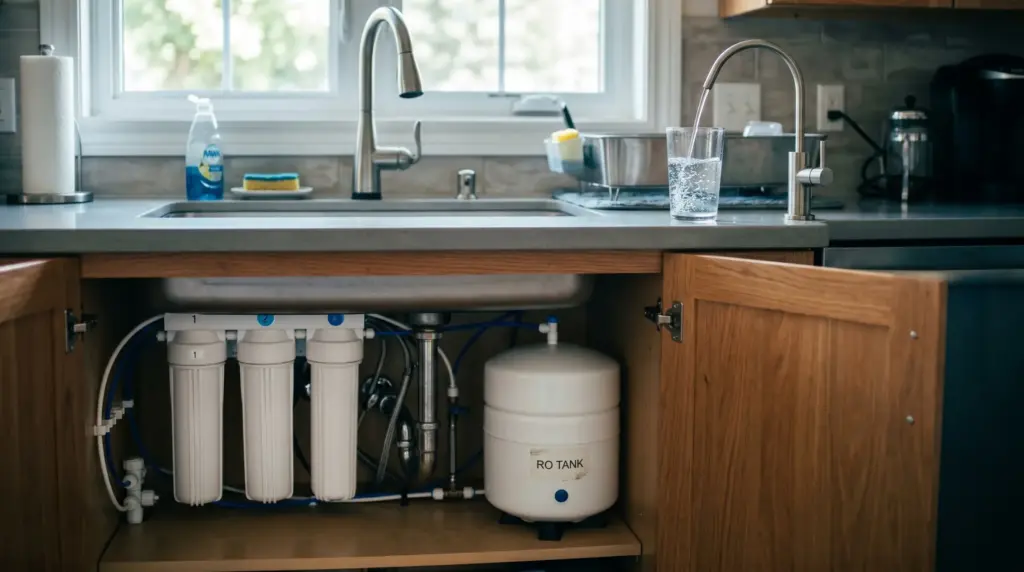
If your well water test came back with arsenic, nitrate, PFAS, or a sky-high total dissolved solids (TDS) number, someone has probably already told you the answer is "reverse osmosis." It's the technology water-treatment companies reach for most, and for good reason — done right, it strips out a remarkable range of dissolved contaminants. But "reverse osmosis" is also where a lot of homeowners overspend, under-protect, or buy the wrong size of system entirely.
This guide is the honest buying-decision companion to our contaminant articles. We'll walk through exactly what reverse osmosis (RO) removes and what it quietly doesn't, the real difference between a small under-sink unit and a whole-house system, the pre-treatment your well almost certainly needs first, and the running costs nobody mentions in the sales pitch. By the end you'll know whether RO is genuinely worth it for your situation — or whether a cheaper, simpler fix does the job.
One ground rule before we start: never buy a treatment system off a hunch about your water. The whole premise of RO is that it targets specific contaminants, so you have to know what's actually in your water first. If you haven't tested recently, start with how to test your well water and come back. Treatment without a test is just guessing with your money.
How Reverse Osmosis Actually Works (the 30-Second Version)
An RO system pushes your water under pressure through a semi-permeable membrane with pores roughly 0.0001 microns wide — small enough that dissolved salts, metals, and most other contaminants can't fit through. Clean water (the "permeate") collects on the other side; everything that got rejected gets flushed down the drain as "concentrate" or brine.
That single fact — water is forced through, contaminants are rejected and sent to waste — explains nearly everything you need to know about RO's strengths and its weaknesses. It's brilliant at removing things that are dissolved in the water. It's wasteful, slow, and needs protection from anything that can clog or chew up that delicate membrane.
- ✓Arsenic
- ✓Nitrate
- ✓PFAS (>99% of most)
- ✓Lead
- ✓Sodium / salt
- ✓Fluoride
- ✓Total dissolved solids (TDS)
- ✕Bacteria & viruses — pair with UV
- ✕Some dissolved gases
- ✕Sediment & iron — will foul the membrane without a pre-filter
What Reverse Osmosis Removes From Well Water

This is where RO earns its reputation. A point-of-use RO system certified to the NSF/ANSI 58 standard must reduce total dissolved solids by at least 75%, and good systems do far better than that across the contaminants well owners worry about most:
| Contaminant | EPA limit (federal) | RO effectiveness |
|---|---|---|
| Arsenic (As V / arsenate) | 10 ppb (0.010 mg/L) MCL | ~95–98% removal |
| Arsenic (As III / arsenite) | 10 ppb (0.010 mg/L) MCL | ~60–65% (needs oxidation first) |
| Nitrate | 10 mg/L MCL | Effective; an EPA-recognized method |
| Lead | 15 ppb action level | Up to ~99% (NSF 58-certified) |
| PFAS (PFOA, PFOS) | 4.0 ppt MCL (2024 rule) | Typically >90% removal |
| Fluoride | 4.0 mg/L MCL | Effective |
| Sodium / salt (TDS) | No federal MCL (taste/health) | ~95–98% of sodium removed |
A few of these deserve a closer look, because the nuance changes whether RO is the right call.
Arsenic — and the trap most people miss
RO is the most cost-effective home method for arsenic in many cases. Maine CDC notes RO is up to 95% effective at removing the form of arsenic commonly found in wells. But there's a catch. Arsenic comes in two flavors: arsenate (As V) and arsenite (As III). RO membranes reject As V at roughly 95–98%, but As III — which is electrically uncharged at normal groundwater pH — slips through far more easily, with removal dropping to around 60–65% according to peer-reviewed studies and state health departments such as Connecticut's.
Well water under "reducing" (low-oxygen) conditions often contains the harder-to-remove As III. The fix is a pre-oxidation step that converts As III to As V before the water reaches the membrane. This is exactly why a lab test that specifies the arsenic species — not just total arsenic — matters, and why arsenic treatment is best designed by someone who has seen your numbers. Our deep-dive on arsenic in well water covers the health stakes and testing in detail.
Nitrate
Nitrate is dangerous precisely because you can't see, smell, or taste it, and it's a serious risk for infants (blue baby syndrome) and pregnant women above the EPA limit of 10 mg/L. Critically, you should not try to boil nitrate-contaminated water — boiling concentrates it as water evaporates, making the problem worse. Health authorities point to reverse osmosis, ion exchange, or distillation instead, and the CDC confirms a home RO system can reduce nitrate. RO handles nitrate well, which makes it a legitimate go-to. See nitrates in well water for the full health and testing picture.
PFAS ("forever chemicals")
In April 2024 the EPA finalized its first-ever national drinking water limits for PFAS, setting 4.0 parts per trillion each for PFOA and PFOS — extraordinarily low thresholds. (As of 2026 the EPA has proposed keeping the PFOA and PFOS limits while reconsidering the separate limits it had set for several other PFAS compounds; the rules are still in flux, but the practical takeaway for homeowners hasn't changed.) The good news: EPA research shows tight membranes like RO are typically more than 90% effective at removing a wide range of PFAS, including the shorter-chain ones that are hardest to capture. If your test flagged PFAS, RO is one of the few proven home options.
Sodium and TDS
If your water is salty, brackish, or just tastes "off" with a high TDS reading, RO is the only common household technology that meaningfully removes dissolved salt — roughly 95–98% of sodium. A water softener, by contrast, does the opposite job (more on that below). RO is what you want when the goal is genuinely lower mineral content in your drinking water.
What Reverse Osmosis Does NOT Remove
This section is where the honesty pays off — because the gaps are exactly the things well owners most often assume RO is handling.
Bacteria and viruses (not reliably — and not the point)
On paper, an RO membrane is tight enough to block bacteria and viruses. In practice, the University of Nebraska–Lincoln Extension is blunt: RO is "not recommended" for that use because the membrane can deteriorate and a microscopic pinhole leak can let contamination through undetected. If your test showed coliform or E. coli, RO is the wrong tool. You need disinfection — typically UV light, which delivers a reliable 99.99% kill of bacteria and viruses — and that's a job for whole-home treatment, not an under-sink filter. Read coliform and E. coli in well water if that's your situation.
Dissolved gases — including that rotten-egg smell
Gases exist as molecules, not dissolved solids, so they pass straight through the membrane. RO will not fix hydrogen sulfide (the rotten-egg odor), radon in water, or excess carbon dioxide. If your complaint is smell, RO is not your answer — see sulfur smell in well water for what actually works.
Some pesticides, solvents, and VOCs
The UNL Extension also notes RO does not remove certain pesticides, solvents, and volatile organic chemicals. These are usually addressed with activated carbon — which, conveniently, is built into most RO systems as a pre- or post-filter stage anyway. But don't assume the membrane itself is doing that work.
The beneficial minerals — by design
RO doesn't discriminate. Along with the bad stuff, it strips calcium and magnesium, leaving water that some people find tastes "flat" and that measures slightly acidic. We'll cover the simple fix (remineralization) below — it's worth knowing about before you buy.
Under-Sink (Point-of-Use) vs. Whole-House RO
This is the single biggest decision, and for most well owners the answer is clearer than the showroom suggests.
Under-sink RO (point-of-use)
This is the standard setup: a compact multi-stage unit that lives in the cabinet under your kitchen sink and feeds a dedicated little faucet. It treats only the water you drink and cook with — typically a few gallons a day. Because you're only purifying the water that actually goes in your body, it's efficient, affordable, and easy to maintain.
- Unit cost: roughly $150–$600 for a quality under-sink system (budget units start lower; multi-stage and remineralizing models sit at the top).
- Installed cost: about $300–$950 with professional installation, depending on complexity.
- Best for: dissolved contaminants you're drinking — arsenic, nitrate, lead, PFAS, sodium/TDS, fluoride.
Whole-house RO (point-of-entry)
Whole-house RO treats every drop entering the home — taps, showers, laundry, the lot. It exists, but for the vast majority of homes it's overkill, and the costs reflect that. A whole-house RO system runs roughly $1,500–$5,000+ installed (some configurations climb higher) because it needs large membranes, a booster pump, and big storage tanks. It also magnifies every downside of RO: far more wastewater, far more pre-treatment, and far more maintenance.
Crucially, you almost never need RO on your shower or toilet water. The contaminants RO targets — arsenic, nitrate, lead, PFAS — are health risks you ingest by drinking. Filtering them out of the water you flush is paying premium prices to solve a problem you don't have. Whole-house RO makes sense in a narrow band of cases: genuinely brackish or high-salinity well water, or specialized needs. For nearly everyone else, an under-sink unit at the kitchen sink is the right call.
The Pre-Treatment Your Well Almost Certainly Needs First
Here's the part that separates an RO system that lasts from one that fails in months. That delicate membrane is easily fouled, and untreated well water is full of things that foul it. Skip pre-treatment and you'll be replacing membranes constantly — or watching performance quietly collapse.
- Sediment pre-filter: Wells carry sand, silt, and grit. A sediment filter ahead of the membrane catches particles that would otherwise clog it. This is non-negotiable.
- Carbon pre-filter for chlorine: If you chlorinate (for example after shock chlorination) or your water otherwise carries chlorine, it will destroy a standard thin-film composite (TFC) RO membrane. An activated carbon stage removes it. Most under-sink systems include this.
- Water softener for hard water: The UNL Extension notes that for hard water, a softener ahead of the RO increases membrane life. As a rule of thumb, water above roughly 7 grains of hardness shortens membrane lifespan — the harder the water, the shorter the life. If you have hardness or iron staining, address it first. Our guides on hard water and iron and the full menu in well water treatment options walk through this.
- Arsenic-III oxidation: As covered above, if your test shows arsenite, an oxidation step belongs before the membrane.
The softener + RO combo (and the sodium question)
People often worry a water softener makes their water "salty." It doesn't, really — softeners swap calcium and magnesium for a small amount of sodium, and the amount added is minimal, not a meaningful share of daily intake. But if you're sodium-sensitive and it bothers you, here's the elegant part: an RO unit at the kitchen sink removes most of the sodium a softener adds. So the common, correct setup for hard well water is softener for the whole house, RO at the sink for drinking — the softener protects the RO membrane, and the RO removes the softener's sodium from your glass. They're partners, not competitors.
Wastewater, Remineralization, and Maintenance: the Running Costs
Wastewater — the efficiency you should ask about
RO is not a frugal process. Conventional point-of-use systems send several gallons of water down the drain for every gallon of clean water produced, and inefficient units can hit 10:1. The University of Nebraska–Lincoln Extension frames it as a 20–30% recovery rate — feed 100 gallons, get back 20–30, waste the rest. On a private well that's water your own pump lifted and your own septic or drain has to handle, so it's not free.
The fix is to buy efficient. The EPA's WaterSense program labels point-of-use RO systems that waste no more than 2.3 gallons per gallon produced — far less than a conventional unit, saving the average household more than 3,100 gallons a year. Look for the WaterSense label; it's the single easiest way to cut RO's biggest drawback.
Remineralization
Because RO strips calcium and magnesium, the water can taste flat and run slightly acidic. The simple solution is a remineralization cartridge — typically calcite (calcium carbonate), sometimes with magnesium oxide — added as the final stage. It dissolves a little mineral back in, nudges the pH back toward a neutral range, and improves taste. Many quality systems include one; if yours doesn't, it's an inexpensive add-on. (For reference, the EPA's recommended pH range for drinking water is 6.5 to 8.5.)
Maintenance
RO is not set-and-forget. Sediment and carbon pre-filters typically get changed every 6–12 months, and the membrane every 2–3 years (sooner on rough well water). Budget roughly $80–$200 per year in replacement filters. Neglecting this is the number-one reason RO systems stop protecting you — a clogged or expired system can underperform without any obvious sign at the tap.
So — Is Reverse Osmosis Worth It? An Honest Scenario Guide
Whether RO is worth it depends entirely on what your test showed. Here's the plain-spoken version:
- Arsenic, nitrate, lead, fluoride, PFAS, or high TDS/salt in your drinking water → Yes, RO is worth it. An under-sink, NSF/ANSI 58-certified, WaterSense-labeled unit at the kitchen sink is one of the best dollars-per-protection buys in home water treatment. Add the right pre-treatment for your well.
- Bacteria, coliform, or E. coli → No, RO is the wrong tool. You need disinfection (UV or chlorination). RO is not designed to make bacteria-unsafe water safe.
- Rotten-egg smell, radon, or other dissolved gases → No. Gases pass through. Use the right gas-specific treatment instead.
- Hard water / scale / iron staining only → Probably not RO alone. That's a softener's job; add an under-sink RO only if you also want purer drinking water.
- "I just want the whole house on RO" → Almost certainly not. You'd be paying $1,500–$5,000+ to purify shower and toilet water that doesn't need it, with multiplied waste and maintenance. Put the money into the right under-sink unit and the correct pre-treatment.
The thread running through all of this: RO is a precision instrument, not a cure-all. It shines against dissolved contaminants you drink, it has real blind spots, and it needs to be matched to your actual water and protected by the right pre-treatment. That's a design decision, not a shopping decision — and it's exactly the kind of thing a licensed local well professional sizes up every day. If your test results have you weighing options, it's worth having a licensed driller or water-treatment pro look at the numbers and recommend a system built for your well. You can compare free quotes from licensed local well contractors through Well Driller Finder — no pressure, just the right people to size it correctly the first time. For a broader look at the alternatives, our well water treatment options guide lays out the full menu, and the cost guide and tools can help you budget.
Frequently Asked Questions
Does reverse osmosis remove bacteria from well water?
Not reliably, and it isn't recommended for that purpose. While an RO membrane is technically tight enough to block bacteria and viruses, the University of Nebraska–Lincoln Extension warns that membranes can deteriorate and pinhole leaks can let contamination through undetected. If your water has coliform or E. coli, use disinfection such as UV light (which inactivates about 99.99% of bacteria and viruses) rather than relying on RO.
Does reverse osmosis remove arsenic?
Yes, but it depends on the form. RO removes arsenate (As V) at roughly 95–98%, but arsenite (As III) — common in low-oxygen well water — only at about 60–65% unless it's oxidized to As V first. Because of this, a lab test that identifies the arsenic species matters, and arsenic systems are best designed by a professional. The federal limit is 10 ppb.
How much does a reverse osmosis system cost for well water?
An under-sink (point-of-use) system runs roughly $150–$600 for the unit, or about $300–$950 installed. Whole-house RO is far more expensive at roughly $1,500–$5,000+ installed because of larger membranes, pumps, and tanks. Budget another $80–$200 a year for replacement filters. For most homes, the under-sink option is the right choice.
Do I need a water softener before reverse osmosis?
If your well water is hard, yes — it increases membrane life. Water above roughly 7 grains of hardness shortens an RO membrane's lifespan, and a softener also removes iron that can foul the membrane. Since RO then removes most of the small amount of sodium a softener adds, the softener-plus-sink-RO combination works well together.
How much water does reverse osmosis waste?
Conventional point-of-use systems waste several gallons for every gallon of clean water (up to 10:1 on inefficient units), which the University of Nebraska–Lincoln Extension describes as a 20–30% recovery rate. EPA WaterSense-labeled systems cut that to no more than 2.3 gallons wasted per gallon produced — worth looking for, especially on a private well.
Does reverse osmosis remove PFAS ("forever chemicals")?
Yes. EPA research shows tight membranes like RO are typically more than 90% effective at removing a broad range of PFAS, including hard-to-capture short-chain compounds. The EPA's 2024 limits for PFOA and PFOS are very low — 4.0 parts per trillion each — so if your test flagged PFAS, RO is one of the few proven home treatment options.
Does reverse osmosis remove healthy minerals, and is that a problem?
RO does remove calcium and magnesium along with contaminants, which can make water taste flat and slightly acidic. It's not a health concern for most people, but if taste or pH bothers you, a remineralization cartridge added as the final stage restores some minerals and brings the pH back toward neutral, within the EPA's recommended 6.5–8.5 range.
Should I get a whole-house reverse osmosis system?
Usually no. The contaminants RO targets are ones you drink, so filtering shower and toilet water provides little benefit for a much higher price, plus far more wastewater and maintenance. Whole-house RO mainly makes sense for genuinely brackish or high-salinity water. For most wells, an under-sink unit at the kitchen sink is the smarter buy.

Author: Well Driller Finder Editorial Team
The Well Driller Finder editorial team researches and writes our guides on water-well drilling, pumps, and well water for homeowners across the US and Canada. We translate current cost data, NGWA and state well-construction standards, and EPA and CDC guidance into clear, practical answers. What we stand for: honest, independent help. Every price and claim is researched and fact-checked against multiple 2026 sources — never guessed, never borrowed from a single advertiser. We answer to homeowners, not to the companies we write about, because our only goal is to help you make a confident, well-informed decision about your water.
Find verified, local contractors who handle new installations, pump service, and water quality testing — in your area.