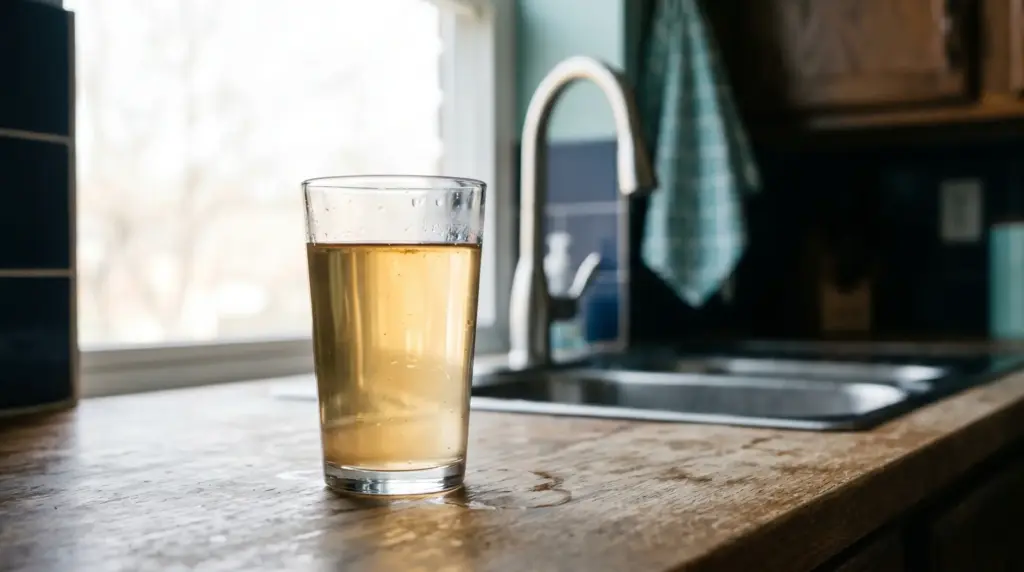
You pour a glass of water from your well and it looks like weak tea — a faint yellow, tan, or amber tint, the kind of color that makes you tilt the glass against the light to be sure you're not imagining it. Maybe your white laundry is coming out of the wash with a yellowish cast, or the toilet tank and sink have a tea-colored film. Sometimes there's a faint musty or earthy smell, like the water has been sitting near a forest floor.
If that's what you're seeing, the most likely culprit is tannins — the same family of natural compounds that gives tea, coffee, and red wine their color. Tannins in well water are almost always an aesthetic nuisance rather than a health hazard, but they're genuinely annoying, and they trip up a lot of homeowners who assume their water softener will take care of the color. It won't, and understanding why is the key to actually fixing the problem.
This guide walks through what tannins are, how to tell them apart from iron (the other big cause of discolored well water), the simple overnight test you can do in your own kitchen, why a softener is the wrong tool, what actually removes tannins, and one important safety caveat: heavy tannins can be a sign that surface water is reaching your well, which raises a bacteria question worth taking seriously.
What Tannins Actually Are
Tannins are a natural organic material — chemists also call them humic and fulvic acids — created as groundwater filters through peaty soil, leaf litter, bark, and decaying vegetation. Picture water seeping through a forest floor or a marshy lowland: it picks up the byproducts of nature's slow fermentation process, and those byproducts carry color. The Water Systems Council's wellcare program describes tannins as exactly this — a natural organic material that can tint water from a faint yellow to a tea-like brown, give it a tangy or tart aftertaste, and leave a musty or earthy odor.
Because tannins come from organic matter at or near the surface, they show up far more often in shallow wells and surface-influenced supplies than in deep ones. Homes in marshy, low-lying, coastal, or heavily wooded areas are especially prone to them. A deep, well-cased drilled well that draws from a protected aquifer is much less likely to deliver tea-colored water than a shallow dug or bored well sitting close to organic-rich soil. (If you're curious how well depth and construction type affect water quality in general, our guides on how deep a well should be and drilled vs. bored vs. driven wells go deeper.)
Here's the reassuring part: tannins themselves are considered an aesthetic problem, not a health risk. They make water unappealing to drink and they stain laundry and fixtures, but the wellcare information sheet is explicit that tannins "present no health risk." There is no EPA enforceable health limit for tannins. The closest federal yardstick is the EPA's Secondary Drinking Water Standard for color, set at 15 color units — roughly the point at which water has a visible tint. Secondary standards are non-enforceable guidelines aimed at taste, odor, and appearance, not at protecting your health.
Tannins vs. Iron: How to Tell Them Apart
This is the single most useful thing to get right, because the two problems look superficially similar but need completely different treatment — and confusing them is how people waste money on equipment that can't work.
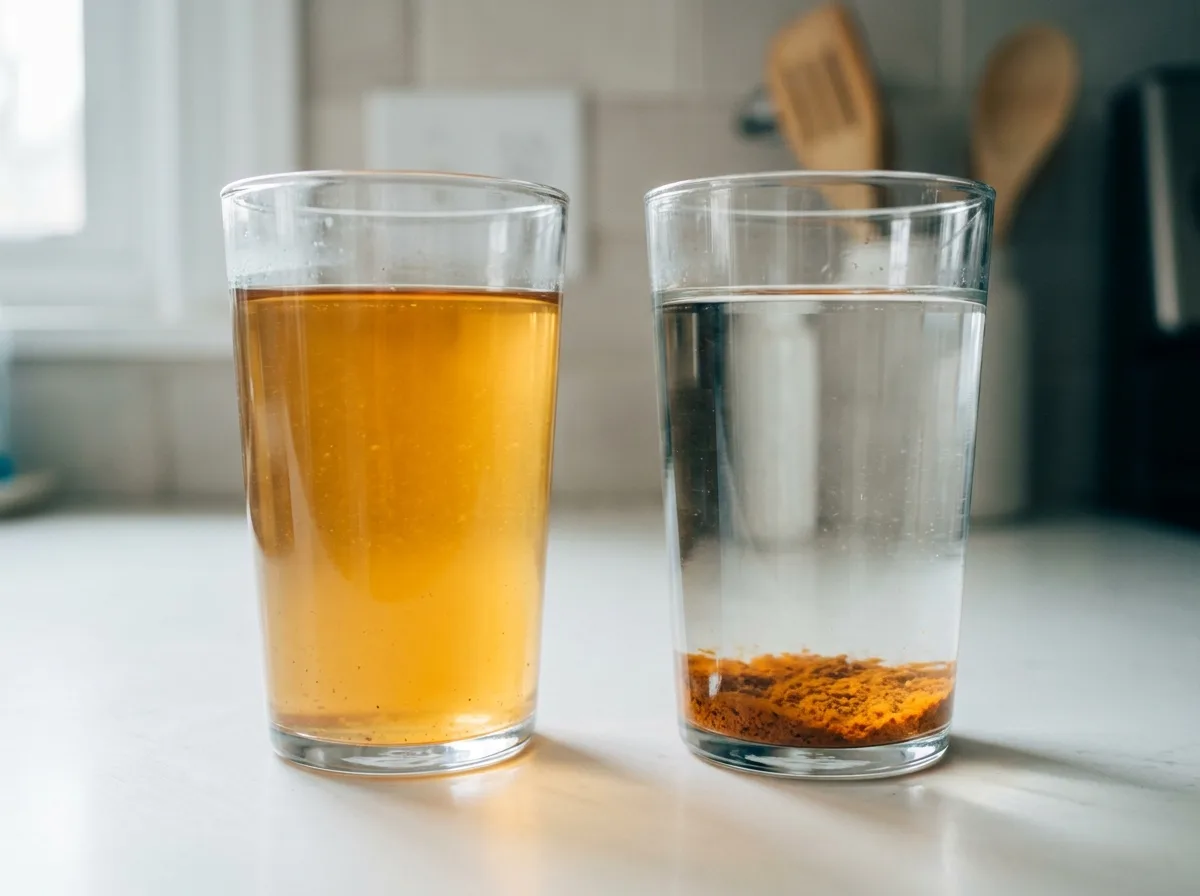
The fastest tell is color. Tannins skew yellow, tan, or tea-brown, and the tint is uniform throughout the glass. Iron skews orange, rust, or reddish-brown — the classic "rusty water" look. Iron also tends to leave orange or reddish stains on fixtures and laundry, while tannins leave a yellow cast. The EPA's secondary standards capture the difference: iron (limit 0.3 mg/L) produces a rusty, reddish, or orange staining, and manganese (limit 0.05 mg/L) produces black-to-brown color and staining.
The most reliable kitchen test is the overnight glass test, straight from the wellcare guidance:
- Fill a clear glass with water straight from the tap.
- Let it sit, undisturbed, overnight.
- Look at it in the morning.
If the color settles to the bottom of the glass and the water above clears up, the discoloration is most likely iron and/or manganese — the particles oxidize, become heavier, and drop out. If the color stays uniform and the water looks just as tinted as it did the night before, you're most likely looking at tannins, which stay dissolved and don't settle.
A second clue: iron-laden water often comes out of the tap clear and only turns rusty after it's exposed to air for a few minutes. That's "ferrous" (dissolved) iron oxidizing into rust-colored "ferric" particles. The Minnesota Department of Health describes it plainly: the water "comes out of the faucet clear, but turns red or brown after standing." Tannin water, by contrast, is already colored the moment it hits the glass. Penn State Extension notes that iron is so common that excessive concentrations turned up in about 17% of the private water supplies sampled in Pennsylvania — so iron is a very real alternative explanation worth ruling out.
There's one more wrinkle the wellcare sheet flags: iron creates a false positive on lab tannin tests. If your water has both, a lab has to subtract the iron contribution to find the true tannin concentration. This is exactly why you don't want to guess — a certified lab test settles it. If iron turns out to be your real problem, our guide to hard water and iron in well water covers that path instead.
| Clue | Tannins | Iron / Manganese |
|---|---|---|
| Color | Yellow, tan, tea-brown | Orange/rust (iron); black-brown (manganese) |
| Overnight glass test | Color stays uniform, doesn't settle | Color settles to the bottom |
| Straight from the tap | Already colored | Often clear, turns rusty in air (ferrous iron) |
| Staining | Yellow on laundry, fixtures | Orange/reddish (iron); black (manganese) |
| Taste / smell | Tangy/tart; musty, earthy | Metallic taste |
| EPA secondary limit | Color: 15 color units | Iron: 0.3 mg/L; Manganese: 0.05 mg/L |
Why a Water Softener Won't Remove Tannins
This is the part that surprises almost everyone. You may already own a softener, or a salesperson may have told you a softener will "clean up" your water. For tannins, it won't — and the reason is genuinely simple once you see it.
A water softener works by cation exchange. It's packed with resin beads that grab positively charged ions — calcium and magnesium, the minerals that cause hardness — and trade them for sodium. That's a perfect tool for hard water. The trouble is that tannins carry a negative charge. They're anions, and a cation-exchange resin simply has nothing to grab them with. It's like trying to pick up a magnet's south pole with another south pole — wrong polarity, no grip.
So tannins sail right through a standard softener untouched. Worse, over time tannins can actually coat and foul the softener's resin — and the wellcare sheet warns the same thing happens to the media in iron filters, cation-exchange filters, and neutralizing filters — which is why the guidance recommends testing for tannins before you install any of that equipment. If you've been fighting hardness and color together and only half your problem went away after a softener, this is almost certainly why. Our explainer on water softeners vs. water filters unpacks the cation-vs-anion distinction in plain terms — it's the heart of the whole story.
What Actually Removes Tannins
To remove a negatively charged contaminant, you need a resin with the opposite charge. That's an anion exchange resin — specifically what the industry calls an "organic scavenging" tannin resin. According to the Water Systems Council, anion exchange is the standard, most common approach: the resin trades negatively charged ions for the tannin molecules, pulling the color out of the water. With a properly sized and maintained system, it's also the most effective option for whole-house color removal.
Here's the practical setup most water-treatment pros recommend, and it explains the "second tank" you'll often see:
- Softener first, tannin tank second. Anion tannin resin is sensitive to hardness. So most installations put a water softener ahead of the tannin unit as pretreatment. The softener removes the hardness and metals that would otherwise foul the tannin resin, which (per wellcare) "extends the life of the anion resin and increases tannin absorption." That's why your softener isn't useless — it just isn't the part doing the color removal.
- Regeneration with salt and baking soda. Like a softener, the tannin tank periodically regenerates — the wellcare sheet says anion systems "should be regenerated occasionally with a baking soda and saltwater solution to improve the effectiveness of the resin." One quirk worth knowing: when the resin needs cleaning, the water can briefly carry a "fishy" odor — that's the sign of a fouled anion resin, not a new contaminant.
- It can shift your water chemistry. Anion systems can change the alkalinity, chloride, and sulfate levels of your water, so those are worth monitoring after installation.
Anion exchange isn't the only option, just the most common:
- Oxidation followed by filtration. This oxidizes the tannin particles to make them larger, then filters them out. The wellcare sheet notes it's a multi-step approach and generally more complicated than anion exchange.
- Ultrafiltration. A fine membrane can capture tannin particles if their molecular weight is large enough — but tannins vary, so wellcare recommends a pilot test before committing to this route.
- Reverse osmosis (RO) at the tap. RO can reduce tannins and is a reasonable choice for drinking and cooking water specifically. Because RO is point-of-use (under the sink), it doesn't fix the color in your laundry, showers, or fixtures — for whole-house color you'll want the anion system. If you're weighing RO, see is reverse osmosis worth it for well water.
Whatever route you choose, look for systems certified by NSF or the Water Quality Association (WQA), and plan to retest your water after installation to confirm the system is actually doing its job. For the bigger picture on matching treatment to the specific problem in your water, our overview of well water treatment options lays out how these pieces fit together.
The Safety Caveat: Heavy Tannins Can Mean Surface Water
Here's the one part of the tannin story that's about more than appearance. Because tannins come from decaying surface organic matter, a sudden or heavy tannin problem — especially in a shallow well, or one near a pond, stream, swamp, or low-lying ground — can be a hint that surface water is reaching your well instead of being properly filtered by deep soil and rock first.
That matters because surface water carries the things groundwater normally doesn't. The CDC notes that coliform bacteria "get into your water the same way as germs that do cause disease" and are found in soil, on plants, and in surface water like lakes and rivers — a breach that lets surface water in can carry them along. The EPA likewise treats a sudden change in water quality as a reason to test. Shallow wells and surface-influenced wells are the most likely to test positive for bacteria, simply because there isn't enough soil and rock in the path to filter microbes out.
So the tannins aren't the danger — but they can be a warning light worth heeding. The CDC recommends testing private wells at least once a year for total coliform bacteria, nitrate, total dissolved solids, and pH, and testing any time the color, taste, or smell of your water changes — which is exactly what's happening if tannins have appeared. (The EPA gives the same annual-testing and "test immediately on a change in odor, color, or taste" guidance.) If you notice new color, get a bacteria test done alongside your tannin test. Our guides on how to test your well water and what to do about coliform and E. coli in well water walk through the steps. If a test does come back positive for bacteria, shock chlorination is the usual first response, but the underlying construction issue letting surface water in needs a professional's eyes.
How to Confirm It's Tannins: The Testing Step
The overnight glass test is a great first screen, but it isn't proof. The wellcare program is clear that the home test "is not guaranteed and should be followed by a certified lab test." When you send a sample to a state-certified lab, ask them to also run:
- Iron — both because it's the main look-alike and because it skews the tannin reading high (the lab subtracts it to find your true tannin level).
- Hardness — to size the softener pretreatment that protects the tannin resin.
- pH, alkalinity, chloride, sulfate, sodium, and total dissolved solids — wellcare specifically recommends these because they help a treatment pro pick and tune the right system, since anion exchange itself nudges some of these numbers.
- Total coliform bacteria — the safety check discussed above.
Your state or local health department can point you to a certified lab. Bringing real numbers to a water-treatment professional means you'll get a system sized for your water, not a generic guess. There are an estimated 23 million U.S. households on private wells (per the EPA), and tannin water is common enough in the right geology that the treatment path is well-trodden.
Quick Reference: Living With (and Fixing) Tannins
- It's almost certainly cosmetic. Tannins are an aesthetic problem with no recognized health risk — but the color and staining are real and treatable.
- Rule out iron first. Do the overnight glass test. Color that settles = iron; color that stays = tannins. Confirm with a lab.
- A softener alone won't do it. Wrong charge. You need an anion tannin resin — usually a second tank after the softener.
- Get a bacteria test too if the color is new or heavy, especially with a shallow or surface-near well.
- Choose certified equipment (NSF/WQA) and retest after install.
Tannins are one of those well-water problems where the fix is straightforward once you know what you're dealing with — but the wrong equipment can cost real money and still leave you with tea-colored laundry. If your water has turned yellow or tea-brown and you want it diagnosed and solved correctly the first time, the smartest move is to have a licensed local well or water-treatment professional test your water and size the right system. You can use our tools to estimate what treatment might involve, and when you're ready, we can connect you with licensed, vetted well professionals in your area for free, no-obligation quotes — so you get the right tank in the right order, not a softener that was never going to fix the color.
Frequently Asked Questions
Are tannins in well water dangerous to drink?
No. Tannins are a natural organic material classified as an aesthetic problem, not a health hazard — the Water Systems Council's wellcare program states they "present no health risk." They make water look, taste, and smell unappealing and they stain laundry and fixtures, but there's no EPA enforceable health limit for tannins. The one caveat: heavy tannins can signal that surface water is reaching your well, so it's worth running a bacteria test, since bacteria can be a health concern.
Why doesn't my water softener remove the yellow color?
A softener uses cation-exchange resin, which removes positively charged hardness minerals (calcium and magnesium). Tannins carry a negative charge, so a softener's resin has nothing to grab them with and they pass straight through. Removing tannins requires the opposite — an anion-exchange (tannin) resin, typically installed as a second tank after the softener.
How can I tell if my discolored water is tannins or iron?
Fill a clear glass and let it sit overnight. If the color settles to the bottom and the water clears, it's most likely iron or manganese. If the color stays uniform, it's most likely tannins. Color is also a clue: tannins look yellow to tea-brown, while iron looks orange or rusty. A certified lab test confirms it — and is important because iron creates a false positive on tannin tests.
What's the best way to remove tannins from well water?
For whole-house removal, an anion-exchange "organic scavenging" tannin resin is the standard, most common solution. Because the resin is hardness-sensitive, it's usually installed downstream of a water softener used as pretreatment. Oxidation-plus-filtration and ultrafiltration are alternatives, and reverse osmosis can handle drinking water at a single tap. Look for NSF- or WQA-certified equipment and retest after installation.
Does reverse osmosis remove tannins?
Yes, an RO system can reduce tannins and is a reasonable choice for drinking and cooking water at a specific faucet. But RO is point-of-use, so it won't fix the color in your laundry, showers, or fixtures throughout the house — for that, you need a whole-house anion-exchange system.
Should I test my well for bacteria if I have tannins?
Yes, especially if the color is new, heavy, or your well is shallow or near surface water. Tannins come from surface organic matter, so their presence can hint that surface water is reaching the well — which is also how bacteria get in. The CDC recommends testing private wells at least once a year for total coliform bacteria, nitrate, total dissolved solids, and pH, and any time the color, taste, or smell of your water changes.

Author: Well Driller Finder Editorial Team
The Well Driller Finder editorial team researches and writes our guides on water-well drilling, pumps, and well water for homeowners across the US and Canada. We translate current cost data, NGWA and state well-construction standards, and EPA and CDC guidance into clear, practical answers. What we stand for: honest, independent help. Every price and claim is researched and fact-checked against multiple 2026 sources — never guessed, never borrowed from a single advertiser. We answer to homeowners, not to the companies we write about, because our only goal is to help you make a confident, well-informed decision about your water.
Find verified, local contractors who handle new installations, pump service, and water quality testing — in your area.