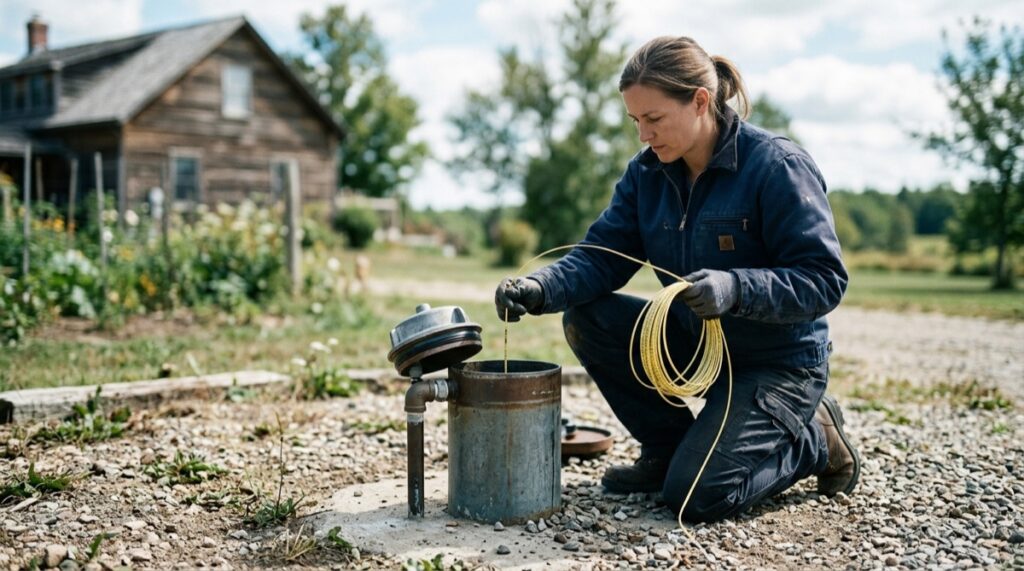
It's the first question almost every property owner asks before drilling: how deep will my well need to go? The honest answer is that there's no universal number. Most residential water wells in the US and Canada land somewhere between 100 and 300 feet, but the depth that matters for your property is set by one thing above all others — the local water table.
The typical range — and why it's only a starting point
Across most of North America, a standard drilled residential well falls in the 100–300 foot range. That band is common enough to be a useful planning starting point, but it describes what's typical — it isn't a target to aim for. Two homes on the same street can need noticeably different depths if the ground beneath them holds water at different levels.
What actually sets the depth is the water table — the level below the surface where the ground is reliably saturated with water. A well has to reach below that line and tap a water-bearing layer (an aquifer) that can supply your household steadily, year-round, even in a dry summer when the table drops. Where the water table sits high, a shallower well may be plenty; where it sits deep, the well has to go further to find water that won't run thin.
A few site factors push the number around:
- Local water table depth. The single biggest driver. The deeper the reliable water, the deeper the well.
- Geology. Whether the driller is passing through sand, sedimentary rock, or hard rock affects how far down a productive aquifer sits — and how hard it is to get there.
- Seasonal swings. A good well is drilled deep enough to keep producing when the water table falls during dry months, not just when it's high in spring.
- Household demand. A property with high water use needs a well that yields enough flow, which sometimes means going deeper to reach a stronger aquifer.
How drillers estimate depth before they start
A reputable driller doesn't pull a depth number out of thin air, but they also can't promise an exact figure in advance — they won't know for certain until they hit reliable water. What they can do is make a well-informed estimate from local evidence, and it's usually close.
Neighboring well logs and completion reports
The best predictor of your well's depth is the wells already drilled nearby. When a well is completed, the driller in most states and provinces files a well completion report — often called a well log — recording how deep they drilled, where they hit water, the casing they installed, and the yield. Many jurisdictions keep these logs in a public database. An experienced local driller will pull the records for wells around your property and use them to forecast your depth with real confidence, because homes in the same area usually draw from the same aquifers.
Local records, geology, and experience
Beyond individual well logs, drillers lean on regional groundwater maps, geological surveys, and years of drilling the area. Someone who has put dozens of wells into your township knows roughly where the water sits and what the ground does on the way down. That local knowledge is exactly why hiring a driller who works in your region matters — a number that's a good guess in one county can be wildly off in the next.
If you want a ballpark before you call anyone, our well depth calculator gives you a rough estimate based on your location and ground type. Treat it as a planning aid for budgeting, not a guarantee — your driller's read of the local logs will always be the more reliable number.
Deeper wells cost more — here's the trade-off
Depth is the biggest single driver of what a new well costs, because you pay largely by the foot. Going deeper means more drilling time, more casing to line the borehole, and often a larger pump to lift water from further down. All three add up over hundreds of feet.
For context, a complete residential water-well system typically runs $3,000 to $15,000 in 2025–2026, averaging around $7,500, with most homeowners between roughly $5,500 and $9,000. Drilling alone is about 50–60% of that total; the rest is casing, the pump, the pressure tank, wiring, and permits. The per-foot rate depends heavily on what's underground:
| Ground conditions | Typical complete-system cost per foot | Why |
|---|---|---|
| Sand / soft soil | $25–$40 | Fast drilling, less wear on the bit |
| Sedimentary rock | $35–$55 | Steady, moderate progress |
| Hard rock (granite, basalt) | $55–$85 | Slow going, heavy bits, more time and wear |
Across the board, complete-system drilling tends to run about $25 to $65 per foot, with ground conditions and water-table depth nudging the total 20–40% either way. So a deeper well in hard rock can cost several times more than a shallow one in sand — which is why the water table and your local geology, not a target depth, end up shaping the budget. Plug your own location and depth into the well drilling cost estimator for a range tailored to your site.
One reassurance: a new well is a long-lived investment. A properly built and maintained well commonly lasts 30 to 50 years or more, and the pump — a wearing part — typically needs replacing every 8 to 15 years at an average of around $1,900 (roughly $976 to $2,825). Drilling deeper for a dependable supply now usually beats a too-shallow well that struggles in a dry season later.
What about permits and the rules?
Depth isn't the only thing decided by where you live. Most states and provinces require a well-construction permit before drilling and license the driller who does the work. The specifics genuinely vary by state and site, so always confirm the current requirements with your local water or licensing authority. Our well regulations hub walks through how permitting, licensing, construction standards, and testing work, and where to check the rules for your area.
The bottom line
There's no magic depth. A well needs to go deep enough to reach water that stays clean and reliable year-round below your local water table — most commonly 100 to 300 feet, but genuinely dependent on your site. The smartest move is to hire an experienced local driller who can read the well logs in your area, give you a grounded depth estimate, and build a well that keeps producing for decades.
Ready to find a licensed well driller?
The best depth estimate comes from a driller who knows your area's water table and ground. Compare licensed local drillers, see their experience, and get a quote built on real local well logs.

Author: Well Driller Finder Editorial Team
The Well Driller Finder editorial team researches and writes our guides on water-well drilling, pumps, and well water for homeowners across the US and Canada. We translate current cost data, NGWA and state well-construction standards, and EPA and CDC guidance into clear, practical answers. What we stand for: honest, independent help. Every price and claim is researched and fact-checked against multiple 2026 sources — never guessed, never borrowed from a single advertiser. We answer to homeowners, not to the companies we write about, because our only goal is to help you make a confident, well-informed decision about your water.
Find verified, local contractors who handle new installations, pump service, and water quality testing — in your area.