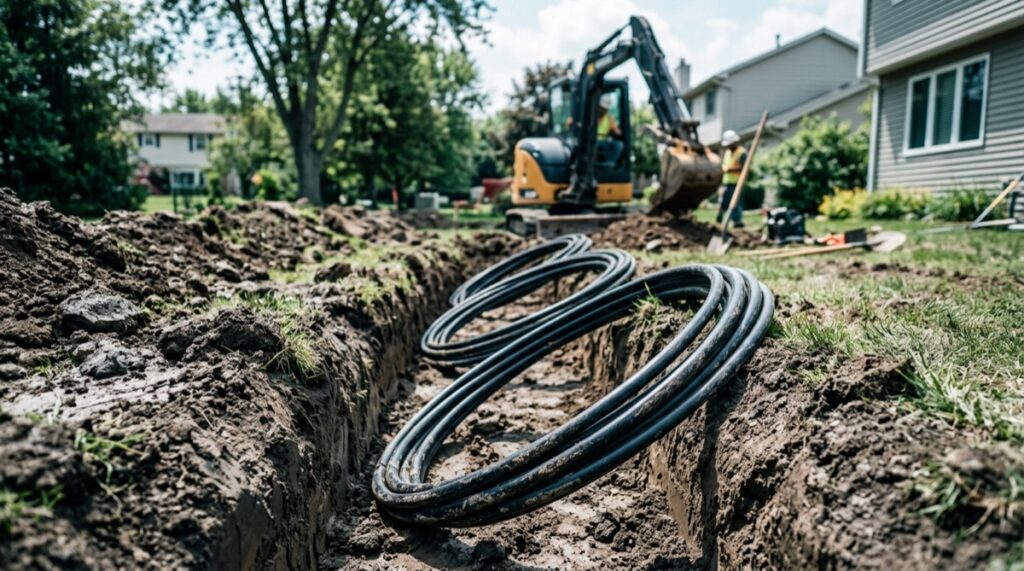
If you're putting in a ground-source heat pump, the most important part is the one you'll never see: the loop field buried in your yard. For a vertical system, that means boreholes drilled deep into the ground — the same work a well driller does for a water well. This guide explains what a geothermal loop field is, why a licensed well driller drills it, and how it's sized and priced.
What a vertical closed-loop borefield actually is
A ground-source heat pump doesn't burn fuel to make heat. Instead, it moves heat between your home and the ground, which stays at a steady temperature year-round a few feet down. To trade that heat, the system needs a network of buried pipe — the loop field, sometimes called a borefield or ground loop.
In a vertical closed-loop system, that pipe runs down into a series of deep, narrow boreholes rather than spreading out in shallow trenches. A continuous loop of high-density plastic pipe is lowered into each borehole, the hole is sealed (grouted) around it, and a water or antifreeze solution circulates through the sealed loop. "Closed" means the fluid never touches the ground or the groundwater — it's a self-contained circuit. Vertical loops are the common choice when a property doesn't have the open space for a horizontal field, which is most suburban lots.
Why a well driller does this work
Drilling a geothermal borehole uses the same rigs, crews, and know-how as drilling a water well. The well driller bores straight down through soil and rock, manages the cuttings, and grouts the hole to protect the ground — exactly the skills a water-well job demands. That's why loop-field drilling is a standard service for many well drilling contractors, and why finding a licensed driller is the right starting point even though you're heating a home rather than pumping water. The only real difference is the purpose of the hole: a water well produces water, while a geothermal bore holds a sealed heat-exchange loop.
How a loop field is sized
Loop fields are sized to the heating and cooling load of your home, measured in tons (one ton is a unit of heat-pump capacity, not weight). A typical single-family home lands somewhere around three to five tons, but the right number depends entirely on your house, your climate, and a proper load calculation.
A common rule of thumb is roughly 150 to 200 feet of bore per ton. So a three-ton system needs in the neighborhood of 450 to 600 feet of drilling in total. That total is usually split across more than one borehole rather than drilled as a single deep hole — commonly two or three bores for a three-ton home, with larger systems using more. A typical residential layout runs a handful of boreholes, each a few hundred feet deep, spaced apart in the yard so the holes don't draw heat from one another.
| System size | Approximate total bore | Typical layout |
|---|---|---|
| 2 tons | ~300–400 ft | 1–2 boreholes |
| 3 tons | ~450–600 ft | 2–3 boreholes |
| 4–5 tons | ~600–1,000 ft | 3–5 boreholes |
Treat these as planning ranges, not a design. The exact bore length, hole count, and depth depend on your local ground conditions and how readily the ground transfers heat where you live — both of which vary by site and region. The driller and your heat-pump designer settle on the final numbers together, the same way a water well's depth depends on local geology and the water table.
What a geothermal loop field costs
Vertical loop drilling is usually priced by the foot. For 2025–2026, the going rate runs roughly $8 to $40 per foot of bore, with the wide spread driven mostly by what's underground: soft soils sit at the low end of that band and hard rock at the high end, because rock is slower and harder to drill through.
The bigger point for budgeting is that drilling alone makes up about 50 to 70 percent of the loop-field cost. The rest covers the loop pipe, the grout, connecting the loops together, and trenching the lines back to the house. That's before the heat pump itself, the indoor equipment, and installation — those are separate line items handled by your HVAC installer, not the driller.
Because the per-foot rate swings so much with ground type, a quote from one property doesn't predict the next. To get a realistic, location-aware range before you call anyone, run your numbers through the geothermal borehole cost estimator. It's the same kind of by-the-foot math the drilling section of our well drilling cost guide uses for water wells.
Permits, standards, and who's allowed to drill
Geothermal boreholes go deep and pass through the same earth that protects groundwater, so they're regulated much like water wells — and the rules are set by your state or province, not by a single national standard. In practice that usually means the driller needs to be licensed, a construction permit may be required before drilling, and the borehole must be properly sealed so it can't become a path for contamination between the surface and the aquifer.
Whether a permit is required, who issues it, and exactly how the hole must be sealed all depend on where you live. Most jurisdictions in the US and Canada license well drillers and require a construction permit, but the specifics genuinely vary — so confirm the current rules with your state or provincial board rather than assuming. Start with the well drilling regulations overview for the bigger picture, then check your own area.
Planning your project
If a ground-source heat pump is on your list, the loop field is where a well driller fits into the project. A few things worth lining up early:
- Get a proper load calculation so the system is sized to your home, not to a rule of thumb — that number drives how much drilling you'll need.
- Ask drillers about your local ground conditions; soft soil versus hard rock can move the per-foot price several times over.
- Use the bore-per-ton math (~150–200 ft per ton) to sanity-check a quote against the size of system you've been quoted.
- Confirm the driller is licensed in your state or province and pulls any permit your jurisdiction requires.
A well-built loop field is long-term infrastructure — the buried pipe and sealed boreholes are meant to last for decades, while the heat pump and its parts are what you'll service and eventually replace over time. Getting the drilling right at the start is what makes the rest of the system worth it.
Ready to find a licensed well driller?
Geothermal loop fields are drilled by the same licensed contractors who drill water wells. Find one near you who handles loop-field work and ask about your local ground conditions.

Author: Well Driller Finder Editorial Team
The Well Driller Finder editorial team researches and writes our guides on water-well drilling, pumps, and well water for homeowners across the US and Canada. We translate current cost data, NGWA and state well-construction standards, and EPA and CDC guidance into clear, practical answers. What we stand for: honest, independent help. Every price and claim is researched and fact-checked against multiple 2026 sources — never guessed, never borrowed from a single advertiser. We answer to homeowners, not to the companies we write about, because our only goal is to help you make a confident, well-informed decision about your water.
Find verified, local contractors who handle new installations, pump service, and water quality testing — in your area.