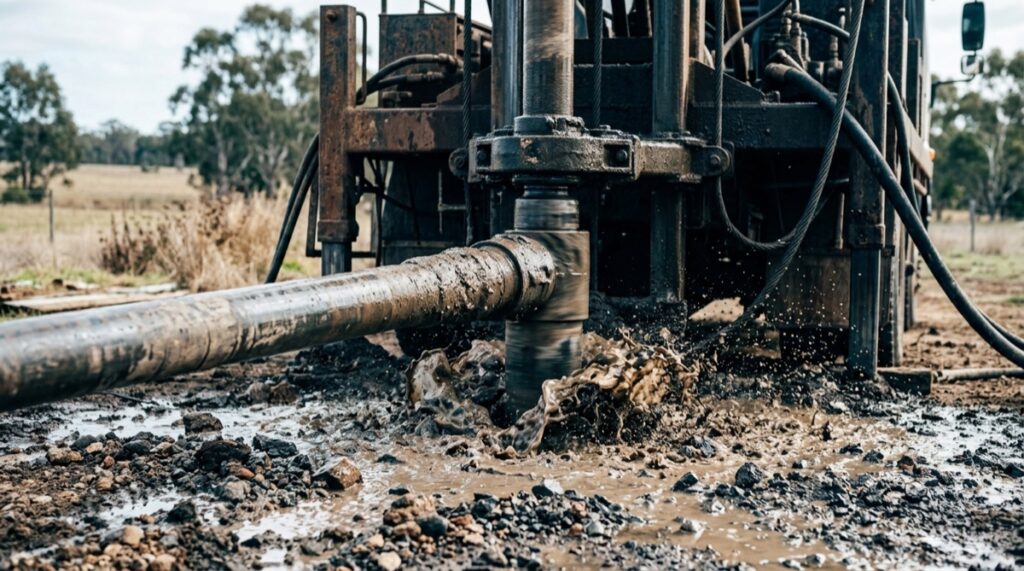
If you're putting in a new well, you'll run into three names: drilled, bored, and driven. They aren't interchangeable styles of the same thing — they reach water in different ways, work in different ground, and deliver very different reliability. The right choice for your property depends mostly on how deep the water sits and what's between you and it, which is a question best answered by a licensed driller who knows your area.
The three well types at a glance
Each method is really just a different way to get a hole into the ground and a pipe into the water beneath it. What separates them is how deep they can go and how dependable the result is over the decades a well is expected to last.
| Drilled well | Bored well | Driven well | |
|---|---|---|---|
| Typical depth | Deep — often 100–300+ ft (depends on the local water table) | Shallow — usually within the first tens of feet | Shallow — typically the shallowest of the three |
| How it's made | A rig drills a narrow shaft, then steel or plastic casing is set and sealed | A wide-diameter hole is augered, then lined | A pointed "sand point" pipe is driven down into loose soil |
| Yield & consistency | Strong, year-round supply from deeper aquifers | Decent in the right soil, but more weather-sensitive | Modest; best for limited or backup use |
| Reliability | Highest — least affected by drought and surface conditions | Moderate — can drop or run dry in a dry season | Lowest — most exposed to seasonal swings and contamination |
| Best suited to | Most homes; properties where water is deep or in rock | Areas with a reliably high water table in soft ground | Shallow water in sandy soil; small or seasonal demand |
| Relative cost | Highest up front | Mid-range | Lowest |
Drilled wells: the deep, dependable default
A drilled well is what most people picture, and for good reason — it's the standard for residential water across the US and Canada. A drilling rig bores a relatively narrow shaft straight down, often reaching well past the shallow layers and into deeper, more stable aquifers. Casing is set and the gap around it is sealed, which keeps surface runoff and shallow contamination out of your water.
Because it taps deeper water, a drilled well gives the strongest and most consistent supply and holds up best through dry spells. Most residential wells land somewhere in the 100–300-foot range, though the real number is entirely local — it comes down to how far down the water sits where you are. A well-built drilled well commonly lasts 30 to 50 years or more, which is part of why it's the type most homeowners end up choosing.
What it costs
A complete new drilled-well system generally runs $3,000 to $15,000, with a national average around $7,500 (most homeowners land in the $5,500–$9,000 band). The drilling itself is only about half the bill — roughly 50–60% of the total — with the rest going to casing, the pump, the pressure tank, wiring, and permits. Depth and ground type are the biggest swing factors: soft soil and sand cost the least per foot, sedimentary rock more, and hard rock or granite the most. For a location-specific picture, see our full well drilling cost guide, and to get a sense of how deep your well might need to go, try the well depth calculator.
Bored wells: wide and shallow, where the water table is high
A bored well is dug with a large auger that creates a wide hole — much broader than a drilled shaft — and then lined to hold the walls back. It only works where groundwater sits relatively close to the surface in soft, stable ground, so geography decides whether it's even an option for you.
The wide diameter lets a bored well store a useful volume of water, which can be handy in soils that yield slowly. The trade-off is that, because it draws from shallow water, a bored well is more exposed to dry seasons and to anything happening at the surface. Yield and reliability sit below a drilled well, and the supply can dip when the water table drops. It's a reasonable middle-cost choice on the right property, but it isn't the all-conditions workhorse a drilled well is.
Driven wells: the simplest and shallowest option
A driven well — often called a sand-point well — is the most basic of the three. A small-diameter pipe with a pointed, screened tip is driven down into loose, sandy soil until it reaches shallow groundwater. Where conditions are right, it's the quickest and cheapest well to put in.
That simplicity comes with real limits. Driven wells only work in soft soil with a high water table, they reach the shallowest depths, and they deliver the most modest, least dependable supply. Being so shallow, they're also the most vulnerable to seasonal swings and to surface contamination, so they tend to suit limited, secondary, or seasonal use rather than serving as the sole supply for a busy household. If shallow water and sandy soil happen to line up on your property, a driven well can be a cost-effective fit — but it's the exception, not the default.
So which well type do you need?
For most properties, the answer is a drilled well. It's the most reliable, lasts the longest, and works almost anywhere because it can reach deep water and seal out shallow contamination — which is why it dominates residential water supply across North America. Bored and driven wells cost less and can make sense where the water table is genuinely shallow and the soil cooperates, but those conditions are specific and entirely site-dependent.
The honest truth is that you can't pick the right type from a web page alone. Whether bored or driven is even viable — and how deep a drilled well would have to go — depends on the geology and water table at your exact address. A licensed local driller can read your area's conditions, check nearby well records, and recommend the method that will actually give you a dependable supply.
Ready to find a licensed well driller?
Get a local pro to assess your ground, your water table, and which well type fits your property — before you spend a dollar.

Author: Well Driller Finder Editorial Team
The Well Driller Finder editorial team researches and writes our guides on water-well drilling, pumps, and well water for homeowners across the US and Canada. We translate current cost data, NGWA and state well-construction standards, and EPA and CDC guidance into clear, practical answers. What we stand for: honest, independent help. Every price and claim is researched and fact-checked against multiple 2026 sources — never guessed, never borrowed from a single advertiser. We answer to homeowners, not to the companies we write about, because our only goal is to help you make a confident, well-informed decision about your water.
Find verified, local contractors who handle new installations, pump service, and water quality testing — in your area.