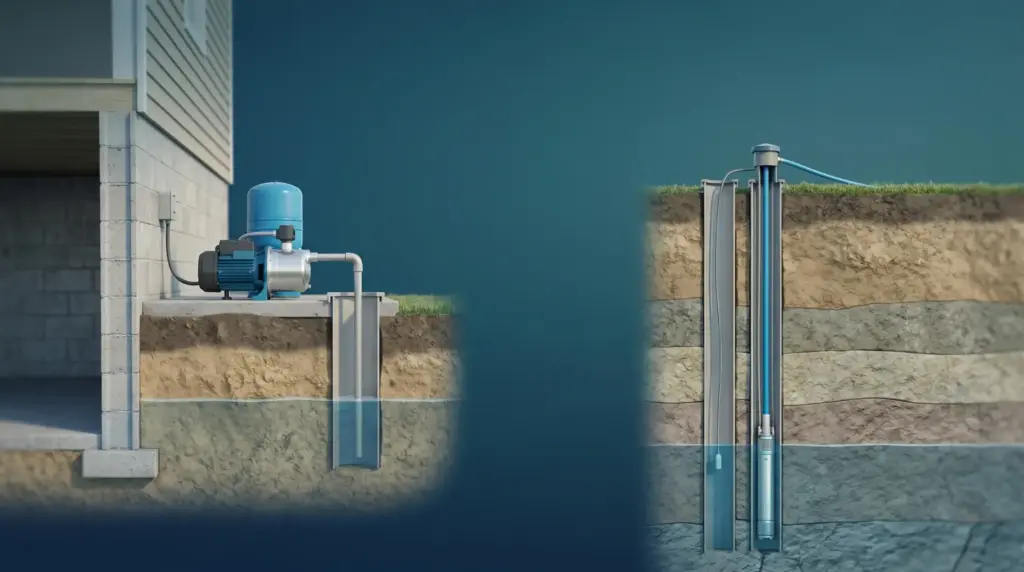
If you own a home with a private well, sooner or later you'll face a decision that quietly shapes your water pressure, your power bill, and your weekend plans for years to come: jet pump or submersible pump? Most homeowners never think about it until the pump quits and a contractor is standing in the yard asking which one they want. That's a bad moment to be learning the trade-offs for the first time.
The good news is that the right answer is usually clear once you understand one number — how far down your water sits. This guide walks through both pump types the way a knowledgeable inspector would explain them at your kitchen table: what each one actually does, where each one shines, where each one struggles, and what it honestly costs. By the end you'll know which pump fits your well and why — and you'll be able to ask a driller smart questions instead of nodding along.
Quick note before we dig in: about 15% of the U.S. population — more than 43 million people — rely on private wells, according to the U.S. EPA. Unlike city water, nobody regulates or inspects your well for you. The pump is the heart of that system, so it's worth understanding.
Suction limit: ~25 ft (a hard physics cap)
Lifespan: ~10–15 years
Efficiency: ~25–40%
Service: easy — it’s in the open
Noise: you’ll hear it run
Suction limit: none — it pushes
Lifespan: ~15–25 years
Efficiency: ~50–70%
Service: must pull it from the well
Noise: quiet
The Short Version: It Comes Down to Depth
If you remember nothing else, remember this. The single biggest factor in choosing a well pump is how deep below the surface your water sits (the "water level," not necessarily the total depth of the hole).
- Water within ~25 feet of the surface? A shallow-well jet pump works fine and is the cheapest option.
- Water roughly 25 to 110 feet down? A deep-well (or convertible) jet pump can do the job, though a submersible is often the smarter long-term pick.
- Water deeper than ~110 feet? A submersible pump is really your only practical choice — and the better one for most modern drilled wells anyway.
Everything else — efficiency, noise, lifespan, repair cost — matters, but depth is the gatekeeper. A jet pump physically cannot pull water up from a deep well no matter how badly you want it to, for reasons we'll explain next. Not sure how deep your well is? Our guide on how deep a well should be covers how to find out and what's typical for your region.
What a Jet Pump Is (and Why It Lives Above Ground)
A jet pump sits above the water — usually in your basement, a crawlspace, a garage, or a small well house. It doesn't go down the well. Instead, it pulls water up by suction, the same way you draw soda up a straw.
Here's the catch, and it's a hard physical limit: a pump can only "suck" water up so far. At sea level, atmospheric pressure (about 14.7 psi) can push water up a maximum of roughly 33.9 feet in a perfect vacuum. Real pumps aren't perfect, and you lose height to friction and the water's own temperature, so the practical ceiling for plain suction is about 25 feet of vertical lift — and less at high elevation, where there's less atmospheric pressure to do the pushing. This is basic physics, the same reason a straw stops working past a certain length. The University of Nebraska–Lincoln Extension's guide to private well distribution systems reflects this directly: it uses shallow-well jet pumps "when the water is less than 25 feet below the surface."
To beat that 25-foot wall, jet pumps come in two flavors:
Shallow-Well Jet Pump
One pipe runs down into the well. The "jet" (a venturi nozzle that creates the vacuum) lives inside the pump body up top. Good when your water sits less than 25 feet below the surface — think shallow dug or driven wells, or areas with a high water table.
Deep-Well (Convertible) Jet Pump
Two pipes run down the well, and the jet/ejector assembly is lowered into the well below the water line. The pump pushes some water back down to power the ejector, which then helps lift water the rest of the way. This stretches a jet pump's reach down to roughly 80 to 110 feet in real-world residential use. (The UNL Extension publication lists deep-well jet ranges of 25 to 250 feet, and some manufacturer charts go higher still — but in practice efficiency falls off a cliff past ~100 feet, because the two-pipe system burns too much energy circulating water down and back up.) A "convertible" pump is simply one body that can run either way depending on which ejector kit you install.
The jet pump trade-offs in plain terms: Because it lives above ground, it's easy to reach, easy to service, and cheap to buy. The downsides are that it's noisier (the motor is in your living space, not buried underground), it's less energy-efficient, and it can "lose its prime" — meaning air gets into the suction line and the pump spins without moving water until you manually refill and restart it. If your pump cycles on and off oddly, struggles to hold pressure, or won't prime, those can be early warning signs; see the signs of a failing well pump.
What a Submersible Pump Is (and Why It Lives Down the Well)
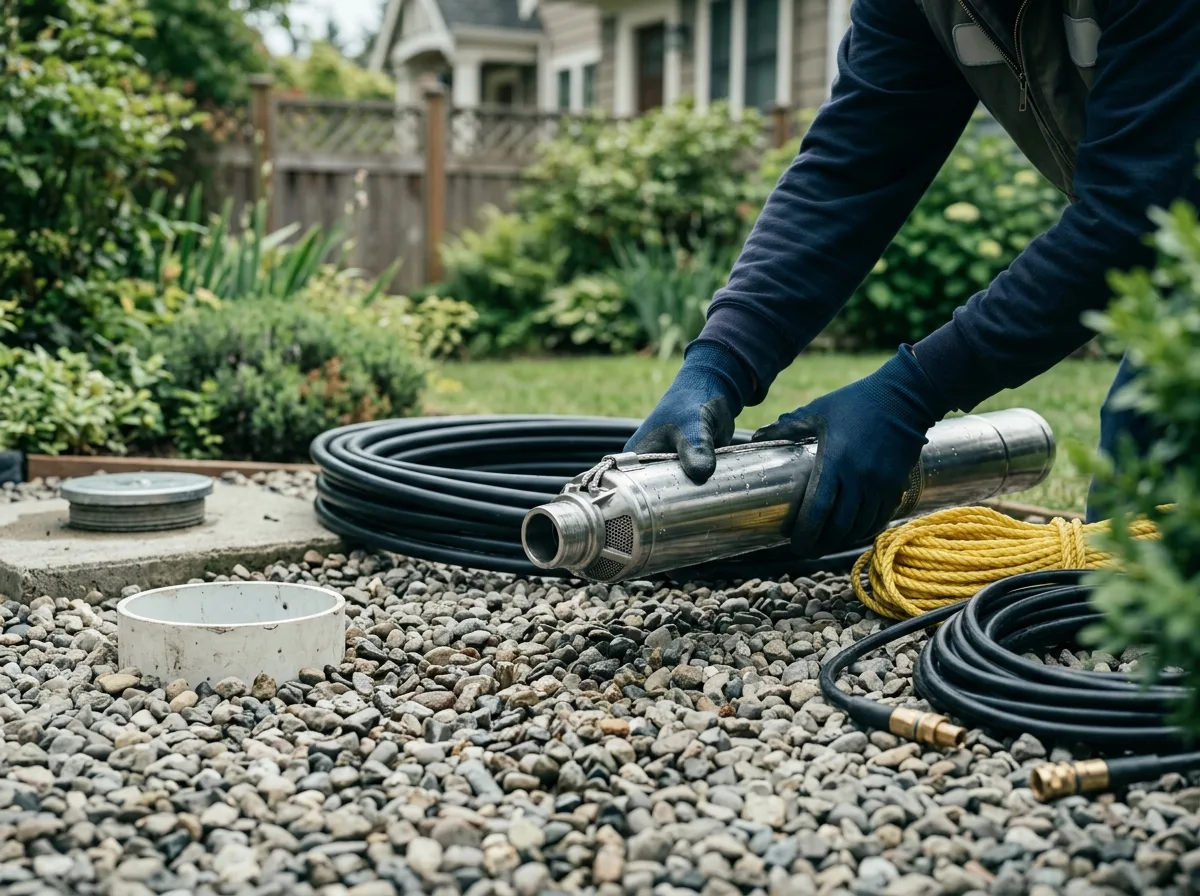
A submersible pump is a sealed, cylindrical unit — pump and motor in one — that hangs deep in the well, fully underwater, on the end of a pipe and a wire. Instead of pulling water up by suction, it pushes water up from below. That single design difference changes everything.
Because it pushes rather than sucks, there's no 25-foot suction limit. Submersible pumps routinely serve wells from about 25 feet to over 400 feet deep, and heavy-duty models can lift water from 1,000 feet or more. Nearly every modern drilled well in North America — the deep, narrow, cased wells most homeowners have today — uses a submersible.
Sitting in the water also keeps the motor cool. The surrounding groundwater acts as a constant coolant, which is a big reason submersibles run quietly and last a long time. You essentially never hear them — they're underground and underwater.
The submersible trade-offs in plain terms: They're quieter, more energy-efficient, and longer-lived. The catch is service. When something goes wrong, a contractor has to physically pull the pump — sometimes hundreds of feet of pipe, wire, and pump out of the ground — before they can even diagnose it. That labor is what makes submersible repairs pricier than jet-pump repairs.
Head-to-Head: The Numbers That Matter
Here's the honest comparison, with figures drawn from extension publications and current contractor cost data. Costs are 2025–2026 ranges and vary widely by region, well depth, and local labor rates.
| Factor | Jet Pump | Submersible Pump |
|---|---|---|
| Where it sits | Above ground (basement/well house) | Submerged deep in the well |
| How it moves water | Suction (pulls up) | Pressure (pushes up) |
| Practical depth range | Shallow: <25 ft | Deep/convertible: ~25–110 ft | ~25 ft to 400+ ft (some 1,000+ ft) |
| Typical flow rate | ~5–15 GPM (shallow wells) | ~3–20+ GPM, steady pressure |
| Energy efficiency | Lower (~25–40%) | Higher (~50–70%) |
| Typical lifespan | ~10–15 years | ~15–25 years |
| Noise | Audible (motor is indoors) | Silent (buried + underwater) |
| Loses prime? | Yes — can need re-priming | No — always submerged |
| Pump unit cost | $230–$1,200 | $275–$1,550 (unit only) |
| Ease / cost of service | Easy — sits in the open | Harder — must be pulled from the well |
A few of these deserve a closer look.
Efficiency and Your Power Bill
Submersible pumps convert roughly 50–70% of the electricity they draw into actual water movement, while jet pumps land closer to 25–40%. On a deep well, that gap can mean a meaningful difference on the monthly electric bill — industry estimates put it in the range of $100–$300 a year. It's not a fortune, but over a 15-year pump life it adds up, and it's one more reason submersibles dominate deeper wells.
Lifespan
Jet pumps typically last about 10 to 15 years; submersibles commonly run 15 to 25 years. The submersible's edge comes largely from that built-in water cooling — the motor simply doesn't get stressed by heat the way an above-ground motor can. Of course, water chemistry, sediment, cycling frequency, and a properly sized pressure tank all affect real-world lifespan. A pump that short-cycles because of a waterlogged or failing pressure tank will wear out early no matter which type it is.
Flow Rate (GPM)
If you have a big household, multiple bathrooms, or irrigation, gallons-per-minute matters. Both pump types can be sized up, but submersibles are generally better at delivering steady pressure and flow from depth, and they handle low-yield wells gracefully. For a typical family, the pump type matters less than proper sizing — which is a job for a licensed driller or pump installer, not a guess.
What It Actually Costs to Replace
According to HomeAdvisor's 2025 cost data, the average well pump replacement runs about $1,900, with most homeowners spending between $977 and $2,824. The full range stretches from about $200 to $5,800 for deep, complicated jobs.
Here's how the pump unit itself breaks down by type (before labor):
- Shallow jet pump: ~$230–$1,000
- Deep-well jet pump: ~$440–$1,200
- Submersible pump: ~$275–$1,550
Then add labor, which HomeAdvisor pegs at roughly $250–$1,000 (hourly rates of $45–$150), plus any local permit fees. The big cost swing usually isn't the pump — it's the access. Replacing a jet pump in your basement is straightforward. Pulling a submersible from 300 feet down, then lowering a new one with fresh pipe and wire, is far more labor. That's why a deep submersible replacement can land at the high end even though the pump unit itself isn't dramatically more expensive.
For a full breakdown of replacement scenarios — including pressure tanks, wiring, and signs you might be paying for unnecessary extras — see our dedicated well pump replacement cost guide. And if you're budgeting for a whole new well, our well drilling cost guide puts pump costs in context.
The Decision, by Well Depth
Here's the clean recommendation. Find your water level, then read across.
| Your water level (depth to water) | Best pump choice | Why |
|---|---|---|
| Less than 25 feet | Shallow-well jet pump | Suction works fine; cheapest to buy and service. |
| ~25–80 feet | Deep-well jet pump or submersible | Either works. Jet is cheaper upfront; submersible is quieter, more efficient, and longer-lived. |
| ~80–110 feet | Submersible (jet possible but strained) | Jet pumps lose efficiency badly near their limit; submersible is the smarter long-term value. |
| More than 110 feet | Submersible — full stop | Suction physics rule jet pumps out entirely at this depth. |
One practical reality: most modern drilled wells in the U.S. and Canada are deep and narrow, so the majority of homeowners end up with a submersible whether they planned to or not. Jet pumps are most common on older shallow wells, dug wells, and high-water-table regions. If you're buying a home with a well, ask which pump it has and how old it is — a 14-year-old jet pump is a known future expense you can factor into your offer.
A Few Things That Trip Homeowners Up
- Total well depth is not the same as water level. A 300-foot-deep well might have water standing only 40 feet from the surface. It's the depth to water that determines suction feasibility — but the pump still has to be set well below the water line, so deep wells almost always get submersibles regardless.
- "Convertible" doesn't mean "unlimited." A convertible jet pump can switch between shallow and deep modes, but it's still bound by the ~100–110-foot practical limit. It can't match a submersible's reach.
- The pump isn't the whole system. Your pressure tank, pressure switch, check valve, and wiring all work with the pump. A "pump problem" is sometimes really a pressure tank problem. Diagnose before you replace.
- Don't oversize. A pump that's too powerful for your well can pump it down faster than it refills, drawing in air and sediment. Matching the pump to your well's yield matters as much as matching it to depth. If your well struggles to keep up with demand, our guide on a well running dry explains what's happening.
Don't Forget the Water Itself
Whichever pump you choose, the pump only moves the water — it doesn't make it safe. Because private wells aren't regulated by the EPA, testing is entirely on you. The CDC recommends testing your well water at least once a year for total coliform bacteria, nitrates, total dissolved solids, and pH. If you've just replaced a pump or done any work that opened up the well, that's a smart time to test — and to shock-chlorinate the well if bacteria show up. Start with our guide on how to test well water if you're not sure where to begin.
The Bottom Line
Choosing between a jet pump and a submersible isn't really a coin flip — it's a depth question with a clear answer for most homes. Shallow water favors a jet pump for its low cost and easy service. Deeper water demands a submersible, and for good reason: it's quieter, more efficient, and lasts longer. The only place the decision gets interesting is that 25-to-80-foot middle zone, where either can work and your priorities (upfront cost vs. long-term value) tip the balance.
What you don't want to do is guess. The depth to your water, your well's yield, your household's demand, and your local labor rates all feed into the right call — and getting it wrong means a noisy pump, a high power bill, or a system that never quite keeps up. A licensed local well driller or pump installer can measure your water level, check your well's yield, and size the pump correctly the first time. If your pump is acting up or you're planning ahead, it's worth getting a qualified pro to look before you're stuck without water. You can compare free quotes from licensed drillers in your area through Well Driller Finder — no pressure, just a straight answer from people who do this every day.
Frequently Asked Questions
How do I know if I have a jet pump or a submersible pump?
Look for the pump. A jet pump is a visible motor-and-pump unit sitting above ground — in your basement, crawlspace, garage, or a small well house — often near the pressure tank. If you see no pump at all, just a well cap outside and a pressure tank inside, you almost certainly have a submersible pump hanging down in the well. When in doubt, a pump installer can tell you in minutes.
Can I replace a jet pump with a submersible (or vice versa)?
Sometimes, but it's not a simple swap. Going from a jet pump to a submersible means running new pipe and electrical wire down the well and setting the pump below the water line — a real job. Going the other way only works if your water level is shallow enough (under ~25 feet for a shallow jet, or under ~110 feet for a deep-well jet). A driller can tell you whether your well's depth and water level make a conversion practical.
Which pump lasts longer?
Submersible pumps typically last 15–25 years, versus about 10–15 years for jet pumps. The submersible's longer life comes largely from being cooled by the surrounding water, which reduces motor stress. That said, real lifespan depends heavily on water quality, how often the pump cycles, and whether the pressure tank is healthy.
Are submersible pumps really quieter?
Yes — noticeably. A submersible pump sits deep underwater in the well, so you essentially never hear it run. A jet pump's motor is above ground inside or near your home, so it's audible every time it cycles. For homeowners with the pump near a living space, that noise difference is a real quality-of-life factor.
Why does my jet pump keep "losing prime"?
Losing prime means air has gotten into the suction line, so the pump spins but can't grab water. Common causes are a leaking foot valve or check valve, a crack or loose fitting in the suction pipe, or a water level that's dropped below the pump's reach. Submersible pumps don't have this problem because they're always submerged. If your jet pump repeatedly loses prime, have the foot valve and suction line checked — and review the signs of a failing well pump to rule out a bigger issue.
How much does it cost to replace a well pump?
Nationally, the average is about $1,900, with most homeowners paying between roughly $977 and $2,824, per HomeAdvisor's 2025 data. The pump unit itself runs a few hundred to about $1,500; the rest is labor, which climbs for deep submersibles that must be pulled and re-set. See our well pump replacement cost guide for a full breakdown.

Author: Well Driller Finder Editorial Team
The Well Driller Finder editorial team researches and writes our guides on water-well drilling, pumps, and well water for homeowners across the US and Canada. We translate current cost data, NGWA and state well-construction standards, and EPA and CDC guidance into clear, practical answers. What we stand for: honest, independent help. Every price and claim is researched and fact-checked against multiple 2026 sources — never guessed, never borrowed from a single advertiser. We answer to homeowners, not to the companies we write about, because our only goal is to help you make a confident, well-informed decision about your water.
Find verified, local contractors who handle new installations, pump service, and water quality testing — in your area.