When the water at your tap suddenly drops to a trickle, sputters air, or carries grit, the well pump is usually the first suspect. A submersible well pump does a hard, invisible job hundreds of feet underground, and like any motor, it wears out. The good news: a failing pump almost always warns you first, so catching it early can save you from a dry house at the worst possible moment. This guide covers the seven most common warning signs, how to tell whether the real culprit is the pump, the pressure tank, or the well itself, and what a replacement typically costs.
The 7 signs your well pump is failing
Pumps rarely die without warning. Watch for these symptoms, and pay special attention when several show up together.
1. No water at all
The most obvious sign: you turn on a tap and nothing comes out. Before assuming the worst, rule out a tripped breaker or a blown fuse at the pump's circuit, and confirm the problem affects the whole house rather than one fixture. If power is fine and every tap is dry, a failed pump or a control problem is the likely cause.
2. Low or dropping water pressure
Weak pressure that gets steadily worse, or water that fades when more than one fixture runs, often points to a pump losing its ability to push water. Pressure that drops gradually over weeks is a common early warning that a pump is on its way out.
3. Sputtering air from the faucets
Air spitting out of your taps usually means the pump is drawing air instead of water. That happens when the water level in the well drops below the pump intake, or when the pump or its piping has developed a leak. Either way, the system isn't staying primed the way it should.
4. Spitting, surging, or uneven flow
Water that surges and then weakens, or comes out in bursts, points to a pressure problem, frequently a waterlogged pressure tank or a pump struggling to keep up. Steady, even flow is what you want; pulsing flow is a flag.
5. The pump short-cycles
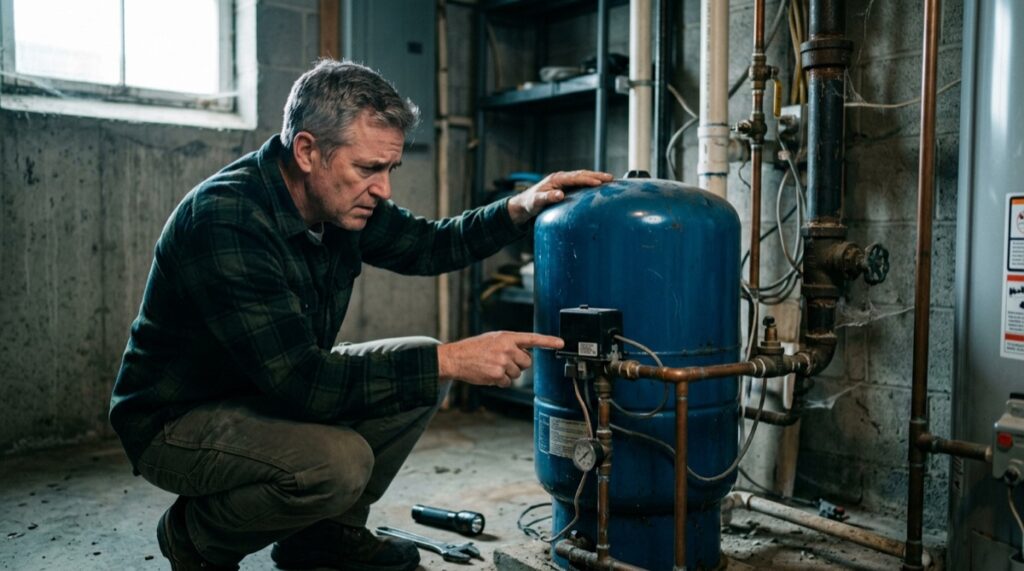
Short-cycling is when the pump rapidly switches on and off instead of running in normal cycles, sometimes clicking on every few seconds. It's hard on the motor and burns it out years early. Short-cycling is often caused by a failing pressure tank rather than the pump itself, which is exactly why a proper diagnosis matters before you replace anything.
6. A jump in your electric bill
A pump that's worn, short-cycling, or running constantly to maintain pressure pulls far more electricity than a healthy one. If your power bill climbs with no other explanation, a struggling well pump is a prime suspect worth chasing down before the motor quits.
7. Dirty, cloudy, or sandy water
New sediment, cloudiness, or sand can mean the pump has dropped lower in the well and is pulling from a sandy zone, or that the well itself is aging. Because private-well water isn't tested for you by any agency, a sudden change in appearance is always worth investigating.
Is it the pump, the pressure tank, or the well?
This is the most important question to answer before spending money, because the three problems look similar at the tap but cost very different amounts to fix. Several symptoms above, especially short-cycling and surging flow, are caused by the pressure tank far more often than the pump, and replacing a pump when the tank was the problem is a common, expensive mistake. Here's a rough guide to where the symptoms point. A licensed well professional confirms it with pressure and electrical tests, but this helps you understand what they're checking for.
| What you notice | Most likely culprit |
|---|---|
| Rapid on/off cycling, surging or pulsing pressure | Pressure tank (often a waterlogged or failed tank) |
| No water at all, with power confirmed on | Pump or its electrical controls |
| Sputtering air, water that runs out after heavy use then recovers | Well water level (low yield) or pump set too high |
| Sand, grit, or cloudiness that's new | Pump pulling from a sandy zone, or the well aging |
| Rising electric bill with weak pressure | Worn or short-cycling pump |
A useful rule of thumb: problems that come and go with how much water you've used point toward the well's water level or yield, while constant problems point toward the pump or tank. If your well runs dry during heavy use and recovers overnight, the issue may be the well rather than the equipment, a different and bigger decision. Our New Well vs. Repair helper walks you through whether a repair makes sense or whether you're better off drilling a new well.
How long should a well pump last?
A submersible well pump typically lasts 8 to 15 years. The well itself, the borehole and casing, is long-term infrastructure that can last 30 to 50 years or more, so over a well's life you should expect to replace the pump at least once, sometimes twice. If your pump is well into that window and starting to show the signs above, age alone is reason to start planning.
What shortens a pump's life most is the wrong size: an undersized or oversized pump short-cycles and wears out years early. If you're replacing a pump that failed prematurely, check that the replacement is correctly matched to your well depth and household demand. The well pump sizing calculator helps you understand the right size before you talk to a contractor, so nobody upsells you horsepower you don't need.
What does well pump replacement cost?
In 2025-2026, replacing a well pump averages around $1,900, with a typical range of roughly $976 to $2,825 for a submersible pump plus the labor to pull the old one and install the new one. Deeper wells cost more, since there's more pipe and wire to handle and a stronger pump to buy.
Put that in context: a pump replacement is a fraction of the cost of a new well. A complete new water well system runs $3,000 to $15,000 (averaging around $7,500), with drilling alone making up 50 to 60 percent of that total. So if your well is sound and only the pump has failed, a replacement is by far the more economical path, exactly the comparison the New Well vs. Repair helper is built to clarify.
What to do when you spot the signs
If you notice one symptom, keep an eye on it. If you notice two or more, especially dropping pressure, sputtering air, short-cycling, or a rising electric bill, it's time to call a professional rather than wait for the system to quit on a holiday weekend. A licensed well contractor can test the pressure tank, check the pump's electrical draw, and measure the well's water level to pinpoint the real problem instead of guessing.
Because private wells aren't regulated the way public water systems are, keeping yours running well rests with you as the property owner, which makes it doubly worth hiring someone licensed and qualified. Whenever you have well work done, it's also a good moment to test your water with a state-certified lab.
Ready to find a licensed well driller?
Whether you need a pump replaced or a fresh diagnosis on a struggling system, compare verified well drillers in your area with direct contact info and confirmed state licensing.

Author: Well Driller Finder Editorial Team
The Well Driller Finder editorial team researches and writes our guides on water-well drilling, pumps, and well water for homeowners across the US and Canada. We translate current cost data, NGWA and state well-construction standards, and EPA and CDC guidance into clear, practical answers. What we stand for: honest, independent help. Every price and claim is researched and fact-checked against multiple 2026 sources — never guessed, never borrowed from a single advertiser. We answer to homeowners, not to the companies we write about, because our only goal is to help you make a confident, well-informed decision about your water.
Find verified, local contractors who handle new installations, pump service, and water quality testing — in your area.