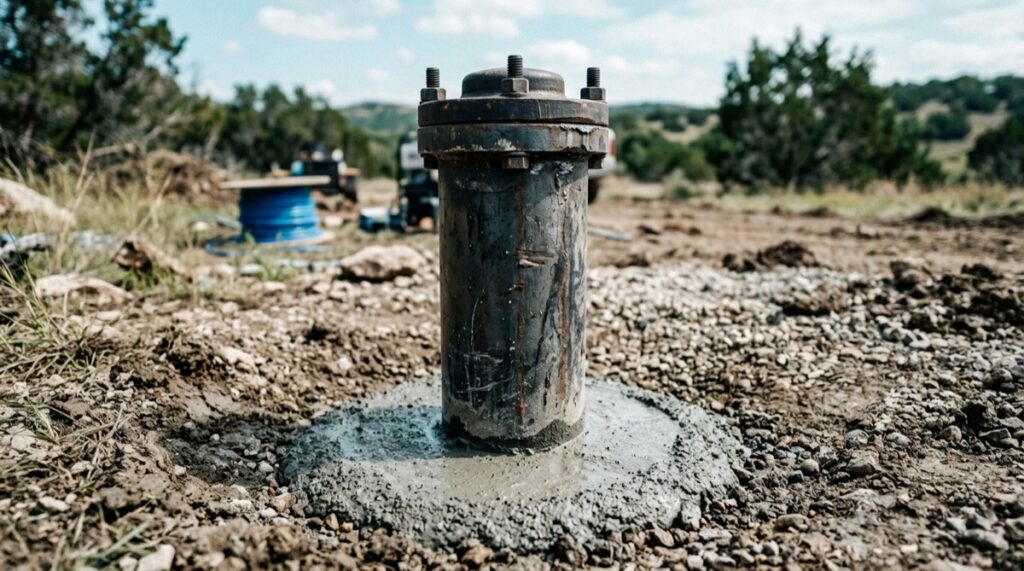
When you picture a water well, it's easy to imagine just a deep hole that fills with water. In reality, two less-visible parts do most of the work of keeping that water safe: the casing that lines the borehole, and the grouted annular seal packed around it. They're what separate clean groundwater from everything happening at the surface — and they're the reason well-construction codes exist at all.
What the casing does
The casing is the pipe that lines the drilled hole from the surface down into the water-bearing zone. It has two jobs. First, it holds the borehole open so loose soil, sand, or fractured rock can't cave in and clog the well. Second, it creates a clean, sealed pathway for water to travel up to your pump without picking up dirt or bacteria along the way.
Without casing, an open hole in unstable ground is both unreliable and unsafe. The casing turns a raw borehole into durable, long-term infrastructure — one of the reasons a properly built well can last 30 to 50 years or more, while the pump inside it is the part you'll typically replace every 8 to 15 years.
What the grouted annular seal does
Casing alone isn't enough. When a driller installs casing, there's a thin gap between the outside of the pipe and the wall of the borehole — called the annulus. If that gap is left open, it becomes a highway: rainwater runoff, surface spills, or seepage near the wellhead can run straight down the outside of the casing and into the aquifer your family drinks from.
The fix is grout — a watertight material (commonly bentonite clay or a cement-based mix) pumped into that annular gap to seal it from top to bottom. This grouted annular seal is the single most important barrier between surface contamination and your groundwater. It's also why setback rules — keeping a well a code-required distance from a septic system, typically in the range of 50 to 100 feet depending on your state — work as a second line of defense alongside a proper seal.
A correctly built well, in other words, has a cased borehole with a watertight, grouted annular seal. That's not an upgrade or an add-on. It's the baseline of a safe well.
PVC vs. steel casing
Casing usually comes in one of two materials, and the right choice depends on your ground conditions and how deep the well goes.
| Casing type | Strengths | Typical use |
|---|---|---|
| PVC (plastic) | Lower cost; corrosion-resistant; lighter and easier to install | Common in shallower wells and stable or softer ground |
| Steel | Much stronger; handles pressure and unstable formations | Often required at greater depths and in harder or shifting ground |
PVC is generally the cheaper option, which is why it's widely used where conditions allow. Steel costs more but stands up to the pressure and movement found in deeper wells and certain rock formations — and in some ground, your state code or your driller's judgment will require it. There's no single "best" casing; there's the right casing for your site, and a licensed driller chooses it based on what they encounter as they drill.
Why casing affects what you pay
Casing is one of the three things that move a well budget the most, alongside depth and the size of the pump. You pay for casing by the foot, so a deeper well needs more of it — and a wider-diameter or steel-cased well costs more than a shallow PVC one. Across hundreds of feet, that adds up.
It's also a common place for lowball quotes to cut corners. A cheap estimate that quietly skimps on casing or the annular seal isn't a better deal — it's a well that may not last or may not be safe. As a frame of reference, a complete new well system in 2025–2026 typically runs from about $3,000 to $15,000 (with an average near $7,500), and drilling plus casing is the bulk of that. For a location-specific number, our well-drilling cost guide breaks down each cost driver, and the cost estimator gives you a range for your own depth and ground type.
Why the standards exist
Casing and grouting aren't left to chance because the stakes are your drinking water. Private household wells are not regulated under the federal Safe Drinking Water Act — that law covers public water systems, so as a well owner you're responsible for your well's safety and for testing it. (Health agencies like the CDC recommend testing at least once a year for total coliform bacteria, nitrate, total dissolved solids, and pH, using a state-certified lab.)
Because the federal government doesn't set the construction rules, your state does. The widely referenced model is ANSI/NGWA-01, the water-well construction standard that spells out proper casing and a grouted annular seal, and most state codes are aligned with it. In practice, most states also require a well-construction permit before drilling, license the well driller, and have the driller file a well completion report (a "well log") afterward recording the depth, casing, and grout. The specifics genuinely vary from one state or province to the next, so confirm the exact requirements for your location.
If you want the full picture of how this works where you live — driller licensing, permits, setbacks, and testing rules across the US and Canada — start with our well regulations hub.
What this means for you as a homeowner
You don't need to specify casing materials or grout mixes yourself — that's the driller's expertise. What you should do is make sure the work is done by someone qualified to do it right. When you collect quotes, confirm each driller holds a current state license, and ask exactly what's included: casing, the annular seal, the pump, the pressure tank, permits, and a water test. A driller who builds to the standard the first time is protecting the next several decades of your water.
Ready to find a licensed well driller?
A properly cased and grouted well is only as good as the contractor who builds it. Find a licensed, verified driller near you who builds to code.

Author: Well Driller Finder Editorial Team
The Well Driller Finder editorial team researches and writes our guides on water-well drilling, pumps, and well water for homeowners across the US and Canada. We translate current cost data, NGWA and state well-construction standards, and EPA and CDC guidance into clear, practical answers. What we stand for: honest, independent help. Every price and claim is researched and fact-checked against multiple 2026 sources — never guessed, never borrowed from a single advertiser. We answer to homeowners, not to the companies we write about, because our only goal is to help you make a confident, well-informed decision about your water.
Find verified, local contractors who handle new installations, pump service, and water quality testing — in your area.