You can't see it, smell it, or taste it. It won't cloud your water, leave a stain, or give your coffee an off flavor. And yet radon in well water is one of the few contaminants on this site with a direct line to lung cancer. Most homeowners never think to test for it, because nothing about their water seems wrong. That's exactly what makes it dangerous.
If your home draws water from a private well, especially one drilled into granite or other hard bedrock, radon deserves a place on your testing list. Here's the part that surprises people most: the bigger health risk isn't from drinking the water at all. It's from breathing the gas that escapes when you shower, run the dishwasher, or do a load of laundry. This guide walks through what radon in water actually is, the two distinct risks it poses, why it needs a special test (a normal water-test kit won't catch it), and how to get rid of it safely if your numbers come back high.
What Radon in Well Water Actually Is
Radon is a naturally occurring radioactive gas. It has no color, no odor, and no taste. It forms underground as a decay product of uranium and radium, which are present in trace amounts in soil and rock almost everywhere, but in much higher concentrations in certain geology. As uranium slowly breaks down over geologic time, it produces radium, and radium decays into radon gas. When groundwater moves through uranium-bearing bedrock, the radon dissolves directly into the water.
Two things make this a private-well problem specifically. First, radon is short-lived and constantly escaping, so water that sits in an open reservoir or travels through a public treatment system loses most of its radon to the air before it ever reaches a tap. According to the U.S. EPA, radon in water is essentially a concern only when your supply comes from underground, like a well pumping from an aquifer. Surface water has usually off-gassed by the time you'd drink it. Second, private wells aren't regulated or routinely tested for radionuclides the way public systems are. As the EPA puts it plainly, wells are usually not inspected for radionuclides, so nobody is checking your water but you.
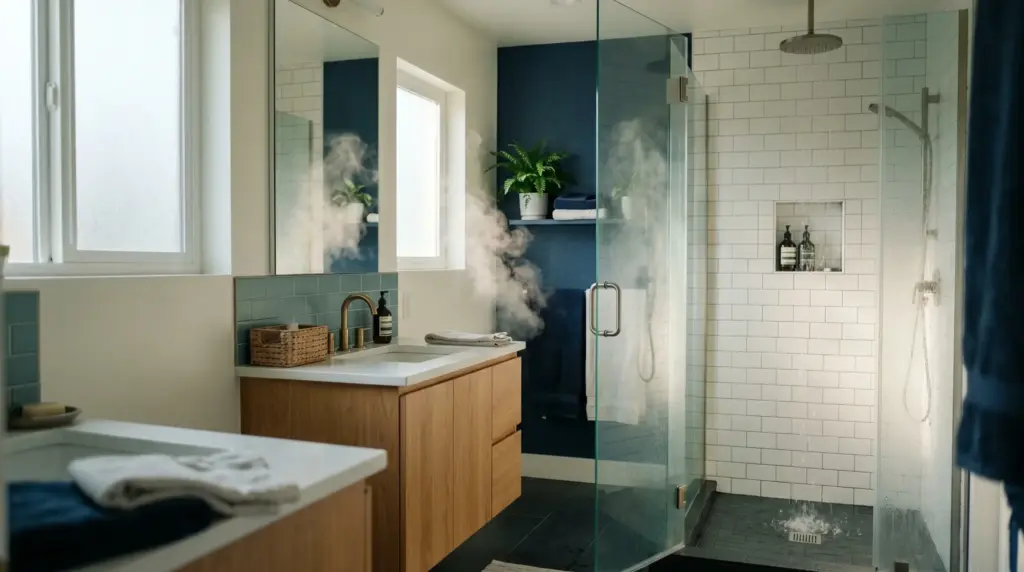
The radon stays dissolved and invisible right up until your water meets air. Turn on a faucet, start a hot shower, or fill the washing machine, and the dissolved gas escapes into the room. That's the mechanism behind the larger of the two health risks, and it's why radon is unusual: a water contaminant whose main danger is something you inhale.
The Two Risks: One You Breathe, One You Drink
Radon in water creates two separate exposure pathways, and they are not equal.
The inhalation risk (the big one). Every time radon-laden water is agitated and warmed, as in a shower, dissolved radon gas is released into your indoor air. You then breathe it. According to the CDC, radon is the second leading cause of lung cancer in the United States after smoking, and the EPA identifies it as the number one cause of lung cancer among people who don't smoke. The EPA attributes roughly 21,000 lung cancer deaths a year to radon overall (most of that from soil-gas radon seeping up into homes, a separate problem). When the EPA looked specifically at the radon that enters indoor air from water, it estimated, based on a National Academy of Sciences review, that water-borne radon causes about 168 cancer deaths per year in the U.S., with about 89% of those from lung cancer caused by breathing the off-gassed radon.
The ingestion risk (the smaller one). When you actually drink water containing radon, the radioactive decay can damage tissue in your digestive tract, with the stomach most at risk. This is a real but considerably smaller hazard. Of those ~168 deaths per year, the EPA attributes the remaining 11% to stomach cancer from consumption, on the order of 19 deaths a year. So while it's worth knowing about, the math is clear: the steam in your bathroom is the part that matters most.
One number ties these together and helps you judge your own results. The EPA's accepted transfer estimate is that roughly every 10,000 pCi/L (picocuries per liter) of radon in your water adds about 1 pCi/L of radon to your indoor air. That relationship is cited consistently across state programs and university extensions, including the University of Georgia Extension. For context, the EPA's action level for radon in indoor air is 4 pCi/L. So water at, say, 8,000 pCi/L is contributing close to 1 pCi/L to your air on its own, before you account for any radon seeping in from the soil under your foundation.
Why There's No Federal Limit (and What the Proposed Numbers Mean)
Here's a fact that catches a lot of homeowners off guard: there is currently no federally enforceable drinking-water standard for radon. Unlike arsenic, nitrate, or lead, radon has no legal limit you can point to.
It's not for lack of trying. Back in 1999, under the Safe Drinking Water Act, the EPA proposed a radon-in-water rule with a tiered structure. It included a Maximum Contaminant Level Goal of zero (the aspirational, no-risk target), a proposed enforceable Maximum Contaminant Level (MCL) of 300 pCi/L, and an Alternative Maximum Contaminant Level (AMCL) of 4,000 pCi/L. The AMCL was meant to apply where a state or water utility ran a "multimedia mitigation" program to reduce the much larger radon-in-air problem at the same time. That proposed rule was never finalized, so for private-well owners none of these numbers are legally binding.
That said, they are the best practical yardsticks available, and many state health departments have adopted their own guidance levels in the same ballpark. The 4,000 pCi/L AMCL, in particular, is widely treated as a sensible "you should do something about this" threshold. Some states go further: New Hampshire, where the USGS estimates 55% of the state is more likely than not to have groundwater above the state's radon standard, sets that drinking-water standard at 2,000 pCi/L. The bottom line for a homeowner: no agency is going to enforce a radon limit on your private well, which means the responsibility, and the decision, sits with you.
| Radon in water (pCi/L) | What it means | Recommended action |
|---|---|---|
| Under 300 | Low | No treatment needed |
| 300 – 4,000 | Slightly elevated | Treatment optional; retest periodically |
| 4,000 – 10,000 | Significant | Treat with GAC or aeration (point-of-entry) |
| Over 10,000 | High | Aeration recommended; also test for uranium & radium |
Interpretation framework adapted from the University of Georgia Extension, the Wisconsin DNR, and state health department guidance. These are advisory levels, not legal limits.
Where Radon in Well Water Is Most Common
Radon in water tracks geology. It shows up wherever wells draw from bedrock rich in uranium, which means granite, schist, and certain shales. According to USGS and EPA mapping, the highest-risk regions in the U.S. include New England, the Appalachian Mountains, the Rocky Mountains, the Colorado Plateau, and the northern glaciated states of the upper Midwest. Crystalline granite bedrock, the kind that underlies much of New Hampshire, Maine, and parts of the Carolinas and Georgia, is a classic high-radon setting. A USGS study of northern aquifers found that wells in the New York and New England crystalline bedrock had radon levels about ten times higher than other aquifer types.
The numbers spread enormously. The EPA estimates the average radon concentration in U.S. groundwater is somewhere between 200 and 600 pCi/L, which is generally not a concern. But water from granite aquifers can exceed 8,000 pCi/L, and the University of Georgia documented a Georgia well at a staggering 140,000 pCi/L. Wells drilled deep into bedrock tend to carry more radon than shallow dug or driven wells in sand and gravel, simply because they spend more contact time in the uranium-bearing rock.
If you're in one of these regions, especially with a drilled bedrock well, radon belongs on your list. But geology is only a probability, not a guarantee. Two wells on the same street can read very differently depending on the exact fracture the water travels through. There is genuinely no way to know your well's radon level without testing it, which conveniently is the next step. (If you're still in the buying process, this is one of the items worth checking; our guide to buying a home with a well covers what to ask for.)
Testing for Radon Needs a Special, Non-Aerated Sample
This is the single most important practical point in this article, and it trips up almost everyone: you cannot test for radon in water with a normal water-test kit. Not the all-in-one strips, not the standard mail-in lab panel, not the kit you'd use for bacteria or hardness. Here's why.
The same property that makes radon dangerous, how readily it escapes from water into air, also makes it remarkably easy to lose from a sample. The instant water is exposed to air, splashed, poured, or left with an air gap in the container, the dissolved radon starts off-gassing. A regular sampling method that involves any aeration or headspace will let the radon escape and hand you a falsely low, useless reading.
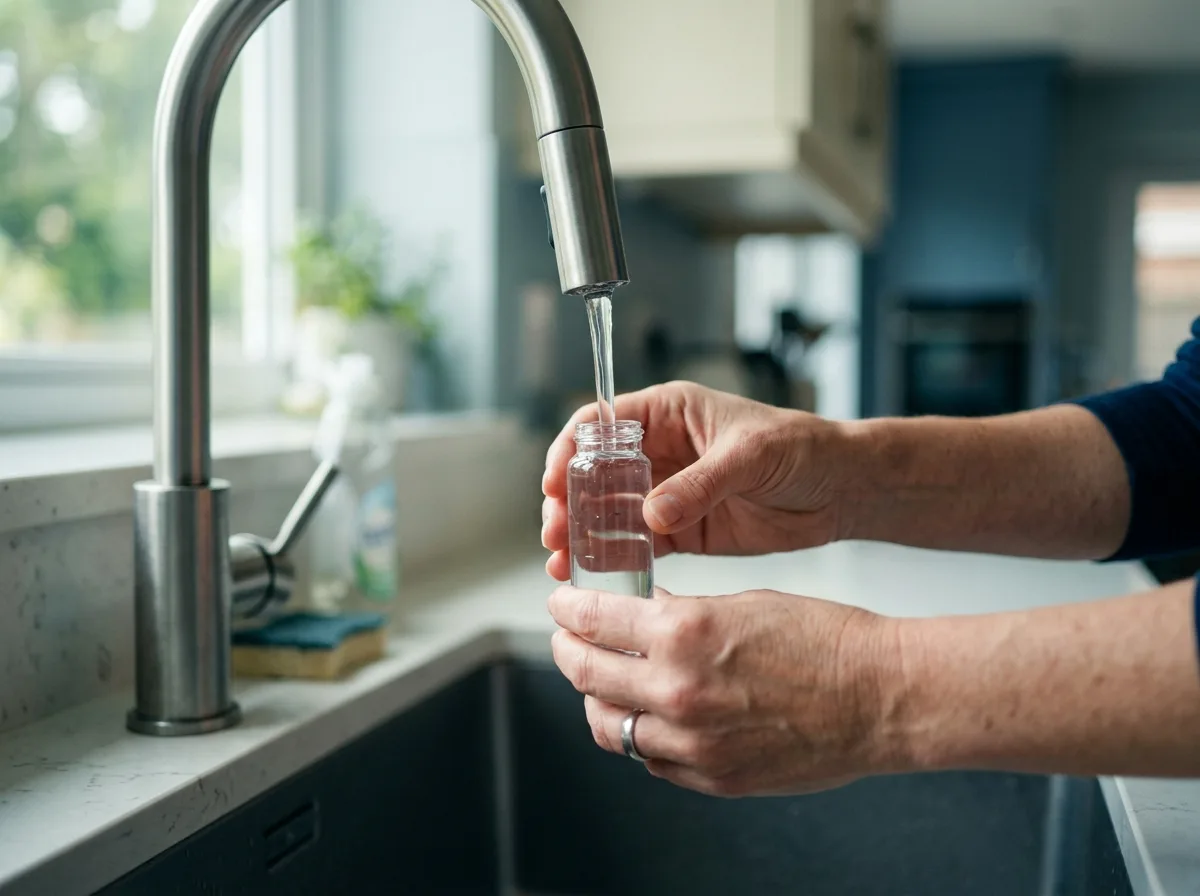
Proper radon-in-water testing uses a special small non-aerated sample. Labs that test for radon send a specific vial with strict instructions, which generally look like this:
- Run a cold tap that draws water as directly from the well as possible (a tap before any existing treatment is best), and let it run briefly first.
- Reduce the flow to a gentle stream to avoid splashing and bubbles.
- Fill the vial completely, submerging it so there is no air bubble and no headspace whatsoever. Many instructions have you fill the vial underwater inside a larger container.
- Cap it tightly, then turn it upside down and check for bubbles. If you see even a small one, dump it and start over, the result won't be valid.
- Ship it to the lab immediately, typically by overnight or expedited mail, because radon decays with a half-life of under four days. Most labs require the sample within about 7 days of collection (some states are stricter), or it's no good.
That sensitivity is also why radon usually isn't bundled into a general well-water panel. You can test it alongside everything else, but the radon sample has to be collected its own special way. For the full picture of what a thorough well screening covers and how to order one, see our guide to how to test your well water. If you're arranging a test, it's efficient to check for radon, arsenic, and uranium at the same time, since the same uranium-rich granite that produces radon often produces those too.
How to Get Rid of Radon: Aeration vs. Carbon Filtration
The good news is that radon in water is very treatable, and unlike some contaminants, the treatment doesn't require exotic chemistry. There are two established, effective methods, and the right one depends mostly on how high your radon level is. Both are point-of-entry systems, meaning they treat all the water as it enters the house, not just one faucet. A point-of-use filter at the kitchen sink does almost nothing for radon, because it leaves the shower and laundry, the real exposure points, untreated.
Aeration (the preferred method for higher levels)
An aeration system does deliberately what a shower does accidentally: it bubbles or sprays air through the incoming water to strip the radon out, then vents that radon safely outdoors with a fan before it reaches your living space. Done well, aeration removes up to about 99% of the radon. It's the method state programs and university extensions recommend for water above roughly 10,000 pCi/L. It costs more upfront, commonly in the range of $3,500 to $4,000 installed, and needs an exhaust vent plus periodic cleaning, but it has one decisive advantage explained below.
Granular activated carbon, GAC (good for lower levels)
A GAC system passes the water through a tank of activated carbon, which traps the radon as the water flows past. It's effective, more than 95% removal when radon is below about 10,000 pCi/L per the University of Georgia, and it's cheaper to install, often around $1,000. For moderate radon in the roughly 4,000–10,000 pCi/L range, GAC is frequently the practical choice.
The radioactivity catch with carbon
Here's the crucial reason you don't just default to the cheaper carbon filter for high radon. As GAC traps radon, the radon keeps decaying inside the tank, and its solid radioactive decay products accumulate on the carbon. At high radon concentrations, that filter can build up enough radioactivity to become a genuine handling and disposal hazard. The Wisconsin DNR warns that GAC filters "may accumulate hazardous levels of radiation when treating water with radon levels of 4,000 pCi/L and higher." That's the whole reason aeration is preferred for high-radon water: aeration vents the radon harmlessly outside instead of concentrating it on a filter you eventually have to handle and dispose of. So the rule of thumb most state programs follow is straightforward, carbon for moderate levels, aeration for high levels, and for very high water you'll want to test for uranium and radium too.
Radon treatment also sits within the broader question of cleaning up your well water generally. If you're weighing a whole-house approach, our overview of well water treatment options puts aeration and carbon in context alongside the systems used for other contaminants, so you don't end up buying three separate units when one well-chosen system could cover more ground.
Putting It All Together: A Sensible Plan
You don't need to panic about radon, and you definitely don't need to spend thousands on a system you may not need. What you need is a number. Here's the calm, sequential way to handle it:
- Test, the right way. If you're on a private well, particularly a drilled bedrock well in a high-radon region, order a proper radon-in-water test with the special non-aerated vial. This is the only step that's actually mandatory, and it's inexpensive.
- Read your result against the thresholds. Under 300 pCi/L, you're fine. Up to 4,000, treatment is optional and a retest down the road is reasonable. Above 4,000, plan to treat.
- Match the method to the level. Moderate radon (4,000–10,000): GAC or aeration. High radon (over 10,000): aeration, and add uranium and radium tests.
- Confirm it worked. After any system is installed, retest the treated water to verify it's actually doing its job, and keep up the maintenance the installer specifies.
Because radon gives you no warning signs, testing is the entire ballgame, you simply cannot infer it from how your water looks, smells, or tastes. The reassuring flip side is that once you know your number, the path forward is clear and the technology is proven.
If your test comes back high and you're ready to put in an aeration or carbon system, this is work for a licensed local well or water-treatment professional, both for correct sizing and for safe venting and filter handling. A good installer will size the system to your actual radon level and water usage, set up the outdoor venting correctly, and handle the radioactive-media disposal questions so you don't have to. If you'd like to compare options, you can find a licensed local driller and request free, no-obligation quotes, so you can make the call with real numbers in front of you instead of guesswork.
Frequently Asked Questions
Can you smell or taste radon in well water?
No. Radon is completely colorless, odorless, and tasteless, and it doesn't discolor your water or affect its flavor. There are no sensory warning signs at all, which is exactly why the only way to know your level is a laboratory test using a special non-aerated sample.
Is it more dangerous to drink radon water or to shower in it?
Showering is the bigger risk. When radon-laden water is heated and agitated in a shower, the dissolved gas escapes into your bathroom air and you breathe it in. The EPA estimates that of the roughly 168 annual U.S. cancer deaths linked to radon in water, about 89% are lung cancers from breathing off-gassed radon, versus about 11% stomach cancers from drinking it.
Will a regular water filter or my Brita remove radon?
No. A pitcher filter or a single under-sink filter (a point-of-use device) can't meaningfully address radon, partly because it treats only a fraction of your water and leaves your shower and laundry untreated, which are the main exposure points. Radon requires a whole-house, point-of-entry system: either aeration or a properly sized granular activated carbon unit.
What radon level in water is considered dangerous?
There's no federal legal limit, but the EPA's never-finalized proposal floated 300 pCi/L (MCL) and 4,000 pCi/L (AMCL). In practice, most state health programs and university extensions treat about 4,000 pCi/L as the level at which you should treat, and above 10,000 pCi/L as clearly high. Below 300 pCi/L is generally considered low.
Does radon in well water go away on its own?
The radon already dissolved in a glass of standing water will decay and dissipate over a few days, but your well continuously pulls fresh radon-laden water from the aquifer, so the supply is constantly replenished. The level in your tap water won't drop on its own as long as the well draws from radon-bearing rock. Only a treatment system fixes it.
How much does it cost to remove radon from well water?
Roughly $1,000 for a granular activated carbon system suitable for moderate radon (under ~10,000 pCi/L), and roughly $3,500 to $4,000 for an aeration system, which is the preferred choice for high radon. A licensed installer should size the system to your specific radon level and water usage and quote accordingly.

Author: Well Driller Finder Editorial Team
The Well Driller Finder editorial team researches and writes our guides on water-well drilling, pumps, and well water for homeowners across the US and Canada. We translate current cost data, NGWA and state well-construction standards, and EPA and CDC guidance into clear, practical answers. What we stand for: honest, independent help. Every price and claim is researched and fact-checked against multiple 2026 sources — never guessed, never borrowed from a single advertiser. We answer to homeowners, not to the companies we write about, because our only goal is to help you make a confident, well-informed decision about your water.
Find verified, local contractors who handle new installations, pump service, and water quality testing — in your area.