If your home runs on a private well, no government agency is checking your water for you. Public utilities have to meet federal drinking-water rules, but private household wells fall outside that system entirely — which means testing is the owner's job. The good news: a sensible testing routine is simple, affordable, and the single best way to know your water is safe to drink.
Why private well water is your responsibility
Public water systems in the U.S. are governed by the Safe Drinking Water Act, which sets standards and requires regular testing. Private household wells are not covered by that law. The same is broadly true in Canada, where private wells sit outside the regulated public-supply system. In both countries, that leaves the well owner responsible for testing, interpreting results, and treating the water if a problem turns up.
This isn't a reason to worry — it's a reason to have a routine. Groundwater quality can shift over time, and contaminants like bacteria or nitrate are usually invisible, tasteless, and odorless. Regular testing is how you catch a change before it becomes a health issue. For how testing fits alongside permits, setbacks, and driller licensing, see our well regulations hub.
The annual baseline: what to test every year
The U.S. Centers for Disease Control and Prevention (CDC) recommends testing a private well at least once a year for four core indicators. These are the workhorse tests — cheap, fast, and capable of flagging the most common problems.
| Test | What it tells you |
|---|---|
| Total coliform bacteria | A general indicator that surface water, soil, or waste may be reaching your well. Its presence is a signal to investigate further, not necessarily proof of illness-causing germs. |
| Nitrate | Often linked to fertilizer, septic systems, or animal waste seeping into groundwater. High nitrate is a particular concern for infants and pregnant women. |
| Total dissolved solids (TDS) | The combined minerals and salts in your water. A baseline reading helps you spot changes over time and can hint at taste or scaling issues. |
| pH | How acidic or alkaline the water is. Off-balance pH can corrode plumbing or leave deposits, and it affects how other treatment works. |
Doing all four once a year gives you a running record. The first year sets your normal; every year after, you're watching for drift away from it.
When to test beyond the yearly check
An annual test is the floor, not the ceiling. The CDC advises testing again whenever circumstances change — these event-based triggers often matter more than the calendar. Test your well when:
- There's a new baby, a pregnancy, or a young child drinking the water.
- The water's taste, smell, or appearance changes — even subtly.
- Your well, pump, or plumbing has been repaired, replaced, or newly drilled.
- Your area has flooded, or the wellhead has been submerged or disturbed.
- You learn of a known water problem nearby, or a neighbor's well tests poorly.
If you're buying or selling a property, be aware that a few jurisdictions require a water test at the point of sale or when a new well is drilled. That's the exception rather than a uniform rule, so it depends on your state or province — check the regulations hub or your local health department for what applies where you live.
Use a state-certified lab
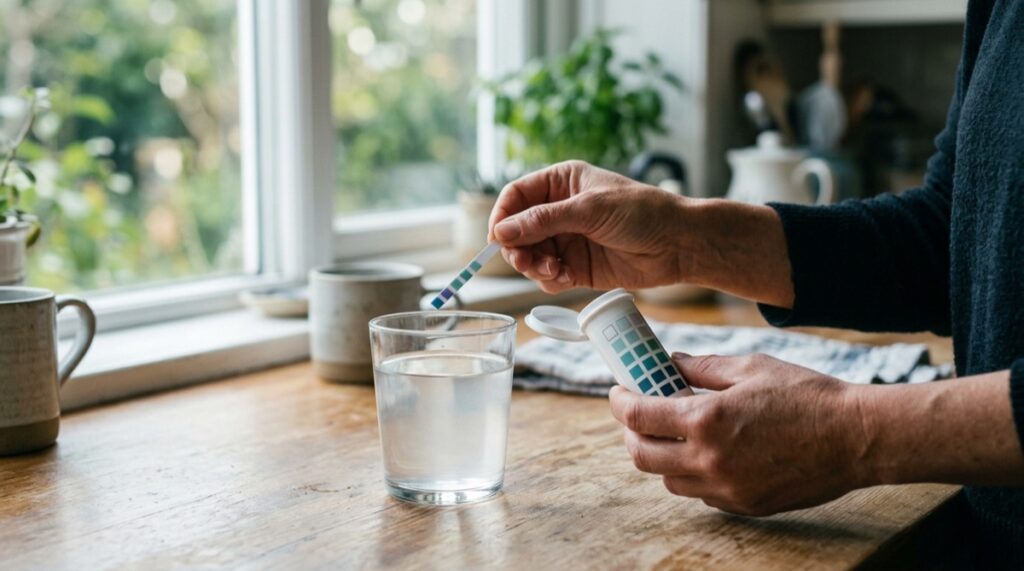
For results you can trust, send your sample to a state-certified (or, in Canada, an accredited) drinking-water laboratory. Hardware-store strip kits can be useful for a quick at-home glance, but they don't carry the accuracy or documentation of a certified lab — and a positive bacteria or nitrate result is not something to guess at.
Your county or state health department is the best starting point: many maintain a list of approved labs, and some help interpret results or even supply sample bottles. Follow the lab's collection instructions exactly, because how you draw and handle the sample affects the reading. Our step-by-step water-quality testing guide walks through choosing a lab, collecting a clean sample, and reading the report.
What common results mean — at a glance
Lab reports list each result against a recommended limit. Here's how to think about the headline findings, in plain terms. Treat this as orientation, not a diagnosis — your health department or a water-treatment professional should help you interpret a specific report.
- Coliform bacteria detected: Worth acting on. It often points to a way for surface water or contamination to enter the well — sometimes a cracked cap, a failing seal, or a nearby source. Retest to confirm, then look at the wellhead and consider disinfection.
- Elevated nitrate: A reason to find the source and avoid using the water for infant formula until it's resolved. Treatment options exist, but identifying where the nitrate is coming from matters.
- High TDS or hardness: Usually a nuisance rather than a health hazard — think scale, spots, or taste. A change from your baseline is the more telling signal.
- pH out of range: Rarely dangerous on its own, but acidic water can corrode pipes (and leach metals from them), while high pH can cause buildup. It's a plumbing-longevity and treatment-tuning issue.
If a result comes back outside the recommended range, don't panic and don't ignore it. Confirm with a retest, ask your health department to help read it, and bring in a licensed well or water professional to inspect the well and recommend a fix.
Keep a record — and know your well
Save every report. A few years of results turns a single snapshot into a trend line, making it far easier to spot when something has genuinely changed. Pair that with your well's basic facts — its depth, age, and construction details. Most wells run 100 to 300 feet deep depending on the local water table, and a well-built well can last 30 to 50 years or more, so the one you have today is likely the one you'll be testing for a long time. If your driller filed a well completion report when the well was built, that document is a useful starting point for the construction details.
Ready to find a licensed well driller?
If a test result points to a wellhead, seal, or construction issue, a licensed driller can inspect the well and put it right. Find vetted, licensed pros near you.

Author: Well Driller Finder Editorial Team
The Well Driller Finder editorial team researches and writes our guides on water-well drilling, pumps, and well water for homeowners across the US and Canada. We translate current cost data, NGWA and state well-construction standards, and EPA and CDC guidance into clear, practical answers. What we stand for: honest, independent help. Every price and claim is researched and fact-checked against multiple 2026 sources — never guessed, never borrowed from a single advertiser. We answer to homeowners, not to the companies we write about, because our only goal is to help you make a confident, well-informed decision about your water.
Find verified, local contractors who handle new installations, pump service, and water quality testing — in your area.