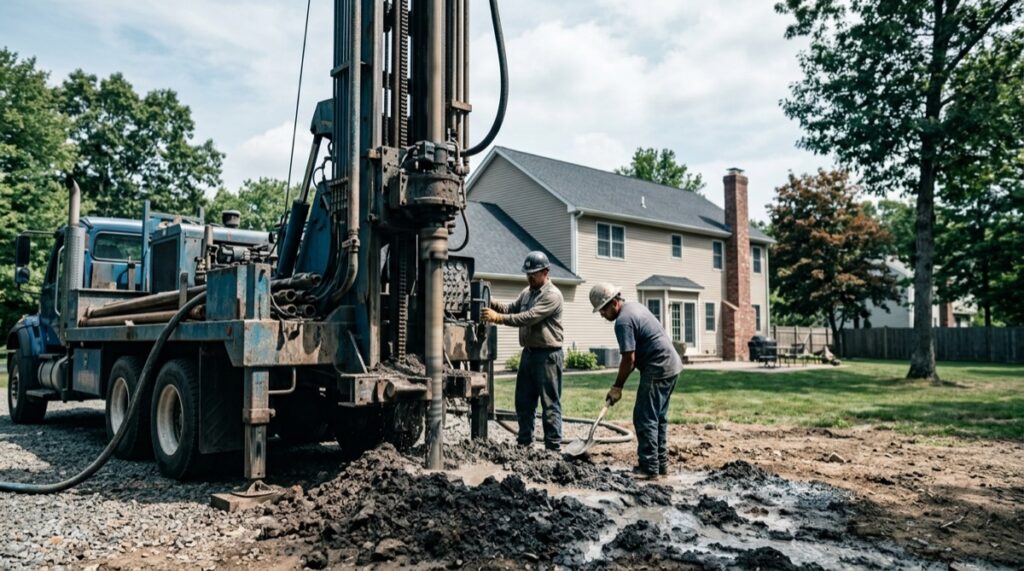
If you are thinking about drilling a new water well, the first question is almost always the same: what is this going to cost? The honest answer is that it depends on how deep you have to drill and what is under your property — but there is a real, useful range. For most homeowners in the US and Canada, a complete new water well costs between $3,000 and $15,000 in 2026, with a national average around $7,500. Most people land in the $5,500–$9,000 band.
How we calculate these figures
Every cost on this page is built from two verifiable inputs, not a single national average copied from a cost-aggregator blog:
- Per-foot drilling rates by ground type — 2025–2026 US market rates for a complete installed system: soft soil/sand $25–$40/ft, sedimentary rock $35–$55/ft, hard rock/granite $55–$85/ft.
- Typical residential well depths — most wells finish between 100 and 300 feet, set by where the local water table sits.
We cross-reference these against the 5,645+ license-verified drillers in our directory to keep the ranges grounded in the markets we actually cover. The cost-by-state table below applies this model to the 21 states and provinces whose governments publish an official typical well depth — so those rows reflect real local depth and geology rather than a national average.
2026 well drilling cost by depth and ground type
Because you pay by the foot, the cleanest way to estimate a well is depth × the per-foot rate for your ground. The table below shows the complete installed system (drilling, casing, pump, pressure tank, wiring, and permits) at common depths. Find your likely depth on the left and your ground type across the top.
| Well depth | Soft soil / sand ($25–$40/ft) |
Sedimentary rock ($35–$55/ft) |
Hard rock / granite ($55–$85/ft) |
|---|---|---|---|
| 100 ft | $2,500–$4,000 | $3,500–$5,500 | $5,500–$8,500 |
| 150 ft | $3,750–$6,000 | $5,250–$8,250 | $8,250–$12,750 |
| 200 ft (typical) | $5,000–$8,000 | $7,000–$11,000 | $11,000–$17,000 |
| 300 ft | $7,500–$12,000 | $10,500–$16,500 | $16,500–$25,500 |
| 400 ft | $10,000–$16,000 | $14,000–$22,000 | $22,000–$34,000 |
| 500 ft | $12,500–$20,000 | $17,500–$27,500 | $27,500–$42,500 |
These are complete-system figures. If you only want the hole in the ground (drilling and casing, no pump or tank), expect roughly $15–$25 per foot — about $3,000–$5,000 for a typical 200-foot well — but you still need the rest of the system before you can turn on a tap. Real quotes vary 20–40% with site access, exact water depth, and local rates, so treat this as a budgeting range, not a firm price.
What actually drives the price
How deep you have to drill
Depth is the single biggest lever on your quote. You pay by the foot, so a well that hits water at 120 feet costs far less than one that has to reach 280 feet. Nobody knows the exact depth until drilling begins, because it is set by where the water table sits under your specific lot — which is why a good driller quotes a per-foot rate plus an estimated depth rather than one flat price.
What is in the ground
The other big driver is geology. Softer ground drills faster and cheaper; hard rock is slow, tough on equipment, and more expensive. Those are the three per-foot bands in the table above — and you do not get to choose which one is under your property, which is why a neighbor’s quote may not match yours.
“Drilling only” vs. a complete system
This is the part of a quote that trips homeowners up most. The drilling itself — boring the hole and setting the casing — is only about 50 to 60 percent of the total bill. A complete, working water system also includes the pump, a pressure tank, the electrical wiring, and any required permits. If a quote looks unusually low, check whether it covers the whole system or just the hole in the ground.
| What you are paying for | Share of the total | Typical 200-ft well |
|---|---|---|
| Drilling & casing | ~50–60% | ~$3,000–$5,000 |
| Pump, pressure tank, wiring, permits | ~40–50% | ~$2,500–$4,000 |
| Complete system | 100% | ~$5,500–$9,000 |
Why costs vary by region
Because depth and geology are the two biggest drivers, and both follow regional patterns, well costs cluster by geography. Wells across New England and the Appalachians often go through crystalline hard rock and finish deeper, pushing costs toward the top of the ranges above. Much of the Great Plains, the Gulf Coast, and the Southeast’s coastal plain sit over softer sedimentary and unconsolidated aquifers that drill faster and shallower. Mountain-West states vary lot by lot. The only way to know your number is a driller who has worked your ground — which is exactly what our directory is for.
2026 well drilling cost by state and province
The table below is built from government well-depth records — state geological surveys, USGS studies, and provincial well databases — not from national averages. The depth figures are sourced; the cost is then worked out as depth × the per-foot rate for that area’s ground type, using the same model as the table above.
Only 21 states and provinces publish a usable typical well depth. That is not an oversight on our part. Most agencies hold hundreds of thousands of individual driller logs but never compute an aggregate figure, and several state plainly that one statewide number would be misleading given how much the geology varies inside their borders. Where no official depth exists, we leave the row out rather than invent one.
| State / province | Estimated cost | Typical depth | Ground |
|---|---|---|---|
| California | $6,800–$11,000 | ~274 ft | Soft soil / sand |
| Connecticut | $20,800–$32,100 | 378 ft | Hard rock |
| Louisiana | $3,000–$4,800 | 120 ft | Soft soil / sand |
| Maine | $13,800–$21,200 | 250 ft | Hard rock |
| Michigan | $2,500–$8,000 | under 200 ft | Soft soil / sand |
| Minnesota | $2,500–$12,000 | 100–300 ft | Soft soil / sand |
| New Hampshire | $22,000–$34,000 | 400 ft | Hard rock |
| Oklahoma | $3,500–$22,000 | 100–400 ft | Sedimentary rock |
| Oregon | $5,100–$17,300 | ~203 ft | Mixed † |
| Pennsylvania | $3,500–$11,000 | 100–200 ft | Sedimentary rock |
| Rhode Island | $8,200–$21,200 | 150–250 ft | Hard rock |
| South Carolina — Coastal Plain | $3,000–$4,900 | 122 ft | Soft soil / sand |
| South Carolina — Piedmont | $16,800–$25,900 | 305 ft | Hard rock |
| Texas | $3,800–$16,500 | 150–300 ft | Mixed † |
| Vermont | $16,600–$25,700 | ~302 ft | Hard rock |
| Wyoming | $7,600–$16,900 | 216–307 ft | Sedimentary rock |
| British Columbia | $3,800–$12,800 | 150 ft | Mixed † |
| New Brunswick | $3,500–$11,000 | 100–200 ft | Sedimentary rock |
| Newfoundland & Labrador | $10,000–$15,400 | 181 ft | Hard rock |
| Nova Scotia | $11,000–$17,000 | 200 ft | Hard rock |
| Ontario | $1,800–$11,000 | 50–200 ft | Sedimentary rock |
| Yukon | $4,800–$16,200 | ~191 ft | Mixed † |
† These jurisdictions span two genuinely different ground types — for example a soft coastal valley on one side and hard mountain bedrock on the other — so the range is correspondingly wide. Which part of the state you are in matters more than the state figure.
Several states run well above the national $3,000–$15,000 range, and that is the point. New Hampshire, Connecticut and Vermont are deep hard-rock states: a 400-foot bedrock well simply costs more than a 120-foot sand well in Louisiana. That gap is exactly what a single national average hides. South Carolina appears twice for the same reason — its coastal plain and its Piedmont are effectively two different markets, roughly $3,000 against roughly $17,000–$26,000.
Why most states are not in this table
We checked every US state and Canadian province against official sources. Thirty-eight publish no statewide typical well depth — their agencies store the individual driller logs but never compute an average, and several note that a single statewide figure would be misleading given the geology inside their borders. We could have filled those gaps with numbers from cost-comparison sites; we did not, because we cannot stand behind them. If your state is not listed, use the depth × ground-type table above together with a depth estimate from a driller who works your ground.
Where to find a license-verified driller
Well Driller Finder lists license-verified drillers in every US state and Canadian province — the same data behind the cost model above. Here are the states and provinces where our coverage is deepest; each links to the verified drillers there, and you can confirm any license directly with the state or provincial board.
| State / province | License-verified drillers | Confirm licensing |
|---|---|---|
| Ontario | 543 | Ontario board → |
| California | 303 | California board → |
| Texas | 171 | Texas board → |
| New York | 158 | New York board → |
| Quebec | 155 | Quebec board → |
| Georgia | 154 | Georgia board → |
| Wisconsin | 149 | Wisconsin board → |
| Minnesota | 146 | Minnesota board → |
| Ohio | 130 | Ohio board → |
| British Columbia | 122 | BC board → |
Browse license-verified drillers in all 50 states and 10 provinces →
Don’t forget the pump — now and later
The pump is part of any new complete system, but it is also the main thing you will replace down the road. A well pump generally lasts 8 to 15 years, while the well itself can serve 30, 40, or 50-plus years. When the pump eventually needs replacing, expect roughly $976 to $2,825, with about $1,900 being typical — deeper wells cost more to service because there is more pump and pipe to pull. See our well pump replacement cost guide for the full breakdown.
What about a geothermal loop well?
Some property owners drill not for drinking water but for a geothermal heating and cooling loop. The economics are different: a vertical geothermal borehole typically costs $8 to $40 per foot to drill depending on the ground, and a system needs roughly 150 to 200 feet of bore per ton of heating and cooling capacity. As with a water well, drilling is the lion’s share of the loop cost — about 50 to 70 percent — but the exact design depends on your home, climate, and soil, so this is a conversation for a qualified installer.
How to get an accurate number for your property
National ranges are a sanity check, not a quote. Because the two biggest cost drivers — depth and geology — are specific to your lot, the only way to get a real figure is to involve someone who knows the ground locally. A few practical steps:
- Get a per-foot rate plus an estimated depth. That tells you far more than a single lump-sum number and lets you compare quotes fairly.
- Confirm what is included. Make sure the quote covers the complete system — casing, pump, pressure tank, wiring, and permits — not drilling alone.
- Ask a licensed local driller. They have likely drilled nearby and can estimate your likely depth and ground type.
- Budget for permits and testing. Most states and provinces require a well-construction permit, and you will want your water tested by a certified lab once the well is in.
To turn the ranges above into a ballpark for your situation, try our well drilling cost estimator. When you are ready for a firm price, the next step is talking to a licensed driller who works in your area.
Ready to find a licensed well driller?
Skip the national averages and get a real quote from a driller who knows the ground — and the water table — in your area.
Frequently asked questions
How much does it cost to drill a well in 2026?
A complete residential water well costs about $3,000 to $15,000 in the US and Canada, with a national average near $7,500 and most homeowners paying $5,500 to $9,000. The total depends mostly on drilling depth and ground type — roughly $25 to $85 per foot for a complete installed system.
Is the quote for drilling only or a complete system?
Always check. Drilling and casing are only about 50 to 60 percent of the bill; a complete working system also includes the pump, pressure tank, wiring, and permits. Drilling-only runs about $15 to $25 per foot, versus $25 to $85 per foot for the complete system.
How much does it cost to replace a well pump?
Well pump replacement typically costs $976 to $2,825, with about $1,900 being typical. Deeper wells cost more because there is more pump and pipe to pull and replace.
Why is my well quote different from my neighbor’s?
Depth and geology are set by your specific lot. A home a few miles away can hit water at a different depth or drill through harder rock, which changes the per-foot rate and the total.

Author: Well Driller Finder Editorial Team
The Well Driller Finder editorial team researches and writes our guides on water-well drilling, pumps, and well water for homeowners across the US and Canada. We translate current cost data, NGWA and state well-construction standards, and EPA and CDC guidance into clear, practical answers. What we stand for: honest, independent help. Every price and claim is researched and fact-checked against multiple 2026 sources — never guessed, never borrowed from a single advertiser. We answer to homeowners, not to the companies we write about, because our only goal is to help you make a confident, well-informed decision about your water.
Find verified, local contractors who handle new installations, pump service, and water quality testing — in your area.
Compare cost, depth and permit rules by state or province
These pages combine the national model with local government records and the contractor directory.