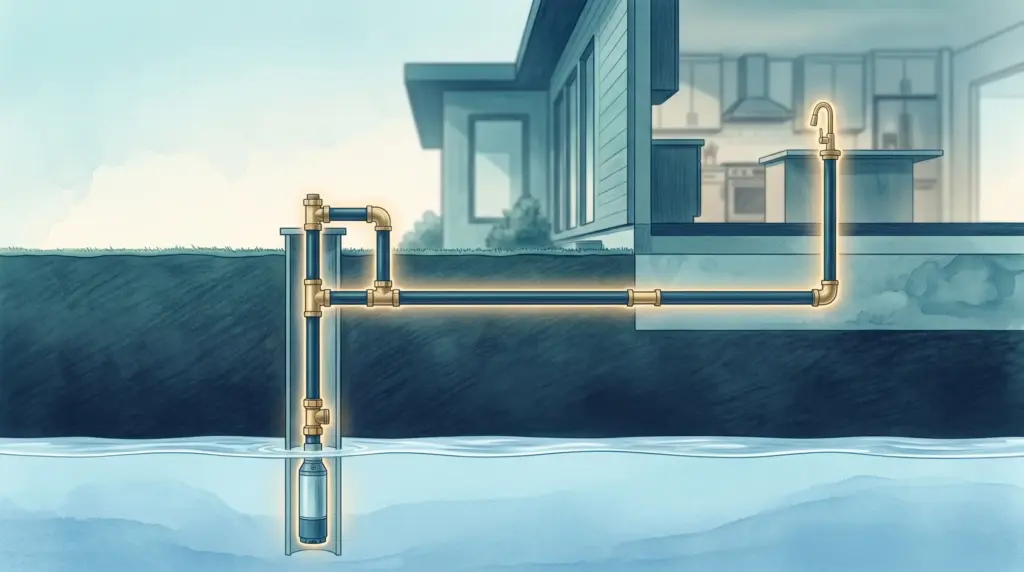
If a water test comes back showing lead, the first instinct is to blame the well — something down in the ground, in the aquifer, leaching poison into your family's drinking water. It's an understandable fear, and it's almost always wrong. Lead is rarely a groundwater problem. In a U.S. Geological Survey study of more than 8,300 private wells, fewer than 1% of untreated samples contained dissolved lead above the EPA's limit. In the overwhelming majority of private wells, the lead isn't coming up from the aquifer at all. It's coming down into your glass from your own plumbing — the solder in the joints, the brass in the faucet, sometimes the pump itself.
That distinction matters enormously, because it changes everything about how you find the problem and how you fix it. A contaminated aquifer is an expensive, sometimes near-hopeless situation. A leaching plumbing system is a known, solvable problem with a clear playbook. This guide walks through where well-water lead actually comes from, why corrosive water is usually the real culprit, how a simple two-bottle test pinpoints the source, who is most at risk, and exactly what to do about it.
joints in homes built before 1986
pre-2014 brass held up to 8% lead
dissolves lead out of all of it
The aquifer is almost never the source
Lead is a metal that occurs naturally in rocks and soil, so it's reasonable to wonder whether it can dissolve into groundwater. In practice, it almost never reaches harmful levels that way. Geologic lead tends to be locked up in mineral forms that don't readily dissolve. The U.S. Geological Survey, summarizing its national sampling, found that groundwater at the wellhead is rarely a source of high lead in drinking water — the lead is almost always somewhere in the plumbing system, and what the groundwater contributes is the corrosive chemistry that pulls it out. The Virginia Department of Health puts it even more directly in its overview of lead in private well water: the natural presence of lead in groundwater "tends to be very small and generally non-detectable."
The U.S. EPA reaches the same conclusion for drinking water generally. According to the EPA's basic information on lead in drinking water, lead enters water primarily through corrosion — "a dissolving or wearing away of metal caused by a chemical reaction between water and your plumbing." The common sources it lists are lead pipes, brass or chrome-plated brass faucets, and lead solder. Notice what's not on that list: the water source itself.
Penn State Extension puts it just as plainly in its overview of lead in drinking water: "The most common source of lead in water is lead service lines and household plumbing." For a homeowner, that's good news disguised as a scary test result. Your well water likely arrived at your house lead-free. Something between the well and the tap is adding it.
Where the lead actually comes from
If your plumbing is adding lead, it's coming from one of a handful of well-known places. The age of your home is the single biggest clue.
- Lead solder (pre-1986 homes). For decades, copper pipes were joined with solder that was roughly half lead. The 1986 amendments to the Safe Drinking Water Act banned lead pipes and lead-bearing solder — but homes plumbed before that ban can still have old solder at every joint. This is the most common culprit in older houses on wells.
- Brass fixtures, valves, and fittings. Here's the trap that catches even newer homes: for years, fixtures could be sold as "lead-free" while containing up to 8% lead by weight. The Reduction of Lead in Drinking Water Act tightened the federal "lead-free" definition to a weighted average of no more than 0.25% lead across wetted surfaces — but that requirement only took effect on January 4, 2014. So a faucet, valve, or pressure-tank fitting installed before 2014 — even one labeled "lead-free" at the time — can still leach lead. Brass is especially prone to releasing tiny particles of lead.
- The well pump and components. This is the one most homeowners never think of. The CDC specifically notes that corrosive groundwater "can damage the pumps of wells and cause lead to leach into water," along with pipes, fixtures, and solder. Older submersible and jet pumps, drop pipe, and check valves can all contribute.
- A lead service line. Less common on private wells than on city systems, but if any run of lead pipe exists between the well and the house, it's a prime suspect — and it tends to show up across all samples, not just the first draw.
The thread tying all of these together is the same: the lead is sitting in your plumbing, waiting. What pulls it into the water is the chemistry of the water flowing past it.
Corrosive, acidic water is the trigger
Lead components don't release lead on their own. They need aggressive, corrosive water to dissolve and wear them away — and corrosive water is exactly what a lot of private wells produce. Water with low pH (acidic) or low mineral content (soft water) is chemically "hungry," and it pulls metal off the inside of pipes and fittings as it sits.
This isn't a rare edge case. A USGS analysis of more than 20,000 wells found that 25 states and the District of Columbia have groundwater with a high or very high potential to be corrosive, concentrated in the Northeast, Southeast, and Northwest. In a related sampling of more than 8,300 wells, about one-third had groundwater chemistry corrosive enough to leach lead from plumbing — if lead was present — at levels above the EPA action level. That's the precise mechanism behind most well-water lead: corrosive water plus old plumbing.
If your water is acidic, you may already have hints: blue-green staining on sinks and tubs (that's copper leaching), a metallic taste, or pinhole leaks in copper pipe. Those are warning signs that lead components, if present, are likely leaching too. Our overview of well water treatment options covers the testing and the neutralizer systems that fix corrosive water in depth — and it's worth reading alongside this article, because raising your water's pH is often the single most effective thing you can do about lead.
The limit: 15 ppb today, no safe level for kids
The number you'll see referenced most often is the EPA's lead action level of 15 parts per billion (ppb). It's important to understand what that number is — and what it isn't. The action level is a regulatory trigger for public water systems, not a line below which lead is "safe." Under the 2024 Lead and Copper Rule Improvements, the EPA is lowering that action level to 10 ppb, with compliance required by November 1, 2027. Either way, these are thresholds for utilities; private wells aren't covered by them at all, which is exactly why testing your own water is on you.
For health, the only honest number is zero. The EPA has set the Maximum Contaminant Level Goal (MCLG) for lead at zero, and the CDC states flatly that "no safe levels of lead exposure for children have been identified." Lead is a cumulative toxin — it builds up in the body over time — so the goal isn't to get under 15 ppb. The goal is to get as close to none as you reasonably can, especially if children or a pregnant person live in the home.
| Benchmark | Value | What it means |
|---|---|---|
| EPA action level (current) | 15 ppb | Regulatory trigger for public systems; not a health-based safe level |
| EPA action level (from Nov 2027) | 10 ppb | Lowered under the Lead and Copper Rule Improvements |
| EPA health goal (MCLG) | 0 ppb | The only level with no expected risk |
| NSF/ANSI 53 & 58 filter pass/fail | ≤ 5 ppb | Certified filters must reduce lead below this, tested against 150 ppb water |
The two-bottle test that finds the source
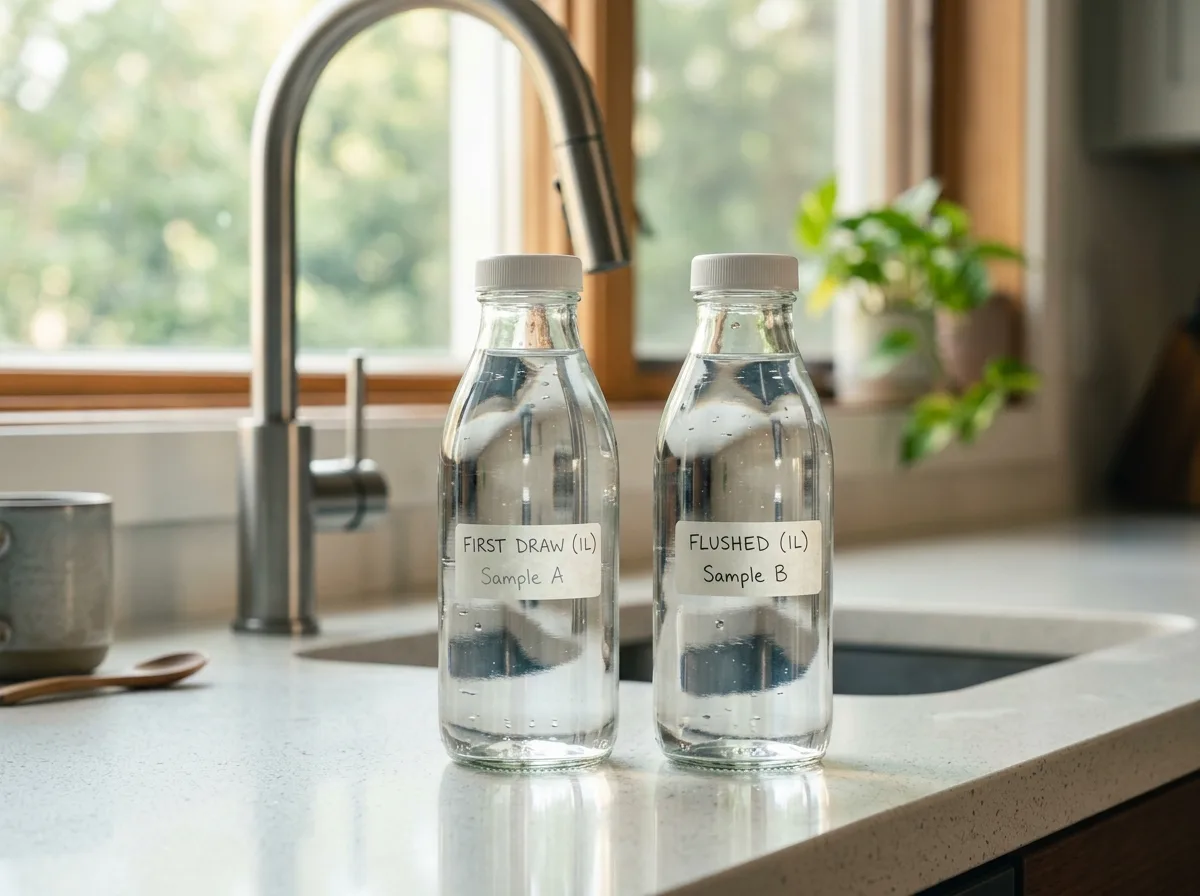
Here's where the homeowner gets a genuinely useful tool. Because lead leaches from plumbing during the hours water sits still, you can pinpoint the source with a paired sample — a first-draw bottle and a flushed bottle, both from the same tap. This is the single most diagnostic thing you can do, and it costs the price of one extra test bottle.
- First-draw sample. Collected first thing in the morning (or after at least 6 hours of no water use anywhere in the house), straight from the cold tap before running any water. This captures the water that sat overnight against your pipes, solder, and fixtures — the worst-case plumbing exposure.
- Flushed sample. Collected from the same tap after running the cold water for a minute or two, so you're sampling water that came more directly from the well and pressure tank, with less plumbing contact.
Now read the two results together:
- High first-draw, low flushed → classic plumbing problem. The lead is leaching from your home's pipes, solder, or fixtures while water sits. This is the most common pattern, and it's the most fixable.
- Lead in both, including the flushed sample → the source is further upstream — a lead service line, the drop pipe, or the pump itself, and in rare cases the source water. This points to a bigger fix, but it's still plumbing/hardware, not the aquifer.
- Both low → no meaningful lead problem at that tap.
One technical note that trips people up: don't remove the aerator or pre-flush the night before, and use cold water only. Hot water dissolves lead faster, which is why the EPA says to never use hot tap water for drinking, cooking, or making formula — and boiling does nothing, it only concentrates the lead as water evaporates. For the full step-by-step on collecting a clean sample and choosing an accredited lab, see our guide on how to test your well water.
Who is most at risk
Lead is harmful to everyone, but the stakes are highest for the youngest members of the household.
Infants and young children. A child's developing brain and nervous system are uniquely vulnerable. The EPA links childhood lead exposure to lower IQ, hyperactivity, behavior and learning problems, slowed growth, and hearing problems. The exposure math is especially stark for bottle-fed babies: the EPA estimates that infants who drink mostly formula can get 40% to 60% of their lead exposure from drinking water, because they consume so much water relative to their tiny body size. The CDC echoes this — infants on formula made with contaminated tap water are at higher risk for exactly that reason.
Pregnant people and the fetus. Lead crosses the placenta. The EPA associates prenatal lead exposure with reduced fetal growth and premature birth, which is why anyone pregnant in the home should treat a lead result as urgent.
Adults. The risks don't vanish with age. In adults, the EPA links lead to increased blood pressure and cardiovascular effects, and to decreased kidney function.
If you have an infant, are pregnant, or have young children and your water hasn't been tested for lead, that's the case for moving it to the top of the list — and using bottled or certified-filtered water for formula and drinking in the meantime.
How to fix it
The right fix depends on what your two-bottle test told you. There are four levers, often used together.
1. Stop the corrosion (raise the pH)
If your water is acidic and corrosive, treating the corrosivity attacks the root cause — it stops new lead from being pulled into the water in the first place. The standard solution for a private well is an acid-neutralizing filter (a tank of calcite or a calcite/magnesia blend) or a soda ash (sodium carbonate) injection system, sized to your flow and installed where water enters the house. Both raise pH above 7.0 so the water stops dissolving metal. This is whole-house corrosion control, and it's the same approach covered in our well water treatment options overview.
2. Replace the lead-bearing components
If the test points to specific hardware — a leaded brass faucet, a stretch of lead-soldered copper, an old pump or fitting — replacing those parts with truly lead-free components (look for the NSF/ANSI 372 mark, the ≤0.25% lead standard) permanently removes that source. For a pre-1986 home with lead solder throughout, this can mean re-plumbing key runs, but even swapping the kitchen faucet and the most-used fixtures makes a real dent.
3. Install a certified filter at the tap
For immediate, reliable protection at the kitchen sink, use a filter certified to NSF/ANSI Standard 53 for lead reduction — and, for a reverse-osmosis system, NSF/ANSI Standard 58. These certifications aren't marketing fluff: certified units are tested against challenge water containing 150 ppb of lead (ten times the EPA action level) and must bring it down to 5 ppb or less to pass. Reverse osmosis is one of the most effective options for lead and a long list of other contaminants. We cover whether it's the right call for a private well in is reverse osmosis worth it for well water. Whatever you choose, confirm "lead" is explicitly listed on the package, and replace cartridges on schedule — a spent filter stops protecting you.
4. Flush before you drink (the free interim step)
Until a permanent fix is in place, you can sharply cut your exposure for free. Because lead accumulates while water sits, the CDC recommends flushing each tap for 1 to 2 minutes before using it for drinking or cooking, especially first thing in the morning. Always draw from the cold tap, and never make baby formula with hot tap water. Flushing is a stopgap, not a cure — but it bridges the gap while you arrange testing and treatment.
If you're buying a home with a well
A well inspection during a home purchase is the ideal moment to catch a lead problem before it becomes your problem. A pre-1986 house, original brass fixtures, or visibly corroded copper with blue-green staining are all reasons to insist on a lead test — ideally the paired first-draw and flushed samples described above — as part of the inspection. Our guide to buying a home with a well walks through what a thorough well inspection should include, and lead testing belongs on that list. Catching it now gives you leverage to negotiate the cost of corrosion control or re-plumbing rather than inheriting it silently.
The bottom line
Lead in well water is a real and serious risk — but it's a plumbing problem wearing an aquifer's clothing. The water came out of the ground clean in nearly every case; the lead is added on the way to your tap by old solder, leaded brass, or an aging pump, and it's pulled into the water by corrosive, acidic conditions. That framing is empowering, because every part of it is fixable: test with a paired first-draw and flushed sample to find the source, neutralize corrosive water to stop the leaching, replace the leaded parts, and put a certified filter at the tap your family drinks from.
The one thing you can't skip is testing — lead is invisible, tasteless, and odorless, and no private well is monitored for you. If your results show lead, or your water is acidic and corrosive, a licensed local well contractor can identify exactly which components are at fault and install the right corrosion control or treatment for your system. Compare what these fixes typically cost, then get free quotes from licensed well professionals in your area — it's the fastest way to turn a scary test result into a solved problem.
Frequently Asked Questions
Can lead come from the well or aquifer itself?
Rarely. The USGS and EPA both identify plumbing — lead solder, brass fixtures, lead pipe, and well pumps — as the source in nearly all cases; in one USGS study of 8,300+ wells, fewer than 1% of untreated samples had dissolved lead above the EPA limit. Groundwater itself usually isn't a lead source; what it provides is corrosive chemistry that leaches lead out of plumbing. If your flushed sample (taken after running the tap) is also high in lead, the source is somewhere in your hardware, such as a lead service line or the pump, not typically the aquifer.
What is a safe level of lead in drinking water?
For health, there is no known safe level — the EPA's health goal (MCLG) for lead is zero, and the CDC states no safe level of lead exposure for children has been identified. The EPA's 15 ppb action level (dropping to 10 ppb by November 2027) is a regulatory trigger for public water systems, not a safety threshold, and it doesn't legally apply to private wells at all.
How do I test my well water for lead?
Use an accredited lab and, ideally, collect two samples from the same cold tap: a first-draw sample after at least 6 hours of no water use (which captures plumbing leaching) and a flushed sample after running the water 1–2 minutes (which reflects the well and pressure tank). Comparing the two pinpoints whether the lead is from your plumbing or further upstream. See our guide on how to test your well water for the full procedure.
Does a water softener remove lead?
Not reliably, and it's not designed to. A standard ion-exchange softener targets hardness minerals like calcium and magnesium. For lead, you want a point-of-use filter certified to NSF/ANSI Standard 53, or a reverse-osmosis unit certified to NSF/ANSI Standard 58. If corrosive water is the root cause, an acid-neutralizing system addresses why the lead is leaching in the first place.
Is it safe to boil well water to remove lead?
No. Boiling does not remove lead — it actually concentrates it slightly as water evaporates. Always use cold tap water for drinking, cooking, and baby formula, since hot water dissolves more lead, and rely on a certified filter or treatment system rather than boiling.
Why are infants most at risk from lead in water?
Infants drink a large volume of water relative to their small body size, and their nervous systems are still developing. The EPA estimates that babies fed mostly formula can receive 40% to 60% of their total lead exposure from the water used to mix it. If you have an infant and unconfirmed water, use bottled or certified-filtered water for formula until you've tested and, if needed, treated your water.

Author: Well Driller Finder Editorial Team
The Well Driller Finder editorial team researches and writes our guides on water-well drilling, pumps, and well water for homeowners across the US and Canada. We translate current cost data, NGWA and state well-construction standards, and EPA and CDC guidance into clear, practical answers. What we stand for: honest, independent help. Every price and claim is researched and fact-checked against multiple 2026 sources — never guessed, never borrowed from a single advertiser. We answer to homeowners, not to the companies we write about, because our only goal is to help you make a confident, well-informed decision about your water.
Find verified, local contractors who handle new installations, pump service, and water quality testing — in your area.