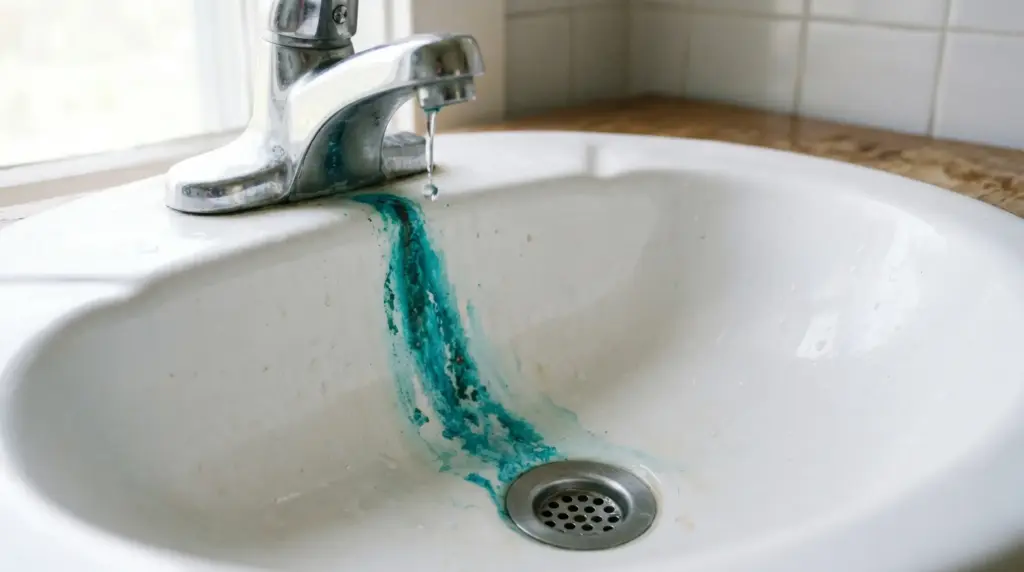
If you keep finding blue-green stains in your sink, bathtub, or toilet bowl - or you've had a plumber out for a mysterious pinhole leak in a copper pipe - your well water is trying to tell you something. The most common culprit is acidic, low-pH water: water that is mildly corrosive and slowly dissolving the metal in your plumbing.
It's an easy problem to ignore, because the water usually looks clear and tastes fine (or just slightly metallic). But corrosive water doesn't sit still. Over years it leaches copper and lead from your pipes, fittings, and water heater, stains your fixtures, and eventually punches tiny holes through copper line that can flood a wall or ceiling. The good news: it's one of the most fixable problems in private-well ownership, and the fix is mechanical and predictable once you know your numbers.
This guide walks through what "acidic water" actually means, the tell-tale signs, the EPA's pH guideline and why below roughly 6.5 matters, the copper-and-lead health angle, exactly how to confirm it with a test, and the two proven treatment paths - a calcite neutralizer tank versus soda-ash injection - and when to use which.
What "acidic" or "low-pH" well water actually means
pH is a 0-14 scale that measures how acidic or alkaline water is. Seven is neutral; below 7 is acidic, above 7 is alkaline (basic). The U.S. EPA lists pH under its Secondary Drinking Water Standards with a recommended range of 6.5 to 8.5. These secondary standards are non-enforceable guidelines for "nuisance" qualities - taste, color, staining, and corrosion - rather than direct health limits. The EPA specifically lists "bitter metallic taste" and corrosion as the effects of low pH.
Here's the part that trips people up: the water itself is rarely the thing harming you. Low-pH water is "hungry" - chemically, it wants to grab ions from whatever it touches. As it sits in and flows through your copper pipes, brass fittings, galvanized steel, and the steel tank of your water heater, it dissolves tiny amounts of those metals and carries them to your tap. So the real issue with acidic water is what it picks up on the way to your glass.
One important nuance from Penn State Extension: pH alone doesn't tell the whole story. Corrosivity also depends on calcium concentration, hardness, total dissolved solids (TDS), and temperature. Soft, low-mineral, acidic water - common in granite and sandstone aquifers and in areas with lots of rainfall - is the most aggressive combination. Penn State notes that the generally accepted measures of water corrosivity are saturation or stability indices (like the Langelier Saturation Index), not just a single pH reading. In plain terms: a pH of 6.4 in very soft water can be more damaging than the same pH in mineral-rich water. But for homeowners, pH is the practical, affordable first number to check, and it correlates strongly with the staining and pipe damage you're seeing.
The tell-tale signs of acidic water
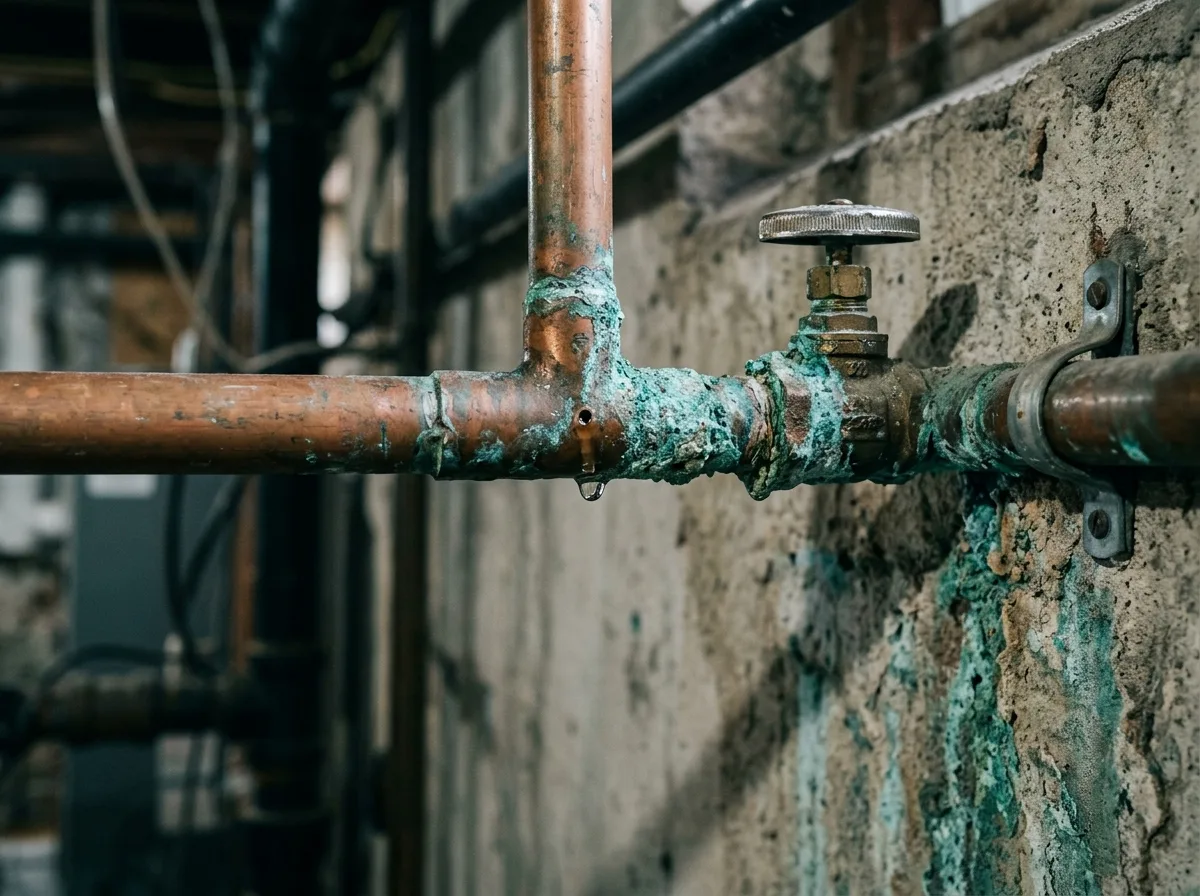
Corrosive water leaves a remarkably consistent fingerprint. If you have several of these, low pH is the prime suspect:
- Blue-green stains on sinks, tubs, showers, and toilet tanks. This is dissolved copper from your pipes, deposited as the water evaporates. The EPA flags "blue-green staining" as the signature effect of copper above its secondary limit. It's the single most common reason homeowners discover they have acidic water.
- Rust or reddish-orange stains if you have galvanized steel or iron in your system - that's iron and steel corroding rather than copper.
- Pinhole leaks in copper pipe. Acidic water corrodes copper from the inside out, and over years it can perforate the wall of a pipe. These leaks are tiny but relentless and often show up first as a water stain on a ceiling or a green crust on a pipe joint.
- A metallic or bitter taste, often strongest in the "first water in the morning" - water that sat in your pipes overnight has the most time to dissolve metal. Penn State lists this morning-metallic-taste pattern as a classic corrosive-water symptom.
- Frequent fixture and appliance failures - faucets, valves, water-heater elements, and the heater tank itself wearing out faster than they should. If you're replacing a water heater every 5-6 years instead of every 10-12, corrosivity is a likely accomplice.
- Green or blue-green crust (verdigris) building up on pipe joints, shut-off valves, and fittings.
Sulfur-rotten-egg odor and hard-water scale are separate problems with their own causes - if those are your main complaints, see sulfur smell in well water and hard water and iron. It's entirely possible to have acidic water and hardness or iron at the same time, which is why a full test matters.
- •Best for pH about 6.0–6.9
- •Raises pH as water passes through
- •Adds ~4–6 grains/gal of hardness
- •No power needed
- •Roughly $1,200–$1,900 + install
- •The choice for pH below ~6.0
- •A small metering pump doses soda ash
- •Adds no hardness
- •Needs power + monthly refill
- •Handles very corrosive water
The health angle: copper, lead, and your plumbing
This is where acidic water stops being just a cosmetic and plumbing nuisance. The metals corrosive water dissolves end up in the water you drink and cook with.
Copper. The EPA's secondary limit for copper, set for taste and staining, is 1.0 mg/L. Its health-based benchmark under the federal Lead and Copper Rule is an action level of 1.3 mg/L (1,300 micrograms per liter). According to the Minnesota Department of Health and the CDC's ATSDR, drinking water with too much copper can cause short-term gastrointestinal effects - nausea, vomiting, abdominal pain, and diarrhea - and, with long-term high exposure, liver and kidney damage. Visible blue-green staining is a signal that your copper levels may be elevated, because that stain is the copper coming out of solution.
Who's most vulnerable. Infants under one year and people with Wilson's disease or other liver conditions can't clear excess copper from their bodies as easily, so they're more sensitive to it. That's why the Minnesota Department of Health advises using cold tap water - run for 30 to 60 seconds if the tap has sat unused for more than six hours - for drinking, cooking, and especially for mixing baby formula, since hot and standing water pulls more copper out of corroded plumbing.
Lead. This is the quiet one. Acidic water doesn't just leach copper - it also dissolves lead from older solder joints, brass fittings, and fixtures. Under federal law, lead solder in plumbing wasn't banned until the 1986 Safe Drinking Water Act amendments, so homes built before the late 1980s often have lead solder in their copper joints; and per the EPA, "lead-free" brass could legally contain up to 8% lead until the standard tightened to 0.25% in 2014. There is no safe level of lead in drinking water, and infants and young children are the most at risk. If your water is corrosive, lead belongs on your test list even if you've never thought about it - your results will tell you exactly where you stand.
The scale of the issue is bigger than most well owners realize. A 2016 USGS study of more than 20,000 wells nationwide found that groundwater in 25 states has a high or very high potential to be naturally corrosive, with the most affected areas clustered in the Northeast, Southeast, and Northwest. In a closer look at roughly 8,300 of those wells, the USGS found that about one-third had water chemistry capable of leaching lead - if lead is present in the plumbing - above the EPA's action level. With roughly 44 million Americans relying on private wells that aren't routinely tested or treated, the USGS concluded that "prudent, routine testing of the water" is the key safeguard - because, unlike a city customer, a well owner is their own water utility.
How to confirm it: testing pH and copper
Don't treat blind. The fixes for acidic water differ depending on how low your pH actually is, and you want a baseline number before and after you install anything. Here's how to get reliable answers.
Test pH. A certified lab test is the gold standard, but pH is one of the few parameters where a decent home test strip or digital pH meter gets you in the ballpark for an initial screen. One catch: pH can drift after water is exposed to air, so for an accurate number, test promptly or have a lab measure it. If you're sending a kit to a lab, ask for pH plus a corrosion panel that includes copper, lead, hardness, alkalinity, and total dissolved solids - those together tell you not just that the water is corrosive but how corrosive.
Test copper the right way - first-draw vs. flushed. Copper testing has a clever trick built in. Per the Connecticut Department of Public Health, collect a first-draw sample - the very first water out of a cold tap that has sat unused for at least six hours, before any water runs. Then run the tap and collect a second flushed sample. Comparing the two tells you the source:
- If the first-draw copper is much higher than the flushed sample, the copper is coming from corrosion of your household plumbing - pipes, solder, fittings. This is the classic acidic-water signature, and a neutralizer will fix it.
- If both samples are nearly equal, the copper is likely coming from outside the house - the well, pump, or source water itself - which points to a different solution.
For the full step-by-step on collecting samples and choosing a certified lab, see our guide on how to test your well water. As a baseline, the USGS and state health departments recommend private-well owners test at least annually for bacteria, nitrate, and pH, and more often if you notice changes like new staining or a metallic taste.
Fix #1: A calcite acid-neutralizer tank (the workhorse)
For the large majority of homes with mildly acidic water - roughly pH 6.0 to 6.9 - a calcite neutralizer tank is the standard, low-fuss fix. It's a tank filled with calcite media (crushed calcium carbonate - the same mineral in limestone and antacid tablets). As acidic water passes through, it slowly dissolves the calcite, which raises the pH and reduces corrosivity. No electricity, no chemicals, no metering pump.
Penn State Extension describes the trade-off plainly: a neutralizing filter "will increase the hardness of the water, but this is necessary for proper corrosion control." That's the key thing to understand - calcite raises pH by adding calcium, which adds hardness. Most homes see hardness climb by a few grains per gallon (commonly in the 4-6 range). If your water was already hard, you'll likely want a water softener installed after the neutralizer to take that hardness back out. (More on the order below.)
What homeowners like about calcite systems:
- Self-adjusting. The more acidic the water, the faster the calcite dissolves, so the system naturally responds to your water's aggressiveness.
- Simple upkeep. When the media gets low, you pour another bag in the top. Most homes use 1-3 bags a year.
- Long-lived. With no pump to fail, the tank itself can last decades.
Limits to know. Calcite struggles when water is very acidic - the common rule of thumb is that calcite is effective down to about pH 6, and below that it can't dissolve fast enough to fully correct the water. (A blended media that adds a magnesium-oxide product like Corosex or Flomag extends the range lower, but at the cost of overshooting pH if it isn't dialed in.) Calcite tanks also need periodic backwashing in many configurations to prevent the media from packing down and channeling.
Fix #2: Soda-ash (or caustic) injection for very low pH
When your water is strongly acidic - generally below about pH 6.0 - a chemical-feed system is the better tool. A small metering pump injects a solution of soda ash (sodium carbonate) into the line whenever the well pump runs, raising pH on the spot. Penn State notes soda ash is "preferred over sodium hydroxide because it is safer to handle."
The big advantages over calcite:
- It can handle very low pH that calcite simply can't keep up with, and you can dial the dose to hit a precise target.
- It does not add hardness. Because you're not dissolving calcium, soft water stays soft - so if your water is already soft, soda ash avoids the hardness penalty a calcite tank carries.
The trade-offs: a chemical-feed system has more moving parts. You mix and refill the soda-ash solution tank regularly (typically monthly), and the metering pump is a wear item that generally needs replacing every several years. It also needs power and a little more attention than a "pour-a-bag-in" calcite tank.
Calcite tank vs. soda-ash injection: which one?
Here's the decision at a glance, based on Penn State Extension guidance and standard industry practice:
| Factor | Calcite neutralizer tank | Soda-ash injection |
|---|---|---|
| Best pH range | ~6.0-6.9 (mildly acidic) | Below ~6.0 (the choice for very low pH) |
| Adds hardness? | Yes - commonly a few grains per gallon | No |
| Power / pump needed? | No moving parts (may backwash) | Yes - metering pump and solution tank |
| Routine upkeep | Refill media 1-3 bags/year | Mix and refill solution ~monthly |
| Wear items | Minimal; tank lasts decades | Pump replaced periodically |
| pH precision | Self-adjusting, less precise | Dialed to a target |
| Indicative system cost | ~$1,200-$1,900 + install | Comparable; more ongoing labor |
Rule of thumb: if your pH is in the 6.0s and you don't mind (or already manage) some hardness, a calcite tank is the simpler, longer-lived, lower-attention choice. If your pH is below about 6.0, or you specifically want to avoid adding any hardness, soda-ash injection is worth the extra maintenance. A reputable local water-treatment pro or driller will size the system to your pH, flow rate, and number of bathrooms - undersizing is the most common reason a neutralizer underperforms.
The order of equipment matters (don't put the softener first)
If you're combining a neutralizer with other equipment, sequence is not optional. The correct order is acid neutralizer first, then any iron filter, then the water softener. Two reasons:
- Softened acidic water is even more corrosive. A softener swaps calcium and magnesium for sodium but doesn't change pH - and removing those buffering minerals from already-acidic water can make it more aggressive on your pipes, not less. Raise the pH first.
- Other media work better at neutral pH. Iron filters and softener resin both perform and last better at pH 7 or above, so neutralizing up front protects the rest of your system.
For how a softener fits into the bigger picture of treating well water, see our overview of well water treatment options.
What it costs and what to expect
For a typical home, a quality whole-house calcite acid-neutralizer system runs about $1,200 to $1,900 for the equipment, plus roughly $200 to $500 for professional installation (many homeowners install upflow tanks themselves). Ongoing media refills are modest - on the order of $145 to $435 per year depending on how acidic your water is and how much you use, since more aggressive water dissolves calcite faster.
Soda-ash systems land in a similar equipment range but carry more ongoing labor (mixing solution) and a periodic pump replacement. If you'll also need a softener to handle the added hardness from a calcite system, budget for that as a separate piece of equipment. These are real, lasting investments - but set against repeated pinhole-leak repairs, premature water-heater replacements, ruined fixtures, and the health risk of dissolved copper and lead, neutralizing the water is almost always the cheaper path over time. For broader plumbing-and-well budgeting context, see our well drilling cost guide and the calculators in our tools section.
The bottom line
Blue-green stains and pinhole leaks aren't random bad luck - they're your well water telling you it's acidic and slowly eating your plumbing. The pattern is consistent, the testing is straightforward, and the fix is well-established: confirm your pH and copper with a first-draw lab test, then install a calcite neutralizer for mildly acidic water or a soda-ash injection system for very low pH, in the right order relative to any softener. Do that, and you stop the staining, protect your pipes and water heater, and shut down the copper-and-lead pathway into your drinking water.
If your numbers come back acidic and you'd rather not guess at sizing - or you suspect you also have hardness, iron, or older lead-bearing plumbing in the mix - it's worth having a licensed local well or water-treatment professional look at your specific setup. They can size the system correctly the first time and get the equipment order right. When you're ready, you can compare licensed local drillers and request free quotes through Well Driller Finder - no obligation, just a straight answer from someone who knows your region's water.
Frequently Asked Questions
What pH is too low for well water?
The EPA's recommended secondary range is 6.5 to 8.5. Below about 6.5 the water is considered corrosive - the EPA specifically lists a "bitter metallic taste" and corrosion at low pH. Water in the high 5s to low 6s commonly causes blue-green staining and copper leaching; water below about pH 6.0 is strongly acidic and usually warrants a chemical-feed (soda-ash) system rather than a simple calcite tank.
Are blue-green stains in my sink dangerous?
The stains themselves are dissolved copper from your pipes and are a strong signal that your copper levels may be elevated. The EPA's secondary limit for copper is 1.0 mg/L and its health-based action level is 1.3 mg/L. High copper can cause nausea, vomiting, abdominal pain, and diarrhea short-term, and liver or kidney damage with long-term exposure. Infants under one year and people with Wilson's disease are most sensitive. The staining is a cue to test your water for copper - and for lead, which acidic water can also dissolve.
Will a water softener fix acidic water?
No. A softener removes hardness (calcium and magnesium) but does not raise pH. In fact, softening already-acidic water can make it more corrosive to your pipes. You need an acid neutralizer or soda-ash injection to raise the pH, and if you also have hardness, the softener goes after the neutralizer - never before it.
Does a calcite neutralizer make my water hard?
Yes, modestly. Calcite raises pH by dissolving calcium carbonate into the water, which adds hardness - commonly a few grains per gallon. Penn State Extension notes this hardness increase is part of how the system works and is "necessary for proper corrosion control." If the added hardness is a problem, install a water softener after the neutralizer, or use a soda-ash injection system, which raises pH without adding hardness.
How do I know whether to choose calcite or soda ash?
It comes down to how low your pH is and whether you want to avoid adding hardness. For mildly acidic water (roughly pH 6.0-6.9), a calcite tank is simpler and longer-lived. For strongly acidic water (below about pH 6.0) or when you want to avoid any hardness increase, soda-ash injection is the better fit. Test your pH first, then size the system to that number and your home's flow rate.
How often should I test my well for pH?
The USGS and state health departments recommend testing private wells at least once a year for the basics, including pH, bacteria, and nitrate. Test sooner if you notice new blue-green staining, a metallic taste, or pinhole leaks - and re-test after you install any treatment to confirm your pH landed in the safe 6.5-8.5 range and stayed there.

Author: Well Driller Finder Editorial Team
The Well Driller Finder editorial team researches and writes our guides on water-well drilling, pumps, and well water for homeowners across the US and Canada. We translate current cost data, NGWA and state well-construction standards, and EPA and CDC guidance into clear, practical answers. What we stand for: honest, independent help. Every price and claim is researched and fact-checked against multiple 2026 sources — never guessed, never borrowed from a single advertiser. We answer to homeowners, not to the companies we write about, because our only goal is to help you make a confident, well-informed decision about your water.
Find verified, local contractors who handle new installations, pump service, and water quality testing — in your area.