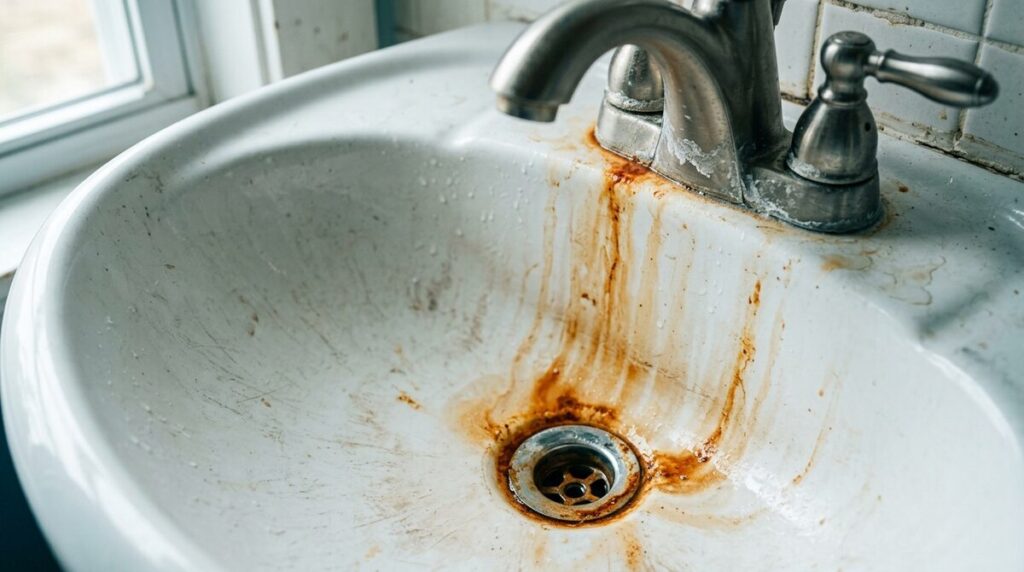
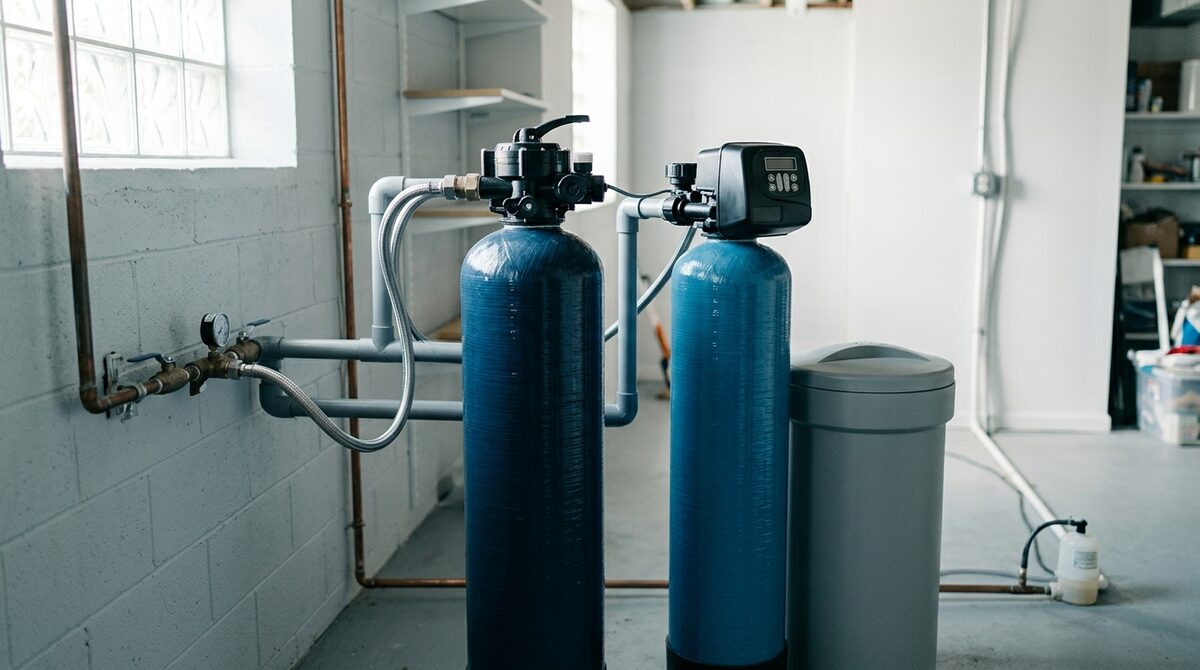
Hard water and iron are the two most common nuisances in private well water, and they have separate fixes: a water softener removes the calcium and magnesium that cause hardness, while a dedicated iron filter removes the iron that stains sinks and laundry. Neither is usually a health risk — both are aesthetic problems — but they wear out appliances, leave orange or white stains, and ruin the taste of your water. A whole-home softener typically runs $800 to $3,500 installed; an iron filter runs about $800 to $3,000. If you have both problems, the iron filter goes first, before the softener.
What causes hard water?
Hardness comes from dissolved minerals — mainly calcium and magnesium — that groundwater picks up as it moves through limestone and other rock. Those minerals are harmless to drink, but they leave white, chalky scale on faucets, kettles, and inside your water heater, and they keep soap from lathering (you end up using more soap and still feel a film).
The U.S. Geological Survey (USGS) measures hardness as milligrams per liter (mg/L) of calcium carbonate and sorts water into four bands:
- Soft: 0–60 mg/L
- Moderately hard: 61–120 mg/L
- Hard: 121–180 mg/L
- Very hard: over 180 mg/L
Many test reports and softener specs use a different unit — grains per gallon (gpg). The conversion is simple: 1 gpg equals 17.1 mg/L. So to turn a mg/L reading into grains, divide by 17.1; to go the other way, multiply grains by 17.1. As a rough guide, water around 10–12 gpg is solidly "hard," and 13–18 gpg is "very hard." Your softener is sized to that grain number.
What causes iron in well water?
Iron dissolves out of the same rock and soil. According to the Minnesota Department of Health, most well water holds less than 10 mg/L of iron, and anything above the U.S. EPA's secondary standard of 0.3 mg/L is usually considered objectionable. That EPA limit is a secondary (aesthetic) standard — it's based on staining, color, and metallic taste, it's non-enforceable, and the EPA does not consider iron at that level a health risk. In fact, your body needs iron to carry oxygen in your blood, so iron in water is a nuisance, not a hazard.
Iron shows up in two forms, and which one you have changes how you treat it:
- Ferrous ("clear-water") iron is dissolved and invisible when you first draw it. The water looks clean from the tap, then turns orange or red after it sits in a glass or a toilet tank and meets the air.
- Ferric ("red-water") iron is already oxidized — it comes out of the tap visibly rusty or carrying reddish-orange particles.
A related problem is iron bacteria, which form a slimy reddish-brown buildup in tanks and toilet bowls. The Minnesota Department of Health notes iron bacteria are not known to cause disease themselves, but they can create conditions where other, disease-causing organisms grow — so they're worth dealing with.
Manganese often travels with iron. Its EPA secondary standard is lower — 0.05 mg/L — because it causes black-to-brown staining and a bitter, metallic taste. The EPA also publishes a non-enforceable health advisory for manganese (around 0.3 mg/L, with stricter guidance for infants), but at the 0.05 mg/L secondary level it, too, is treated as a nuisance.
How to test for hardness and iron
You can't treat what you haven't measured. DIY test strips and home kits — roughly $15 to $50 — are fine as a quick screening tool to tell you whether you have a problem, but they are not lab-grade and don't replace a certified lab test. For numbers you can size equipment from, send a sample to a certified lab.
- Basic lab panel (bacteria, nitrate, pH, hardness): about $75–$150.
- Standard panel (adds iron, TDS, and more): about $150–$250.
Standard private-well guidance is to test at least once a year for bacteria and nitrate, plus pH, hardness, iron, manganese, and sulfides — and to retest any time the taste, odor, color, or staining changes. For a full walkthrough of sampling and reading results, see our guide on how to test well water, and use the water quality testing guide to figure out which panel fits your situation.
Treatment options and what they cost
Match the equipment to the problem. For hardness, you want a softener. For iron, you want an iron filter sized to your iron level. Here's the rough selection ladder for iron, keeping in mind cut-points vary by manufacturer:
- Up to ~1 mg/L ferrous iron: a water softener alone may handle it. (Softeners can manage low ferrous iron — roughly 1–5 mg/L, with some rated to 10 — but iron fouls the resin, so a dedicated filter is the safer route once iron is a real factor.)
- ~1–3 mg/L: a Birm oxidizing filter, which needs water pH above 6.8 to work.
- ~3–10 mg/L: air-injection oxidation (AIO) or manganese greensand filters.
- 10+ mg/L: chemical oxidation (chlorine or peroxide injection) plus filtration.
A widely recommended rule of thumb (from groundwater associations such as NGWA) is to install a dedicated iron filter upstream of the softener once iron exceeds 0.3 ppm or manganese exceeds 0.05 ppm, because iron clogs the softener resin and shortens its life. The standard treatment order is: acid neutralizer (only if your water is acidic) → iron filter → softener.
| System | What it does | Typical cost |
|---|---|---|
| Water softener (installed, whole-home) | Removes hardness (calcium/magnesium) | $800–$3,500 (national range $200–$6,000; avg ~$3,100) |
| Single-tank ion-exchange softener (unit) | Salt-based softening | $500–$1,700 |
| Dual-tank softener (unit) | Continuous softening, no downtime | $1,000–$5,000 |
| Salt-free conditioner (unit) | Reduces scale buildup — not a true softener; doesn't remove hardness minerals | $800–$4,000 |
| Iron filter (installed) | Removes iron/manganese | $800–$3,000 (up to ~$4,500 for larger/chemical systems) |
| Air-injection (AIO) iron filter (unit) | Chemical-free oxidation + filtration | $1,500–$3,000 (+$200–$500 install) |
| Birm iron filter (unit) | Oxidizing media (needs pH > 6.8) | $800–$1,500 |
| Greensand / Greensand Plus filter (unit) | Higher iron/manganese loads | $1,200–$2,500 (+~$50–$100/yr permanganate) |
| Chemical (chlorine/peroxide) injection (unit) | High iron (10+ mg/L) + bacteria | $1,500–$4,000 |
| Combination softener + iron filter (installed) | Both problems together | $2,500–$4,500 |
| Sediment pre-filter (installed) | Catches grit/particles upstream | $200–$600 |
Two more numbers worth knowing when you size by capacity: a 32,000-grain softener (good for roughly 10–12 gpg) runs about $400–$1,000 for the unit, and a 48,000-grain unit (roughly 13–18 gpg) runs $500–$1,200. Professional installation adds $150–$1,000, though most homeowners pay $500–$700.
What it costs to run
The sticker price isn't the whole story. Ongoing costs are modest but real:
- Softener salt: about $100–$300 per year.
- Iron filter media: roughly $200–$500 every 5–10 years.
- Chemical-feed iron systems: about $100–$200 per year in chlorine or peroxide. This is the trade-off behind choosing an AIO filter — air-injection oxidation pulls in air to oxidize the iron with no recurring chemical cost.
For deeper guidance on matching equipment to your water report and weighing salt-based against salt-free, see our overview of well water treatment options.
Frequently asked questions
Is iron in well water dangerous to drink?
Not usually. Iron is regulated only as an aesthetic (secondary) contaminant — the 0.3 mg/L EPA limit is about staining and taste, not health. Your body actually needs iron. The real downsides are orange stains, metallic flavor, and slime from iron bacteria, which can create conditions where other organisms grow.
Why does my water look clear but turn orange in the toilet?
That's ferrous ("clear-water") iron — dissolved and invisible at the tap, it oxidizes and turns orange once it sits in the air. Ferric iron, by contrast, is already rusty straight from the tap.
Will a water softener remove iron?
A softener can handle low levels of ferrous iron — roughly 1–5 mg/L, with some units rated higher — but iron fouls the resin and shortens the softener's life. Once iron is above about 0.3 ppm, install a dedicated iron filter ahead of the softener instead of relying on the softener to do both jobs.
How do I get iron stains out of laundry?
Go straight for a rust-specific stain remover — ordinary soaps and detergents won't lift rust stains, and chlorine bleach can actually set them and make them permanent. Then fix the water at the source so the staining stops happening.
Do I need an iron filter and a softener, or just one?
It depends on your test results. If you only have hardness, a softener is enough. If you have iron above 0.3 mg/L (or manganese above 0.05 mg/L), add an iron filter upstream of the softener. A combination system handling both runs about $2,500–$4,500 installed.
How often should I test my well?
At least once a year for bacteria, nitrate, pH, hardness, iron, manganese, and sulfides — and any time the taste, smell, color, or staining changes. DIY strips ($15–$50) are a quick screen, but use a certified lab ($75–$250) before buying equipment.
Ready to fix it? Start with a lab test, then compare your options. For help matching equipment to your water report and weighing salt-based against salt-free, see our well water treatment options guide — and when you're ready to install, find a verified well driller or water-treatment pro near you who can size the system to your test results.
Sources: USGS Water Science School — Hardness of Water (2026), U.S. EPA — Secondary Drinking Water Standards (2026), Minnesota Department of Health — Iron in Well Water (2026), Minnesota Department of Health — Iron Bacteria in Well Water (2026), WaterHardness.org — Water Hardness Scale (2026), This Old House — Water Softener System Cost (2026), SC Well & Pump Service — Water Treatment System Cost / Iron Filters for Well Water / Well Water Testing Cost (2026), The Well Guide — Well Water Testing Cost (2026), UGA Extension — Remove Stains From Iron/Rust (2026).

Author: Well Driller Finder Editorial Team
The Well Driller Finder editorial team researches and writes our guides on water-well drilling, pumps, and well water for homeowners across the US and Canada. We translate current cost data, NGWA and state well-construction standards, and EPA and CDC guidance into clear, practical answers. What we stand for: honest, independent help. Every price and claim is researched and fact-checked against multiple 2026 sources — never guessed, never borrowed from a single advertiser. We answer to homeowners, not to the companies we write about, because our only goal is to help you make a confident, well-informed decision about your water.
Find verified, local contractors who handle new installations, pump service, and water quality testing — in your area.