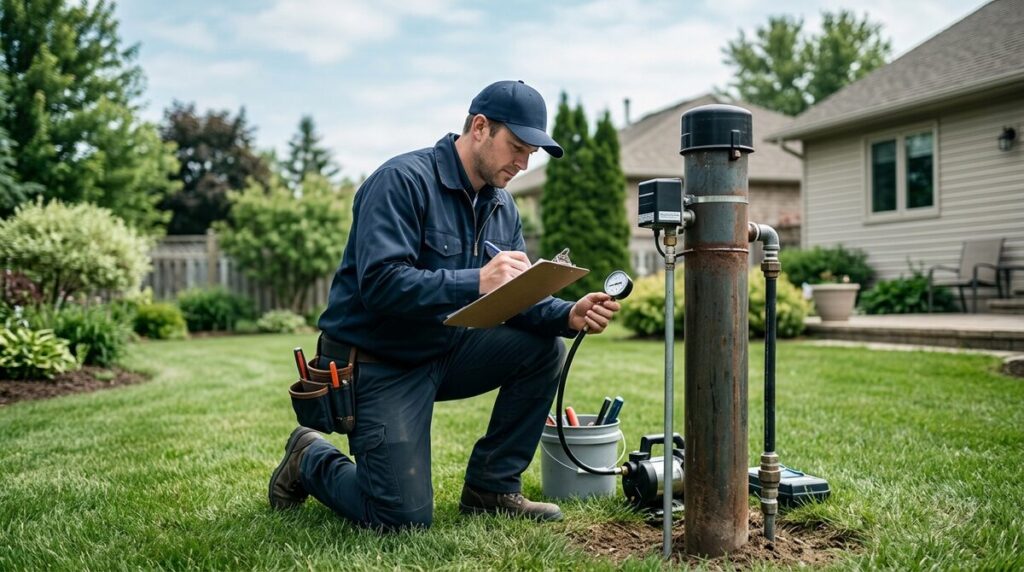
A standard residential well inspection costs roughly $250 to $550 in 2026, and most homeowners pay around $450. A basic visual-only check runs as little as $150, while a comprehensive inspection with a full water-quality panel can reach $800. What you pay depends mostly on one thing: how much water testing is bundled in.
What a well inspection actually checks
A proper well inspection is a hands-on evaluation of the whole system that pulls water into your home, not just a quick look at the cap sticking out of the ground. A standard professional inspection covers five core components:
- Visual wellhead assessment — the casing, cap, and surrounding ground for damage or contamination risk.
- Pressure-system evaluation — the pressure tank and pressure switch that keep your taps flowing.
- Flow-rate test — how many gallons per minute the well reliably produces.
- Electrical-component check — pump wiring, grounding, and line voltage.
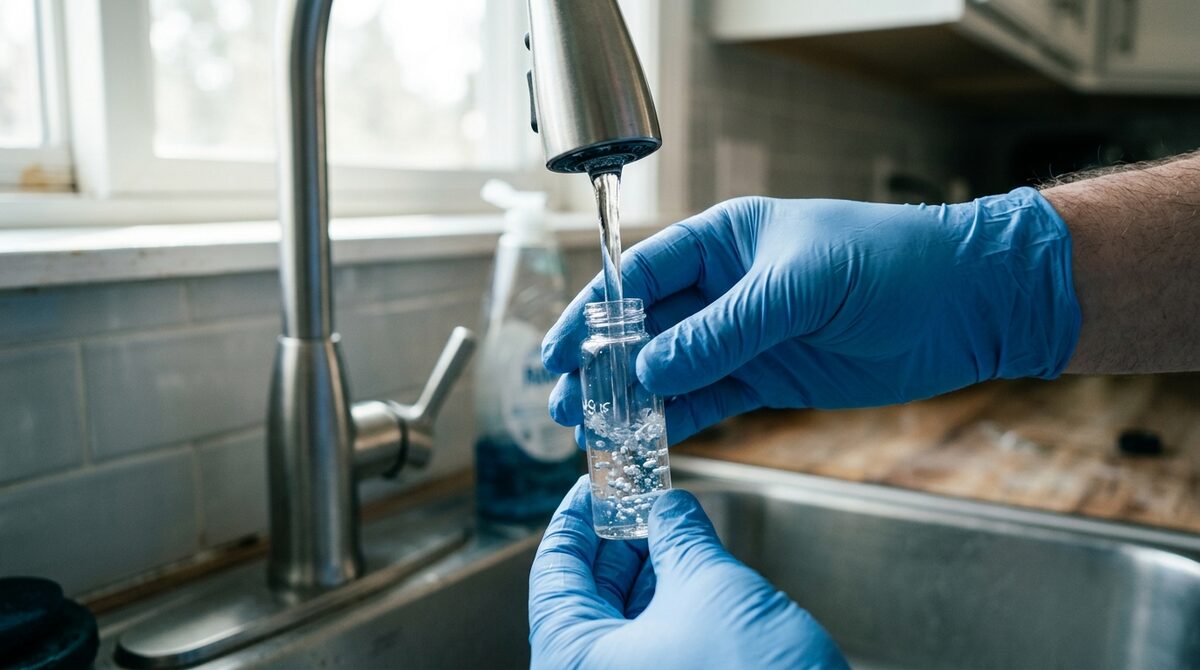
- Water-quality testing — often a paid add-on rather than part of the base price.
The National Ground Water Association (NGWA) describes its annual well checkup in similar terms: a flow test for system output, a check of the water level before and during pumping, a pump-motor performance review (amp load, grounding, line voltage), a pressure tank and switch check, an equipment and sanitary inspection, water testing for disease-causing bacteria and nitrates, and a written report of the results and recommendations. That written report is the part most homeowners actually keep — it tells you what's fine, what's worn, and what's likely to cost you money soon.
Well inspection cost breakdown for 2026
Pricing scales with the depth of testing. Here's how the tiers typically break down:
| Inspection type | Typical cost | What's included |
|---|---|---|
| Basic visual inspection | $150–$250 | Wellhead and equipment look-over only |
| Standard inspection | $250–$400 | Visual + flow-rate + pressure test |
| Standard + basic water test | $350–$550 | Above, plus a basic bacteria/nitrate panel |
| Comprehensive inspection | $500–$800 | Everything above + extended water panel |
| Combined well + septic | $400–$650 | Both systems inspected in one visit |
Across all of these, the full budget spread runs from about $150 on the low end to $900 at the top, but most people land near $450. If a quote falls well outside that range, ask what's driving it.
Water testing is the biggest price swing
The single largest variable in your final bill is how much lab testing is included. Testing can be done as part of the inspection or ordered separately:
- Basic bacteria/nitrate panel: $50–$150
- Comprehensive water-quality panel (bacteria, metals, and more): $200–$400
- Laboratory testing alone (no inspection): $100–$350
A single standalone test can be cheap — a basic bacteria test often starts near $25 — but a full panel that screens for metals and a wider set of contaminants is where the cost climbs. If you're not sure what your water should be screened for, our guide to testing well water walks through which contaminants matter and how often to retest.
The major health agencies broadly agree on a yearly baseline. The CDC recommends testing private well water at least once a year for total coliform bacteria, nitrates, total dissolved solids, and pH, using a state-certified laboratory. The EPA gives the same annual list and adds that you should test right after you repair or replace any part of the well system, or after a change in your water's taste, color, or smell. NGWA echoes the annual bacteria-and-nitrate recommendation and advises testing more often after events like a broken well cap, flooding, or a new contamination source nearby. There's a practical reason this falls on the owner: private wells are not regulated under the Safe Drinking Water Act, so the household is responsible for its own water. More than 23 million U.S. households — over 43 million people, roughly 15% of the population — rely on private wells.
Common add-ons and what they cost
A few extras come up often enough to plan for:
- Camera / borehole video inspection: add $200–$500 to a standard inspection, or $200–$800 as a standalone job (the price rises with well depth). A camera can document casing cracks or holes, corrosion, screen deterioration, sediment buildup, and dropped or misaligned equipment. It's especially worth considering before buying a property or for an older well.
- Septic inspection add-on: roughly $150–$400 when bundled with the well visit.
- Depth surcharge: deeper wells (often those past about 300 feet) can add $50–$150.
- Travel/trip fee: for rural or hard-to-reach properties, some companies charge a per-mile rate while others use a flat rural fee.
FHA and VA loan inspections have stricter rules
If you're buying with an FHA or VA mortgage, the well has to clear specific government-backed standards, and the inspection is built around proving it does. These loans generally call for a sustained well flow in the range of 3 to 5 GPM, with the exact figure tied to the number of bedrooms.
The water itself generally has to pass on four key thresholds:
- Coliform bacteria: absent (0 per 100 mL)
- Nitrates: no more than 10 mg/L
- Nitrites: no more than 1 mg/L
- Lead: no more than 15 ppb
There are also distance rules. The well generally must sit at least 50 feet from a septic tank, 100 feet from the drain field, and about 10 feet from the property line. On VA loans specifically, the water sample typically has to be collected by a disinterested third party — a health official or certified lab technician — not the buyer, seller, or agent. These are general guidelines, and local health authorities set their own minimums, so confirm the exact requirements for your county before scheduling. If a well loan is in your future, our guide to buying a home with a well covers what to negotiate and watch for.
Why an inspection is worth the money
The trade-off is easy to see. A standard inspection costs a few hundred dollars; replacing a failed well pump costs far more — commonly somewhere in the range of $975 to $2,825, averaging around $1,900. A pre-purchase inspection that catches a weak pump, a failing pressure tank, or a cracked casing before you close can save you that kind of money and give you real leverage in negotiations.
One important note on who does the work: a well inspection should be performed by a licensed water-well-system professional or licensed well contractor. Standard home inspectors usually don't carry the training or the equipment — flow meters, cameras, electrical testers — to evaluate a well properly, so a general home inspection is not a substitute.
Frequently asked questions
How much does a well inspection cost in 2026?
A standard residential well inspection costs about $250 to $550, and most homeowners pay around $450. A basic visual-only inspection can be as low as $150, while a comprehensive inspection with a full water panel runs $500 to $800.
Is water testing included in a well inspection?
Not always. Many inspectors quote a base price for the mechanical and visual evaluation, then charge separately for lab testing. A basic bacteria/nitrate panel adds $50–$150, and a comprehensive panel adds $200–$400. Always confirm what testing is bundled before you book.
Who should perform a well inspection?
A licensed water-well-system professional or licensed well contractor. Standard home inspectors typically lack the specialized equipment and training to evaluate flow rate, pump electrics, and casing condition, so a general home inspection won't cover a well properly.
How often should I have my well inspected and tested?
The CDC, EPA, and NGWA all recommend testing private well water at least once a year for total coliform bacteria, nitrates, total dissolved solids, and pH. Test sooner after a repair, flooding, a broken well cap, or any change in your water's taste, color, or smell. An annual professional checkup pairs naturally with that yearly test.
Do I need a special inspection for an FHA or VA loan?
Generally, yes. FHA and VA loans typically require a sustained flow of about 3 to 5 GPM (scaled to bedroom count), and the water usually must show no coliform bacteria, nitrates at or below 10 mg/L, nitrites at or below 1 mg/L, and lead at or below 15 ppb. Distance-from-septic rules also apply, and VA loans generally require a disinterested third party to collect the sample. Confirm exact thresholds with your local health authority.
Should I add a camera inspection?
It can be a smart upgrade for older wells and before buying a property. A borehole camera documents casing cracks, corrosion, screen wear, sediment, and dropped equipment that a surface inspection can't see. Expect to add $200–$500 to a standard visit, or pay $200–$800 for a standalone camera inspection depending on well depth.
Planning a purchase or a yearly checkup? Compare your numbers against our full guide to buying a home with a well, then find a licensed well contractor near you to get an accurate quote — inspection prices vary by depth, location, and how much testing you need.
Sources: HomeGuide — Well Inspection Cost (2026); The Well Guide — Well Inspection Cost (2026); SC Well Service — Well Water Testing Cost; SC Well Service — Well Video Camera Inspection Cost; Angi — Well Pump Replacement Cost (2026); Epp Well Solutions — FHA and VA Loan Requirements for Well Water; National Ground Water Association / wellowner.org — Annual Inspection & Water Testing; CDC — Guidelines for Testing Well Water; US EPA — Protect Your Home's Water & Private Drinking Water Wells.

Author: Well Driller Finder Editorial Team
The Well Driller Finder editorial team researches and writes our guides on water-well drilling, pumps, and well water for homeowners across the US and Canada. We translate current cost data, NGWA and state well-construction standards, and EPA and CDC guidance into clear, practical answers. What we stand for: honest, independent help. Every price and claim is researched and fact-checked against multiple 2026 sources — never guessed, never borrowed from a single advertiser. We answer to homeowners, not to the companies we write about, because our only goal is to help you make a confident, well-informed decision about your water.
Find verified, local contractors who handle new installations, pump service, and water quality testing — in your area.