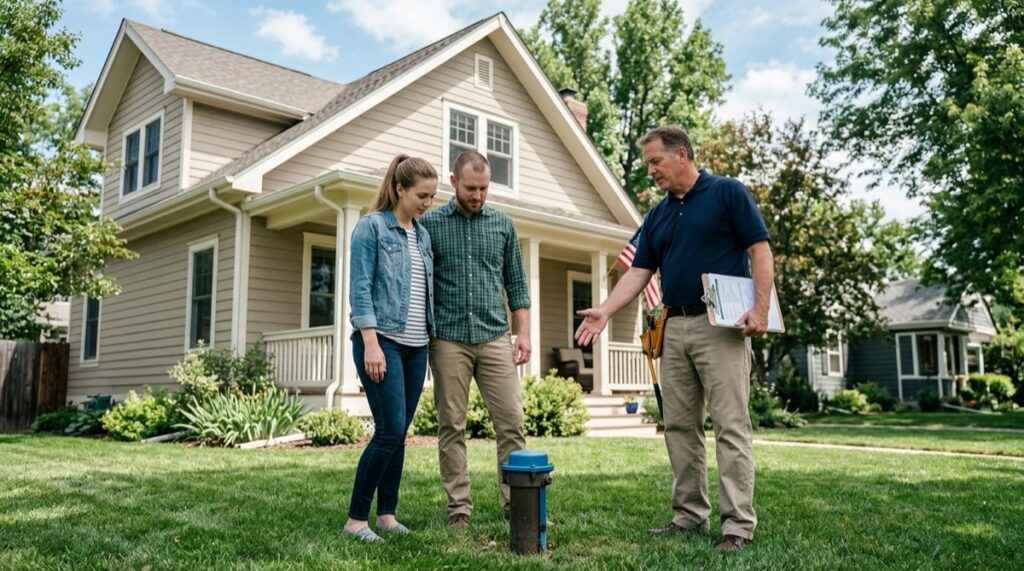
A private well is not like connecting to city water — once you own the home, the well is yours to maintain, test, and eventually repair or replace. That is a real responsibility, but a manageable one if you do a little homework before closing. This guide covers the handful of things a buyer should check so you go in with eyes open rather than inheriting a surprise.
Why the well deserves its own checklist
About 15 percent of people in the United States — more than 43 million — rely on a private well for their drinking water, and millions more across Canada do the same. Unlike a public water system, a private household well is not regulated by the EPA under the Safe Drinking Water Act. That means no utility is testing the water or guaranteeing the equipment. The owner is responsible. When you buy the home, that owner becomes you, so it pays to know exactly what you are taking on.
A properly built well is long-term infrastructure: the borehole and casing can last 30 to 50 years or more. The pump is the part that wears out, typically lasting 8 to 15 years. So a buyer's inspection has a simple goal — confirm the well was built right, still produces good water at a healthy rate, and isn't about to fail on your watch.
The six things to check before you close
1. Get the well completion report (the well log)
When a well is drilled, the driller usually files a well completion report — often called a well log — with the state or provincial agency. It records the depth, the casing, the grouted seal, and the yield measured at the time of drilling. Many states keep these logs in a public database. Ask the seller for a copy, or look the property up with your state's water agency. The log tells you how deep the well is, how it was constructed, and roughly what it produced when new — the baseline you'll measure everything else against. If no log exists, that is worth asking about: it may simply predate digital records, or it may hint at an unpermitted well.
2. Order a flow (yield) test
A flow or yield test measures how many gallons per minute the well can actually deliver, sustained, today — not when it was drilled. This is the single best indicator of whether the well can keep up with a household: showers, laundry, dishwasher, and irrigation. A well that produced well on paper years ago can decline over time. Have the test done while the home is under contract so a weak well shows up before you own it, not after.
3. Run a full water test through a certified lab
Because no agency tests a private well for you, a water test at the point of sale is essential. The CDC recommends testing at least once a year for total coliform bacteria, nitrate, total dissolved solids, and pH — and a property transfer is exactly the kind of life event that warrants a fresh test. Always use a state-certified laboratory; your county or state health department can help interpret the results. A few jurisdictions (California is one) require water testing at drilling or at property transfer, but most do not — so do not assume it happens automatically. Our water-quality testing guide walks through what to test for and how to read the report.
4. Find out the pump's age and condition
The pump is the most likely part to need replacement. Since a submersible pump typically lasts 8 to 15 years, ask how old the current one is. If it is near or past that window, treat a replacement as a near-term cost in your budget. Replacing a well pump commonly runs around $1,900, though the range is roughly $1,000 to $2,800 depending on depth and the pump system — deeper wells cost more. Knowing the age won't necessarily kill the deal, but it lets you plan, and it can be a fair negotiating point.
5. Confirm the setback from the septic system
Most homes on a private well also have a septic system, and the two need to stay a safe distance apart so wastewater can't contaminate the drinking water. Setbacks are set by your state or province and typically fall in the 50 to 100 foot range — the exact distance, and whether it's measured from the tank or the leach field, depends on local code. Have your inspector confirm the well and septic are properly separated. A well sitting too close to a leach field is a genuine red flag worth investigating before you commit.
6. Verify the well was permitted
Most states and provinces require a well-construction permit before drilling, and most license the drillers who do the work — though the specifics vary widely from one place to the next. Confirm the well on this property was permitted and, ideally, drilled by a licensed contractor. A permitted well filed with a completion report is a good sign the well was built to code, with proper casing and a grouted seal keeping surface contamination out. To see how the rules work where you're buying, start with our regulations hub and look up your state or province.
A quick buyer's checklist
| What to get | Why it matters |
|---|---|
| Well completion report / log | Depth, casing, and original yield — your baseline |
| Flow / yield test | Whether the well meets household demand today |
| Full water test | Safety — bacteria, nitrate, TDS, pH |
| Pump age | Whether a replacement is a near-term cost |
| Septic setback | Confirms the well can't be contaminated |
| Permit confirmation | Proof the well was built to code |
What the results tell you
None of these checks are deal-breakers on their own — they're information. A clean water test, a healthy flow rate, a recent pump, and a permitted well with a filed log mean you can move ahead with confidence. A weak yield, a failed water test, or a pump near the end of its life don't necessarily mean walking away; they mean you now know the true cost of ownership and can negotiate or budget accordingly. If the testing turns up a problem that needs fixing, the question becomes whether it's a repair or a bigger job — our New Well vs. Repair helper can point you toward the likely path and cost.
Whatever the findings, the right next step is the same: have a licensed, local well professional do the flow test and look the system over. They know your region's water table, geology, and rules, and they'll catch things a general home inspection won't.
Ready to find a licensed well driller?
Buying a home with a well? Get a local pro to run the flow test, inspect the pump, and confirm the well checks out before you close.

Author: Well Driller Finder Editorial Team
The Well Driller Finder editorial team researches and writes our guides on water-well drilling, pumps, and well water for homeowners across the US and Canada. We translate current cost data, NGWA and state well-construction standards, and EPA and CDC guidance into clear, practical answers. What we stand for: honest, independent help. Every price and claim is researched and fact-checked against multiple 2026 sources — never guessed, never borrowed from a single advertiser. We answer to homeowners, not to the companies we write about, because our only goal is to help you make a confident, well-informed decision about your water.
Find verified, local contractors who handle new installations, pump service, and water quality testing — in your area.