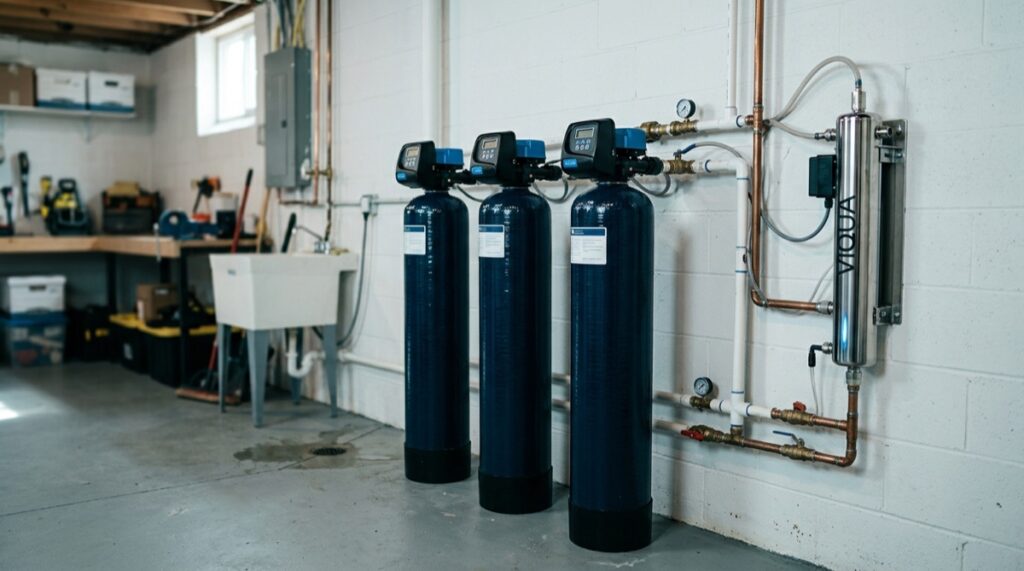
If your well water tastes off, stains the sink, or you simply want peace of mind, you have probably wondered what it would take to clean it up. The honest answer is that there is no single "well water filter" that fixes everything. The right treatment depends entirely on what is actually in your water, which is why every credible approach starts with a lab test, not a product purchase.
This overview walks through the common problems homeowners run into with private wells, the broad category of fix each one calls for, and why a certified water test plus a conversation with a qualified pro should come before you spend a dollar on equipment.
Test before you treat — every time
Because private household wells are not regulated under the federal Safe Drinking Water Act, the responsibility for keeping the water safe falls on you as the property owner. No agency is testing it for you. The U.S. Centers for Disease Control and Prevention recommends testing your well at least once a year for total coliform bacteria, nitrate, total dissolved solids, and pH — and again after any major event, such as a new baby or pregnancy in the home, a noticeable change in taste, smell, or appearance, well repairs, or flooding.
Always send your sample to a state-certified laboratory. A certified lab result tells you exactly what is present and in what concentration, which is the only way to choose treatment that fits your water rather than guessing. Your county or state health department can also help you read the report. For a fuller walkthrough of what to test for and how to collect a clean sample, see our water quality testing guide.
Common well water problems and the general fix
Well water issues tend to fall into a handful of categories. Each one points toward a different broad type of treatment. The table below is a high-level map — your actual lab results, and a pro's read on them, determine which one (or which combination) is right for your home.
| What shows up | What you may notice | General category of fix |
|---|---|---|
| Bacteria (e.g. total coliform) | Often nothing visible; flagged only by a lab test | Disinfection |
| Nitrate | No taste or smell; a lab test is the only way to know | Specialized filtration |
| Arsenic | No taste, smell, or colour; lab test only | Specialized filtration |
| Iron and manganese | Rust-coloured or dark staining on fixtures and laundry; metallic taste | Filtration |
| Hardness (calcium and magnesium) | Scale on faucets and kettles, spotty dishes, soap that won't lather | Softening |
Bacteria — disinfection
Bacteria such as total coliform usually give no warning sign at the tap, which is exactly why the CDC puts it at the top of the annual test list. When a lab flags it, the broad category of response is disinfection. Bacterial contamination can also point to a problem with the well itself — a compromised cap, a cracked casing, or a failing seal — so it is worth having a professional look at the well, not just the water, before deciding how to proceed.
Nitrate and arsenic — specialized filtration
Nitrate and arsenic are the quiet ones. Neither changes the taste, smell, or look of your water, so a certified lab test is the only way to detect them. Both are health-driven concerns rather than nuisance issues, and both call for treatment designed specifically to target them. Reverse osmosis is one of the broad approaches often discussed for this category, but which method suits your water depends on the full chemistry of your sample — another reason this is a decision to make with a pro and a lab report in hand, not off a shelf.
Iron, manganese, and hardness — filtration and softening
These are the problems you can usually see and feel. Iron and manganese leave rust-coloured or dark stains on sinks, tubs, and laundry and can add a metallic taste; the general fix is a form of filtration. Hardness — dissolved calcium and magnesium — shows up as scale on fixtures and kettles, spotty glassware, and soap that struggles to lather; the broad category here is softening. These are nuisance issues more than safety ones, but they are real and they are common, and the right-sized solution still depends on how much is in your water.
Why a pro and a lab come before equipment
It is tempting to read a symptom, match it to a product online, and order. The trouble is that water problems overlap and interact: staining can come from more than one source, a softener aimed at hardness does nothing for bacteria, and a system sized for the wrong concentration can underperform or cost far more than you need. A certified lab result removes the guesswork, and a qualified water professional can interpret that result alongside your well's depth, age, and construction to recommend an approach that actually fits.
Treatment requirements and any testing rules also vary by where you live — a few states require testing at the time of drilling or property transfer, and construction and licensing standards differ from one state or province to the next. For how the rules work where you are, start with our well regulations hub, then confirm the specifics with your state or provincial water authority. Whatever the result, this is one area where it pays to bring in someone who works with private wells across the U.S. and Canada every day.
The short version
- Get a current test from a state-certified lab — at minimum the CDC's annual list, plus anything your area is known for.
- Match the results to a category of treatment: disinfection, filtration, softening, or reverse osmosis.
- Have a qualified professional confirm the approach and size it to your specific water and well before you buy anything.
Skip step one and you are guessing. Do it in order and you spend money once, on the thing your water actually needs.
Ready to find a licensed well driller?
A pro who knows your local water can read your lab results and recommend the right treatment for your well — no guesswork, no over-buying.
Get Free Quotes from Licensed Well Drillers Near You
Tell us about your needs and we'll connect you with a licensed well driller in your area. Free, no obligation.

Author: Well Driller Finder Editorial Team
The Well Driller Finder editorial team researches and writes our guides on water-well drilling, pumps, and well water for homeowners across the US and Canada. We translate current cost data, NGWA and state well-construction standards, and EPA and CDC guidance into clear, practical answers. What we stand for: honest, independent help. Every price and claim is researched and fact-checked against multiple 2026 sources — never guessed, never borrowed from a single advertiser. We answer to homeowners, not to the companies we write about, because our only goal is to help you make a confident, well-informed decision about your water.
Find verified, local contractors who handle new installations, pump service, and water quality testing — in your area.