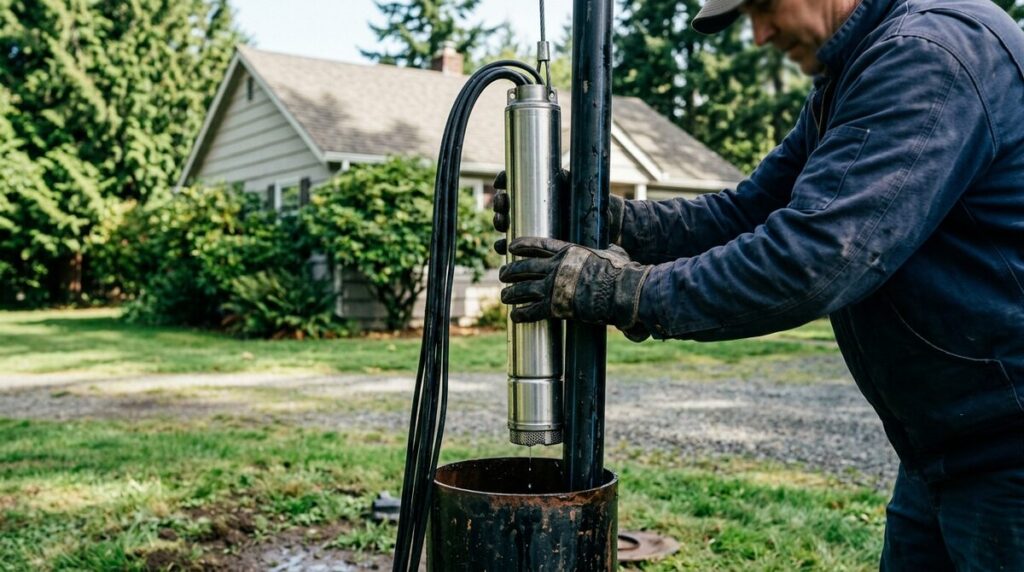
Replacing a well pump costs about $1,900 on average, with most homeowners paying roughly $1,500 to $2,827 all-in (parts plus labor). The two things that move your price the most are the type of pump and how deep your well is — a shallow jet pump near the surface can land around $800, while a submersible pump in a 400-foot well can run $8,000 or more.
That ~$1,900 average holds up across the 2026 data: LawnStarter puts the national average at $1,775 (typical range $975–$2,575), and This Old House lists $900 to $2,500 installed. The full outlier band runs from about $160 for a simple manual pump up to $5,800 for a deep submersible setup — but those extremes are rare. Most homeowners land in that $1,500–$2,800 middle.
Well pump replacement cost by pump type
There are four main pump types, and which one you have (or need) depends almost entirely on how far down your water sits. Here's what each costs installed.
| Pump type | Best for | Installed cost |
|---|---|---|
| Shallow-well jet pump | Wells under 25 ft | $800–$1,800 |
| Deep-well jet pump | Wells ~25–100 ft | $1,200–$2,500 |
| Submersible pump | Wells 25 ft to 500+ ft | $1,500–$8,000+ |
| Constant-pressure (VFD) system | Steady pressure, any depth | $2,000–$5,000 |
| Solar well pump | Off-grid / remote sites | ~$1,800–$4,400 |
| Hand / manual pump | Backup or rustic use | $160–$1,450 |
A word on each. Jet pumps sit above ground and suck water up — but suction has a hard physical limit of about 25 feet of lift from the water surface to the pump inlet. Below that you need a deep-well jet, which uses a downhole ejector and two pipes. Those are inefficient: a big share of the water a deep-well jet moves is recirculated drive water rather than water delivered to your house, and it only works practically to about 80–110 feet.
Submersible pumps are the modern residential standard. They sit underwater near the bottom of the well, never lose prime, and work across the full range from about 25 feet to 500+ feet. If your well is deeper than 100 feet, this is almost certainly what you have. Want to confirm the right horsepower for your well before you call anyone? Our well pump sizing calculator walks you through it.
How well depth changes the price
Because depth drives cost more than anything else, here's the submersible breakdown by how deep the pump sits. Deeper means heavier drop pipe, more wire, more hoist time, and a beefier motor.
| Well depth | Typical installed cost |
|---|---|
| 100–200 ft | $1,500–$3,000 |
| 200–300 ft | $2,000–$4,000 |
| 300–400 ft | $2,800–$5,500 |
| 400+ ft | $4,000–$8,000+ |
Horsepower scales with both depth and flow (gallons per minute), not depth alone. Typical residential sizing runs about 1/2 HP for wells under 100 ft, 3/4 HP for 100–200 ft, 1 HP for 200–300 ft, and 1.5–2 HP for 300–500+ ft. But a high water demand can push a shallower well to a bigger pump — a 200-foot well needs only about 1/2 HP at 5 GPM, but roughly 1.5 HP if the household pulls 25 GPM. The pump unit itself (material only) runs $300–$600 for 1/2 HP, $500–$900 for 3/4 HP, and $700–$1,400 for 1 HP.
Labor and the parts that often get replaced with the pump
Labor to replace a pump runs $250 to $1,500 for the whole project, with $250–$700 typical for a straightforward job; deep wells that take 4–8 hours push toward the high end. Hourly rates land between $45 and $150. A good contractor rarely pulls a pump without checking the components that share its lifespan — here's what those add.
| Part / service | Cost |
|---|---|
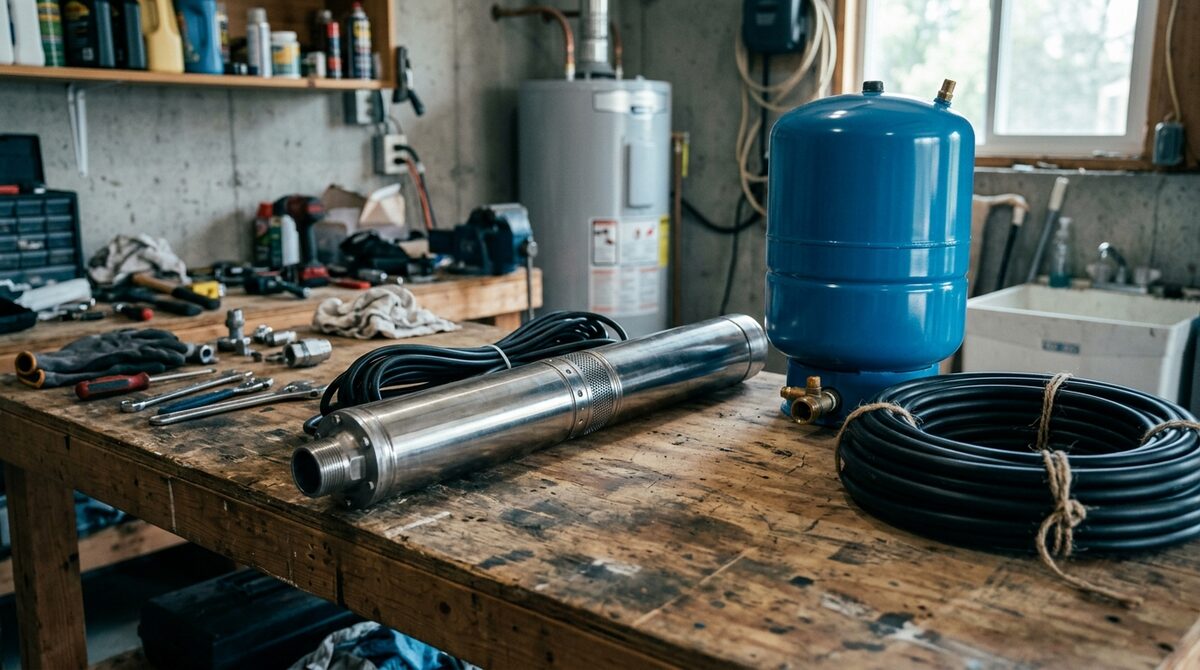
| Pressure tank (replacement) | $800–$3,500 |
| Drop pipe (~$1–$3/ft) | $300–$900 |
| Drop wire / well wiring | $150–$750 |
| Control box / start capacitor | $150–$600 |
| Pressure switch | $50–$300 |
| Pitless adapter | $100–$300 |
| Check valve + torque arrestor | $50–$200 |
| Permit / inspection | $25–$500 |
| Service call-out fee | typically $100–$150 |
Repair or replace?
Submersible pumps typically last 8 to 15 years, and premium units can reach 20–25 years. The rule of thumb: replace rather than repair if the pump is older than 10–12 years, or if the repair would cost more than about half the price of a new pump. A targeted repair (pressure switch, capacitor, a hardware fix) runs $250–$1,300, but a motor failure or ground fault is $800–$2,500 — at which point replacing is often the better call.
Watch for the classic signs a pump is failing: no water or sputtering, spitting faucets; low or dropping pressure; a pump that runs constantly or short-cycles; dirty or sandy water; and a sudden jump in your electric bill. One important warning — submersible motors are water-cooled and have to stay submerged. Run one dry and it overheats fast: the windings can burn out within minutes and ruin the motor for good. So if you've lost water, shut the pump off rather than letting it keep running.
How to avoid overpaying
Wells aren't federally regulated — more than 43 million Americans (about 15% of the population) rely on private wells, and they sit outside the Safe Drinking Water Act, per the USGS. That puts most of the vetting on you. Real red flags worth walking away from, per DrillerDB:
- A demand for a large deposit upfront — in California, for example, the legal cap on a home-improvement deposit is 10% of the contract or $1,000, whichever is less
- A quote that comes in far below everyone else's — usually a sign corners are getting cut
- No itemized written estimate, or no pipe/wire gauge specified
- No mention of permitting or post-job water testing
- No state license or NGWA certification
The EPA recommends hiring a certified well driller and re-testing your water after any service. The CDC adds: check your well each spring, test annually for coliform bacteria, nitrates, total dissolved solids, and pH — and always re-test after replacing or repairing any part of the system. A USGS study of about 2,100 private wells found roughly one in five had a contaminant above a health benchmark, so that post-job test is worth the small cost.
One more note on paying for it: standard homeowners insurance covers sudden damage from named perils like lightning or a falling tree, but typically denies routine wear-and-tear and age failure — which is how most pumps die. For lower-income or older rural owners, the USDA Section 504 program offers home-repair loans up to $40,000 at 1% interest, plus grants up to $10,000 for owners age 62 and older.
Frequently asked questions
How much does it cost to replace a well pump?
About $1,900 on average, with most homeowners paying $1,500 to $2,827 installed. Shallow jet pumps start near $800; deep submersible pumps in wells over 400 feet can reach $8,000 or more.
Why is my well pump replacement quote so high?
Almost always depth. Every additional 100 feet of well adds roughly $500 to $1,000 because of heavier drop pipe, more wire, and longer hoist time. A 400-foot well legitimately costs several times what a 100-foot well does.
How long do well pumps last?
Submersible pumps typically last 8 to 15 years, and premium units can reach 20 to 25 years. If yours is past 10–12 years and acting up, replacing usually beats repairing — especially if the fix would top half the price of a new pump.
What are the first signs my well pump is failing?
No water or spitting faucets, low or dropping water pressure, a pump that runs constantly or short-cycles, sandy or dirty water, and a sudden spike in your electric bill. Any of these is worth a service call before the pump quits entirely.
Can I run my well pump if the water level drops?
No — shut it off. A submersible motor is cooled by the water around it, so running it dry can overheat and ruin the motor within minutes. If you've lost water, kill the power until a pro can check it.
Does homeowners insurance cover a well pump?
Usually only for sudden damage from a covered peril like lightning or fire. Age-related wear-and-tear — the most common cause of failure — is typically not covered. Older or lower-income rural owners may qualify for a USDA Section 504 repair loan or grant.
Ready to plan the full picture? See our complete well drilling cost guide if you're weighing a new well, run the numbers with our well drilling cost estimator, or find a licensed driller near you to get an itemized quote for your specific depth and pump type.
Sources: DrillerDB (2026), The Well Guide (2026), LawnStarter (2025), This Old House (2026), Cycle Stop Valves, USGS, EPA, CDC, SC Well Service (2026), Well Pump Authority, USDA Rural Development
Get Free Quotes from Licensed Well Drillers Near You
Tell us about your needs and we'll connect you with a licensed well driller in your area. Free, no obligation.

Author: Well Driller Finder Editorial Team
The Well Driller Finder editorial team researches and writes our guides on water-well drilling, pumps, and well water for homeowners across the US and Canada. We translate current cost data, NGWA and state well-construction standards, and EPA and CDC guidance into clear, practical answers. What we stand for: honest, independent help. Every price and claim is researched and fact-checked against multiple 2026 sources — never guessed, never borrowed from a single advertiser. We answer to homeowners, not to the companies we write about, because our only goal is to help you make a confident, well-informed decision about your water.
Find verified, local contractors who handle new installations, pump service, and water quality testing — in your area.