A private well can serve a home reliably for 30 to 50 years or more, but only if it is looked after. Because private household wells are not covered by the federal Safe Drinking Water Act, no agency tests your water or inspects your equipment for you — that responsibility falls to you. The good news is a once-a-year routine takes little time and catches small problems before they turn expensive.
1. Test your water every year
Water testing is the single most important item on this list. The U.S. Centers for Disease Control and Prevention (CDC) recommends testing your well water at least once a year for four basics: total coliform bacteria, nitrate, total dissolved solids, and pH. Clear, good-tasting water can still carry contaminants you cannot see or smell, so a clean appearance is never proof of safety.
Always use a state-certified laboratory — your county or state health department can point you to one and help interpret the results. Beyond the annual schedule, the CDC advises testing again after certain events or changes:
- A new baby, a pregnancy, or anyone with a weakened immune system in the home
- Any change in how your water tastes, smells, or looks
- Repairs or replacement of any part of the well system
- Flooding or other events that could affect the water table near your well
- A known water-quality problem in your area
Which tests make sense beyond the four basics depends on your local geology and nearby land use. Our water quality testing guide walks through the recommended tests by region and how to read the results.
2. Inspect the wellhead, cap, and setbacks
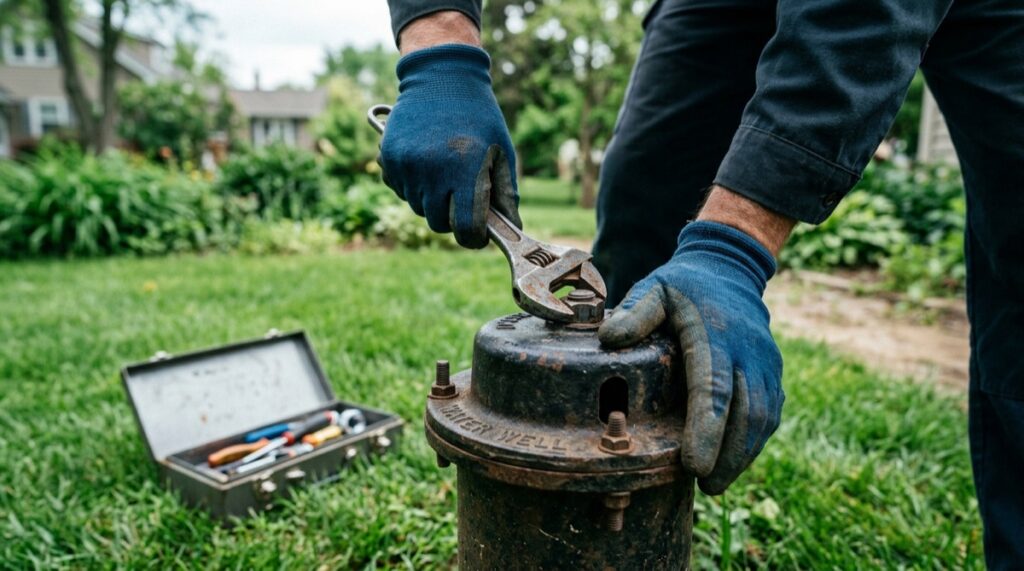
Once a year, walk to the wellhead and look it over. The well cap should be firmly in place, undamaged, and sealed so insects, surface water, and debris cannot get in. The casing — the pipe that lines the well — should stand above ground level and show no cracks, corrosion, or loose fittings. Make sure the ground slopes away from the casing so rainwater drains off rather than pooling around it.
Well construction standards (the model standard is ANSI/NGWA-01) call for a watertight grouted seal around the casing precisely to keep surface contamination out, so the wellhead is your first line of defense — keep the area around it clear.
Keep your distances
Most states set a minimum separation, or setback, between a well and contamination sources such as a septic tank or leach field — commonly somewhere in the 50-to-100-foot range, though the exact figures are set by your state. If you are adding a septic system, a fuel tank, or anything similar, do not eyeball it: confirm the required setback before you build. You will find the framework and links to your state's rules on our well regulations and licensing hub.
3. Check pressure and flow
Your pressure tank and pump keep water moving through the house at a steady pressure. Once a year, turn on a tap and confirm the pressure feels normal and consistent, with no sputtering or sudden drops. Sputtering or air in the lines can signal a problem with the pump, the pressure tank, or the water level in the well. If your system has a pressure gauge, note the pressure at which the pump switches on and off — a tank that has lost its air charge will show up here long before it leaves you without water.
4. Watch for a short-cycling pump
Short-cycling is when the pump rapidly switches on and off instead of running in smooth, longer cycles. It is one of the clearest warning signs that something is wrong — often a waterlogged pressure tank, a failing pressure switch, or a pump nearing the end of its life. Left alone, it wears the pump out faster and drives up your electric bill.
A well pump typically lasts 8 to 15 years, so on an older system this is worth watching closely. Replacing one runs about $1,900 on average, generally between roughly $1,000 and $2,800 depending on the well's depth and the type of pump. If you are hearing the pump click on and off often, or weighing whether to repair or replace, the New Well vs. Repair helper can talk you through the symptoms and likely costs.
5. Keep your well log and records
Your well log — sometimes called a well completion report — records the well's depth, casing, grout seal, and original yield. In most states the driller files this report with the state agency after drilling, and many states keep public well-log databases. Keep your own copy safe, and add to it over time.
A simple home record should include:
- The original well log or completion report (depth, casing, construction details)
- Dates and results of every water test
- Any repairs, pump replacements, or servicing, with dates and who did the work
- The location of the wellhead and any buried lines
These records make every future service call faster, and they are genuinely useful if you ever sell the home — a buyer will want to know the well's history.
6. Schedule professional service when it is due
Some checks are best left to a licensed well or pump professional, especially anything involving the pump, the pressure system, or water that tests poorly. A professional can inspect the parts you cannot see, sanitize the well if bacteria show up, and diagnose pressure or flow problems properly.
Most U.S. states and Canadian provinces require well drillers and pump installers to be licensed or registered, though the requirements vary widely. Always confirm a contractor holds a current license with your state or provincial board before hiring — the regulations hub links to the right authority for your location.
Quick annual checklist
| Task | How often | Who |
|---|---|---|
| Water test (coliform, nitrate, TDS, pH) | Yearly + after any change | Certified lab |
| Inspect wellhead, cap, and casing | Yearly | You |
| Confirm setbacks from septic and similar | Before building nearby | You |
| Check pressure and flow | Yearly | You |
| Watch for pump short-cycling | Ongoing | Pro if it appears |
| Update well log and records | After every test or repair | You |
| Professional system inspection | As needed | Licensed pro |
None of this needs to be complicated. A yearly water test, a five-minute look at the wellhead, and an eye on how your pump behaves will protect both your water and one of your home's most valuable systems. When something is beyond a visual check — or a test comes back outside the safe range — that is the moment to bring in a licensed professional.
Ready to find a licensed well driller?
Whether you need an annual inspection, a pump diagnosis, or a poor water test sorted out, connect with a licensed well and pump professional near you.

Author: Well Driller Finder Editorial Team
The Well Driller Finder editorial team researches and writes our guides on water-well drilling, pumps, and well water for homeowners across the US and Canada. We translate current cost data, NGWA and state well-construction standards, and EPA and CDC guidance into clear, practical answers. What we stand for: honest, independent help. Every price and claim is researched and fact-checked against multiple 2026 sources — never guessed, never borrowed from a single advertiser. We answer to homeowners, not to the companies we write about, because our only goal is to help you make a confident, well-informed decision about your water.
Find verified, local contractors who handle new installations, pump service, and water quality testing — in your area.