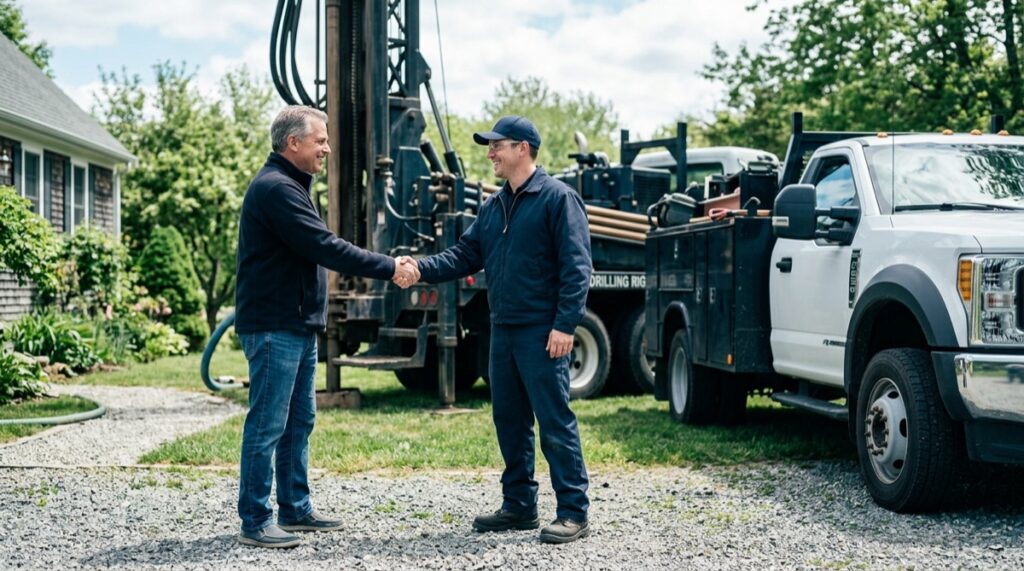
Hiring a well driller is one of the bigger decisions you'll make as a property owner, and the work happens underground where you can't easily inspect it. A new well typically runs $3,000 to $15,000 (the national average lands around $7,500 in the 2025–2026 market), so the right contractor matters as much as the right price. This guide walks you through how to compare drillers, verify credentials, and read a quote before you sign anything.
Start with three written quotes
A single estimate gives you no way to judge whether a price is fair or a scope is complete. Always collect at least three written quotes from licensed local drillers. Local matters here: well costs swing widely by region because the ground itself differs, and an experienced local contractor already knows roughly how deep wells run in your area and what they'll hit on the way down.
When you compare quotes, make sure you're comparing the same thing. Drilling alone is only part of the job — it accounts for roughly 50–60% of the total, with the rest going to casing, the pump, the pressure tank, electrical, and permits. A quote that looks cheap may simply have left those pieces out. Ask each driller to itemize so you can line them up side by side.
Verify the state license — this is non-negotiable
Most U.S. states and Canadian provinces require well drillers to be licensed or registered, but the specifics vary a lot — the experience, exams, bonding, and continuing education a driller must carry differ from one jurisdiction to the next. Because it varies, never assume; confirm. A current license is your baseline proof that the person drilling your well meets your jurisdiction's standards.
You can look up a driller's licensing authority and confirm their standing with our state well-licensing lookup tool, which points you to the right board for your state or province. For the bigger picture on how well rules work — who regulates what, construction standards, and reporting requirements — see our well regulations hub.
Ask about NGWA membership too
Beyond the license, membership in the National Ground Water Association (NGWA) is a good signal. It isn't a license and isn't legally required, but it tells you the contractor stays current with industry standards and best practices. Treat it as a plus on top of — never a substitute for — a valid state or provincial license.
Nail down the dry-hole and depth terms
Here's the part most homeowners don't think to ask about: what happens if the driller goes deep and doesn't find enough water, or has to go far deeper than expected. How a contractor handles depth and dry holes is one of the biggest differences between two quotes that otherwise look identical.
Get clear answers, in writing, on these points before any drilling starts:
- Dry-hole policy. If the well doesn't produce usable water, what do you pay? Some drillers charge full price, some charge a reduced "dry-hole" rate, and terms vary by contractor — so ask.
- Estimated depth. What depth is the quote based on? Most residential wells fall between 100 and 300 feet, but the real number depends entirely on your local water table.
- Per-foot overage rate. If the driller has to go deeper than the estimate, what's the rate for each extra foot? Complete-system pricing commonly runs $25 to $65 per foot, and the ground type is the main driver — soft soil and sand cost less, sedimentary rock more, and hard rock the most. Knowing this rate up front protects you from an open-ended bill.
| Ground type | Typical per-foot range (complete system, 2025–2026) |
|---|---|
| Soft soil / sand | $25–$40 / ft |
| Sedimentary rock | $35–$55 / ft |
| Hard rock / granite | $55–$85 / ft |
These are national ranges to set expectations — your driller's quote should reflect the conditions specific to your site.
Confirm exactly what's included
Because drilling is only part of the job, a complete, apples-to-apples quote should make clear whether each of the following is in or out. Walk through this checklist with every driller:
- Casing and grouting — the watertight lining and annular seal that protect your water from surface contamination.
- The pump — often the second-largest line item. (For context, a pump replacement alone typically runs around $1,900, and a pump lasts roughly 8 to 15 years, so it's worth knowing what you're getting now.)
- The pressure tank and related plumbing connection.
- Permits — most states and provinces require a well-construction permit before drilling. Confirm who pulls it and whether it's in the price.
- A water test — whether the driller includes an initial test of your new water. The CDC recommends testing well water at least once a year (for total coliform bacteria, nitrate, total dissolved solids, and pH) using a state-certified lab, so it's smart to start with a clean baseline.
If any of these isn't included, that's not necessarily a problem — you just need to know, so you can budget for it and compare quotes fairly.
Ask for the well log
Finally, ask each driller to provide the well log (also called a well completion report). In most states and provinces the driller is required to file this report with the relevant agency after the job, recording the well's depth, casing, grouting, and yield. It's the permanent record of how your well was built — valuable if you ever need service, sell the property, or have a water-quality question down the road. A reputable driller will provide a copy without hesitation. If you're told you can't have one, treat that as a red flag.
Putting it together
A well built correctly can last 30 to 50 years or more, so a small amount of due diligence up front pays off for decades. Compare three itemized quotes, verify the license (and ask about NGWA membership), pin down the dry-hole terms and per-foot overage rate, confirm what's included, and get the well log. Do that, and you can choose your driller on genuine value — not just the lowest sticker price.
Ready to find a licensed well driller?
Browse vetted, licensed well drillers near you and start gathering the three quotes you need to choose with confidence.

Author: Well Driller Finder Editorial Team
The Well Driller Finder editorial team researches and writes our guides on water-well drilling, pumps, and well water for homeowners across the US and Canada. We translate current cost data, NGWA and state well-construction standards, and EPA and CDC guidance into clear, practical answers. What we stand for: honest, independent help. Every price and claim is researched and fact-checked against multiple 2026 sources — never guessed, never borrowed from a single advertiser. We answer to homeowners, not to the companies we write about, because our only goal is to help you make a confident, well-informed decision about your water.
Find verified, local contractors who handle new installations, pump service, and water quality testing — in your area.