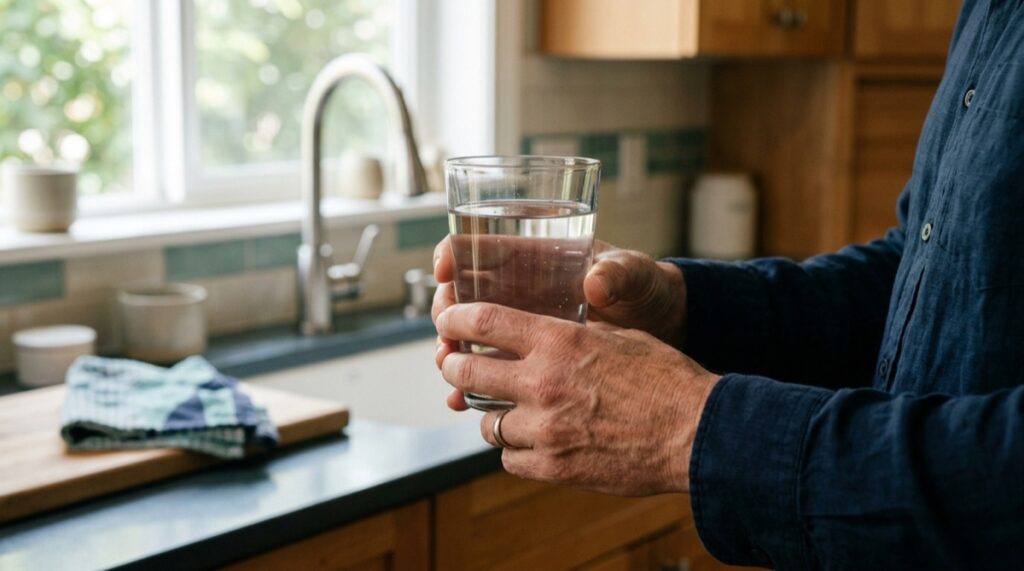
Arsenic in well water has no taste, no smell, and no color — and if your home is on a private well, no agency tests or treats it for you. The EPA's legal limit for public water systems is 10 parts per billion (10 ppb), but that rule does not reach private wells. The U.S. Geological Survey estimates that roughly 2.1 million Americans on private wells drink water above that level without knowing it. The only way to find out is a certified lab test, and the only way to fix it is treatment built specifically for arsenic — your standard carbon "drinking water" filter does essentially nothing.
Why Arsenic in Well Water Is So Easy to Miss
Most well problems announce themselves. Sulfur smells like rotten eggs, iron stains the laundry orange, hardness clogs the showerhead. Arsenic does none of that. Dissolved in water it is completely invisible to your senses, so a well can run clean, clear, and good-tasting for decades while delivering arsenic above the federal limit every single day.
It is also overwhelmingly natural, not industrial. Arsenic is a common element in bedrock and aquifer sediments, and groundwater dissolves it as it moves. According to the U.S. Geological Survey, naturally occurring arsenic is most common across the West, the Southwest, parts of Texas, the Upper Midwest, and New England — but the right geology can put it almost anywhere. That means a brand-new, properly built well in clean countryside can still pull arsenic straight out of the rock.
- You can't smell or taste it. There is no warning sign at the tap, which is exactly why so many homeowners never think to test.
- It comes from the rock, not pollution. A pristine rural setting is no protection — the source is the aquifer itself.
- Neighbors aren't a reliable guide. Arsenic levels can vary dramatically between wells on the same street depending on depth and which water-bearing layer each one taps. Knowing how deep your well is and which strata it draws from matters — see our guide on how deep a well should be.
- Public-system results don't apply. The town's water report covers the municipal supply, not your private well.
Health Risks of Long-Term Arsenic Exposure
Arsenic is a known human carcinogen, and the danger is cumulative rather than acute — it builds quietly over years of drinking and cooking with the same water. The CDC and EPA link long-term exposure above the 10 ppb level to bladder, skin, and lung cancers, as well as cardiovascular disease, type 2 diabetes, and developmental and cognitive effects in children.
The exposure that matters most is the water you ingest: drinking it and cooking with it. Bathing and showering in arsenic-containing water is considered low-risk because skin doesn't absorb meaningful amounts — which is good news for treatment, since it means you often don't need to purify every tap in the house, just the water you consume.
- Infants and children are most vulnerable. Arsenic is especially toxic to the developing body, and it's a real concern when well water is used to mix infant formula.
- The risk is dose-and-time based. Higher levels and longer years of exposure raise the odds — this is about decades, not a single glass.
- There's no fully "safe" trace. Public-health researchers note that even 5–10 ppb over many years carries some elevated cancer risk compared to zero — just far less than water testing well above the limit.
The EPA Limit (10 ppb) and Why "Compliant" Isn't "Safe"
In 2001, under the federal Arsenic Rule, the EPA lowered the drinking-water standard from 50 ppb to 10 ppb (equal to 10 micrograms per liter, or 0.010 mg/L). Every public water utility in the country must meet it. The catch for well owners: that legal limit applies only to public water systems. Private wells are not federally regulated, so there is no requirement to test, no requirement to treat, and no one checking.
It's also worth understanding what 10 ppb actually represents. The EPA set its health goal for arsenic (the MCLG) at zero, but chose the enforceable 10 ppb limit partly on the basis of cost and feasibility for utilities — its own analysis acknowledges measurable cancer risk remains even at 10 ppb. So "below the limit" means "legally compliant for a town," not "biologically safe with zero risk." Plenty of public-health experts and some states treat anything above the detection threshold as worth reducing. Use 10 ppb as your action line, but know that lower is genuinely better.
| Arsenic level (ppb) | What it means | Typical action |
|---|---|---|
| Non-detect to under 5 | Low; below the EPA limit | Retest every few years |
| 5 to 10 | Below the limit, but some elevated long-term risk | Consider treatment, especially with infants/children |
| Above 10 (the EPA MCL) | Exceeds the federal public-water standard | Treat the water you drink and cook with |
| Well above 50 | High; above the old pre-2001 standard | Treat promptly; switch to bottled water meanwhile |
How to Test Your Well for Arsenic
This is the part where most homeowners go wrong: the $20–$50 multi-strip kits sold for "well water" are not reliable for arsenic. The color-change chemistry is too imprecise at the low ppb levels that matter. Arsenic is one contaminant where you genuinely need a certified drinking-water laboratory and a proper analytical method.
- Use a state-certified lab. Order a mail-in kit from a certified drinking-water lab, or contact your county health department or a university extension lab. Penn State, the University of Massachusetts, Cornell Cooperative Extension and similar programs offer certified testing to state residents, sometimes at below-commercial rates.
- Ask for total arsenic. A standalone certified arsenic test typically runs about $30–$75. A broad first-time well panel that includes arsenic alongside bacteria, nitrates and metals usually runs $150–$300.
- Follow the sampling instructions exactly. Use the bottle they send, fill it as directed, and ship it back promptly — sloppy sampling is the most common cause of a bad result.
- Check for local help. Some states subsidize testing; Maine, for example, offers free arsenic testing to qualifying low-income households. Your county may cover the basics too.
If you're sampling for arsenic, it's an efficient moment to run a fuller panel. Our walkthrough on how to test well water covers what a complete baseline test should include and how often to repeat it.
Removal Options: Reverse Osmosis, Iron-Oxide Media, and Dedicated Systems
Here's why your carbon pitcher fails: activated carbon (the stuff in fridge filters and most pitchers) is built to improve taste and odor and to grab chlorine and some organics. It does not reliably remove arsenic. You need a system designed for it — and the right choice depends partly on which form of arsenic your well contains.
Arsenic shows up in two chemical forms. Arsenic V (arsenate) carries a negative charge and is comparatively easy to filter — reverse osmosis removes roughly 95–98% of it. Arsenic III (arsenite) is the more toxic and more stubborn form; it's electrically neutral, so RO alone removes meaningfully less, often only around 60–65%. Many wells contain Arsenic III, which is why a good system often pairs an oxidation step (chlorine, or a specialized media) to convert Arsenic III into the easier-to-remove Arsenic V before filtering. This is a job for a professional who has read your test results — not a guess.
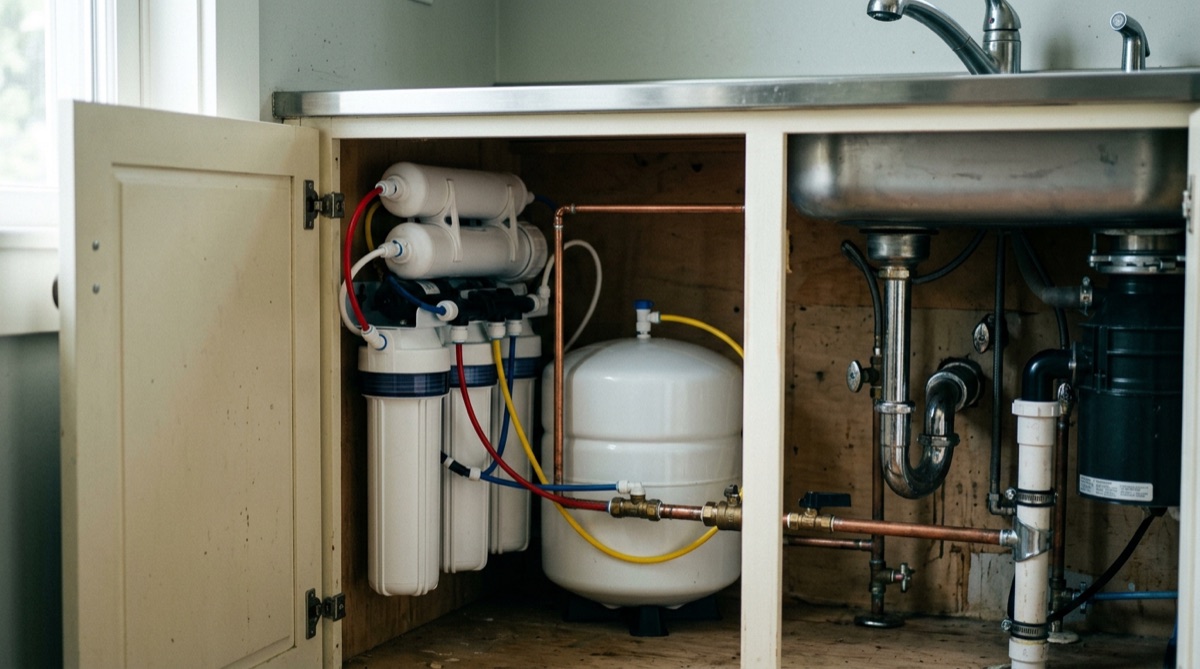
- Point-of-use reverse osmosis. An under-sink RO unit treats one tap — your kitchen drinking and cooking water. Since only ingested water carries meaningful risk, this is often the most cost-effective fix. It has the lowest long-term cost but won't cover other faucets, the ice maker, or whole-house use.
- Dedicated arsenic-removal media (iron-oxide / adsorptive). These tank-based systems use iron-oxide or similar adsorptive media that grab arsenic as water passes through. They handle Arsenic III well and can treat the whole house. The media is consumed over time and must be replaced periodically.
- Anion exchange. Works for Arsenic V but is sensitive to other water chemistry (sulfate, for instance), so it needs a full water profile before anyone specs it.
- Carbon filters — do not rely on them. Standard carbon is not an arsenic treatment. If a salesperson implies otherwise, that's a red flag.
Because arsenic interacts with iron, pH, and other minerals, the correct system depends entirely on your water chemistry. See our broader overview of well water treatment options for how arsenic fits alongside other common issues.
What Arsenic Treatment Costs
Costs vary widely with the technology and your water chemistry, but the ranges below reflect 2026 pricing for residential systems. The single biggest lever is whether you treat one tap (point-of-use) or the whole house (point-of-entry).
- Point-of-use RO typically runs $800–$1,500 installed and has the lowest 10-year cost — but it only treats one faucet.
- Dedicated arsenic media systems carry ongoing media replacement of roughly $400–$600 per change, with the media lasting anywhere from about 18 months to a few years depending on your arsenic level and how much water you use.
- Whole-house systems can climb well into the thousands once pre-treatment (an iron filter or pH adjustment) is added — iron filters alone run around $2,000.
- Don't forget retesting. Budget for a follow-up certified test after installation and periodically after, to confirm the system is actually working.
For context on the larger water-system picture — and where treatment sits relative to drilling and pump costs — see our well drilling cost guide.
Who Is Most at Risk and Should Test First
Everyone on a private well should test for arsenic at least once, because geology can surprise you. But some situations move you to the front of the line — test now, before another season goes by.
- You live in a known arsenic region. New England, the Upper Midwest, the Southwest, and parts of Texas have documented hotspots, but it can occur anywhere with the right bedrock.
- You have infants, young children, or someone pregnant in the home. Arsenic is especially harmful to the developing body, and well water is often used to mix formula.
- You've never tested, or it's been years. The EPA recommends annual testing, yet only about 30% of well owners test yearly. If arsenic has never been on a report, you don't know your number.
- You're buying a home on a well. Make a certified arsenic test part of the purchase — our guide to well inspection costs covers what to require before closing.
- Your well is near old orchards, farmland, or industrial land use. Historic arsenical pesticides and certain land uses can add to natural levels.
Frequently asked questions
Does a regular carbon or fridge filter remove arsenic?
No. Standard activated-carbon filters — pitchers, fridge filters, basic under-sink cartridges — are designed for taste, odor, and chlorine, not arsenic. Removing arsenic requires reverse osmosis or a dedicated adsorptive media (such as iron-oxide) sized to your water chemistry. Relying on carbon is a common and dangerous mistake.
Can I taste or smell arsenic in my well water?
No. Arsenic is completely colorless, odorless, and tasteless in water. Clear, great-tasting water can still test well above the EPA's 10 ppb limit. A certified lab test is the only way to know.
How much does it cost to test a private well for arsenic?
A standalone certified arsenic test typically costs about $30–$75. A broader first-time well panel that includes arsenic with bacteria, nitrates, and metals usually runs $150–$300. Some county health departments and state programs offer subsidized or free testing.
Is water below 10 ppb completely safe?
Below 10 ppb is legally compliant for public systems, but public-health researchers note that long-term exposure even at 5–10 ppb carries some elevated risk compared to zero. Treat 10 ppb as your action line — but with infants or children in the home, reducing levels further is reasonable.
Do I have to treat every faucet in the house?
Usually not. The health risk comes from drinking and cooking with the water, not from bathing or showering, since skin absorbs very little arsenic. That's why a point-of-use reverse osmosis system at the kitchen tap is often the most cost-effective solution.
Why does the type of arsenic matter for treatment?
Arsenic comes in two forms. Arsenic V is easy to filter, but Arsenic III — common in well water and more toxic — is electrically neutral and harder to remove. Effective systems often add an oxidation step to convert Arsenic III to Arsenic V first. This is why your test results should guide system selection, ideally with a professional.
Arsenic is the one well-water problem you cannot see, smell, or taste — and no one is checking it for you. Test once at a certified lab, and if your number comes back above 10 ppb, get a properly specced removal system from someone who has read your water chemistry. To get it right the first time, find a licensed well contractor near you who can test, interpret results, and install treatment matched to your well.
Sources: U.S. EPA, Chemical Contaminant Rules / Arsenic Rule (10 ppb MCL, MCLG zero); U.S. EPA, Arsenic Treatment Technology research; CDC / ATSDR, arsenic health effects; U.S. Geological Survey, arsenic in private wells (~2.1 million Americans above 10 ppb) and geogenic groundwater distribution; Massachusetts Department of Public Health and Connecticut Department of Public Health, arsenic in private well water; Maine CDC / State of Maine, free arsenic testing for low-income households; university extension testing programs (Penn State, UMass, Cornell); 2026 industry cost surveys (The Well Guide, Mid Atlantic Water, SC Well Service). Figures verified June 2026.

Author: Well Driller Finder Editorial Team
The Well Driller Finder editorial team researches and writes our guides on water-well drilling, pumps, and well water for homeowners across the US and Canada. We translate current cost data, NGWA and state well-construction standards, and EPA and CDC guidance into clear, practical answers. What we stand for: honest, independent help. Every price and claim is researched and fact-checked against multiple 2026 sources — never guessed, never borrowed from a single advertiser. We answer to homeowners, not to the companies we write about, because our only goal is to help you make a confident, well-informed decision about your water.
Find verified, local contractors who handle new installations, pump service, and water quality testing — in your area.