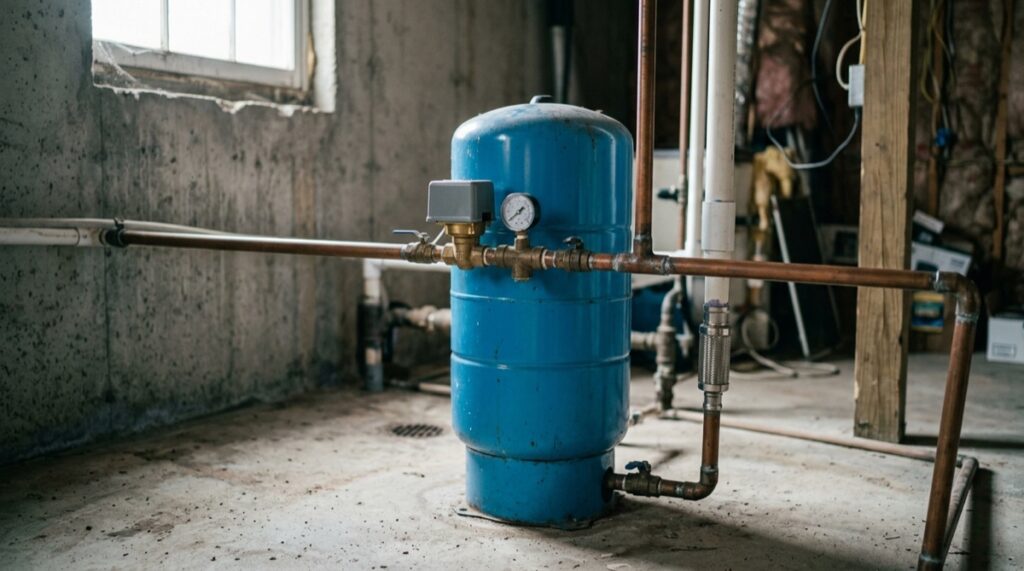
Your well pressure tank is one of the cheaper parts in the system to replace, yet a failing one is among the most expensive things to ignore. A new tank installed by a pro typically runs $300 to $1,500 depending on tank size, brand, and access — and large or hard-to-reach tanks can push higher. Leave it while the tank short-cycles your pump, though, and you can cut a pump rated for 15 to 20 years down to just a few years — turning a few hundred dollars into a $1,500-plus pump replacement.
What a Well Pressure Tank Does and Why It Fails
A pressure tank sits between your well pump and your household plumbing. Inside is a sealed rubber bladder (or a captive air chamber) that keeps a cushion of compressed air separated from the water. As the pump fills the tank, that air compresses and stores pressure. When you turn on a faucet, the stored air pushes water out — so for small draws, the pump never even has to start. That stored "drawdown" is the whole reason the pump isn't running constantly.
Tanks fail for a handful of common reasons:
- Bladder rupture. The internal bladder tears, letting water flood the air side. The bladder is not a serviceable part — once it ruptures, the tank must be replaced.
- Lost air charge. On older captive-air tanks, the pre-charged air slowly bleeds off or is absorbed into the water, leaving too little cushion.
- Corrosion and leaks. Steel tanks rust through at fittings or the base; a pinhole leak quietly drops performance.
- Failed Schrader (air) valve. The tire-style valve at the top leaks, so the tank can't hold its charge.
Industry sources put a typical pressure tank's service life at 10 to 15 years, depending on water quality, household demand, and whether the air charge is ever checked. If yours is approaching that window and you're seeing symptoms, age alone is a strong reason to suspect the tank.
Waterlogged Tank: Symptoms and a Quick Air-Charge Check
"Waterlogged" is the most common pressure tank failure: too much water and too little air inside, usually because the bladder ruptured or the air charge leaked away. With no cushion to absorb demand, the pump is forced to start and stop almost every time water moves through the house.
Watch for these signs:
- Rapid short-cycling. The pump clicks on and off every few seconds while a tap runs.
- A jumpy pressure gauge. The needle swings up and down quickly instead of holding steady through a draw.
- A solid-sounding tank. Tap the tank top to bottom. A healthy tank sounds hollow near the top (air) and solid near the bottom (water); a waterlogged tank sounds solid all the way up.
- Spitting or sputtering faucets as trapped air and pressure swings reach the taps.
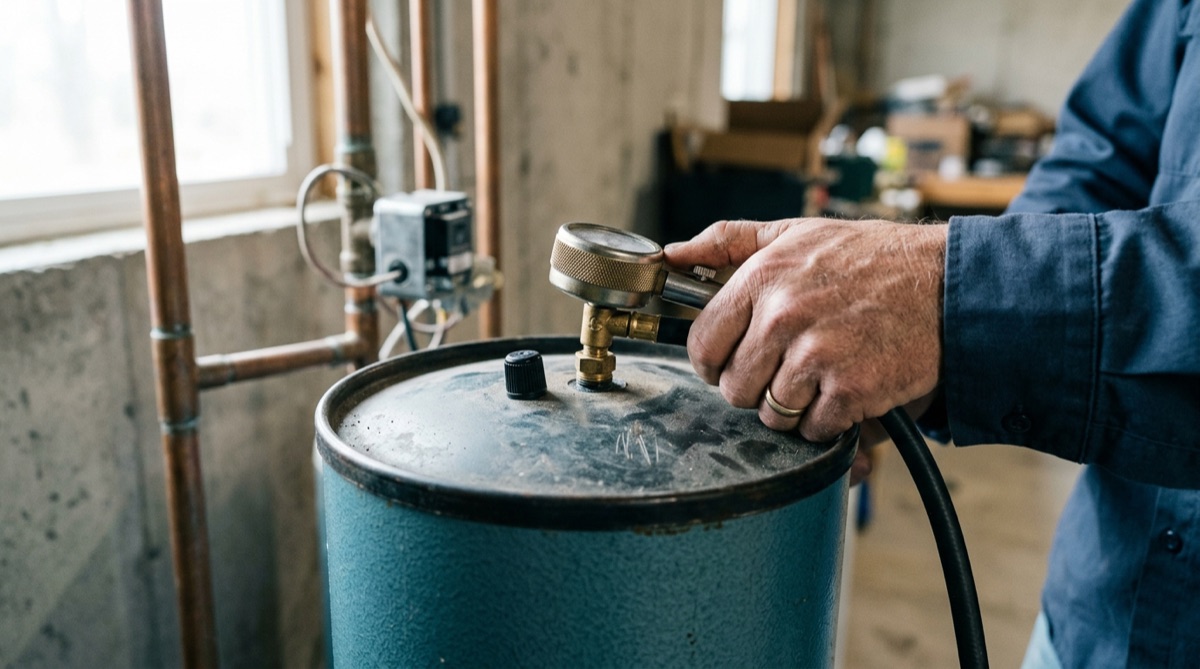
You can verify the air charge with a basic tire gauge. The correct pre-charge is 2 psi below your pump's cut-in pressure. On a common 40/60 pressure switch, the pump kicks on at 40 psi, so the tank should read about 38 psi measured at the Schrader valve with the system depressurized. If the gauge reads near zero or you get a spray of water out of the air valve, the bladder is gone and the tank needs replacing. (If the charge is simply low on a captive-air tank, topping it off may restore normal function.)
Short Cycling: Why the Pump Clicks On and Off Constantly
A correctly working system lets the pump run for several minutes, then rest. As a rule of thumb, a well pump should start no more than roughly 6 to 8 times per hour under normal demand — more than that with little water being used signals a problem. Short cycling means it's switching on and off every few seconds — and that's where the real damage happens.
Every motor start draws a surge of current and generates heat. When a pump cycles dozens of times an hour instead of a handful, the motor and bearings never get to cool, and wear accelerates dramatically. Sources describe pumps that would normally last 15 to 20 years failing within a few years — sometimes within months — under chronic short cycling. For a deeper look at how a pump signals its own decline, see our guide on the signs a well pump is failing.
A waterlogged tank is the most frequent cause, but not the only one:
- Lost or wrong air charge — the single most common cause; the cushion is gone.
- A clogged or fouled pressure switch or one set with too narrow a pressure band.
- A leak on the discharge side (a dripping fixture or pinhole pipe) that quietly bleeds pressure and re-triggers the pump.
- An undersized tank for the household's demand, giving too little drawdown between cycles.
Low or Fluctuating Water Pressure Causes
Not every tank problem announces itself with clicking. Sometimes the symptom is weak or surging pressure at the tap. The tank is a prime suspect, but it isn't the only one — diagnosing in order saves money:
- Wrong tank air charge — too high and flow stutters before the pump catches up; too low and pressure sags between cycles.
- A misadjusted pressure switch set below the household's needs (a 30/50 switch where a 40/60 would serve better).
- A clogged sediment filter or screen ahead of the fixtures, often paired with iron or hard-water buildup — see hard water and iron in well water.
- A weakening pump or dropping water level in the well itself, which can mimic a tank issue.
If pressure problems coincide with other red flags — air spitting from taps, sediment, or a dropping yield — the cause may be the well or pump rather than the tank. Our overview of how a well running dry behaves can help you tell the two apart before you call a pro.
Repair vs. Replace: How to Decide
The honest answer is that pressure tanks are mostly a replace-not-repair component. The bladder is the part that fails, and it cannot be replaced — so a ruptured-bladder tank is done. A few situations are genuinely fixable:
- Low air charge on a captive-air tank with an intact diaphragm — re-charge to 2 psi below cut-in and monitor.
- A leaking Schrader valve cap or core — a cheap part swap if the tank otherwise holds.
- A faulty pressure switch — often the real culprit behind short cycling, and far cheaper than a tank.
Replace the tank when you find a ruptured bladder, visible rust-through or leaks, a tank that won't hold any charge, or one simply past its 10-to-15-year service life. Given how inexpensive a tank is relative to the pump it protects, most well professionals lean toward replacement at the first sign of bladder failure rather than chasing a temporary fix.
2026 Well Pressure Tank Replacement Cost
The good news is that this is one of the more affordable well repairs. Cost estimates vary by source: Angi puts a typical professionally installed replacement at $300 to $700 (around $500 on average), while HomeGuide reports a higher $800 to $1,500 installed once larger tanks and labor are factored in. Taken together, most homeowners land somewhere in a $300 to $1,500 band, with large or hard-to-reach tanks running higher. The tank itself is the cheap part; labor and tank capacity drive most of the variation.
| Item | Typical 2026 Range | Notes |
|---|---|---|
| Bladder tank (unit only) | $150 – $400 | Most common modern type |
| Single-compartment tank (unit only) | $100 – $300 | Older captive-air style |
| Tank by capacity | ~$10 – $15 per gallon | Larger tank = fewer pump starts |
| Professional labor | $250 – $500+ | Higher for tight or hard-to-reach spaces |
| Installed total (Angi) | $300 – $700 | Around $500 on average |
| Installed total (HomeGuide) | $800 – $1,500 | Larger tanks / labor included |
| Difficult access / large tank | up to ~$2,500 | Hard-to-reach or oversized jobs |
Figures reflect 2026 cost data from HomeGuide and Angi. A bigger tank costs more up front but reduces pump starts, which can extend pump life — often a worthwhile trade. For where the tank sits in your overall well economics, see our well drilling cost guide.
How a Failing Tank Can Wreck Your Pump (and the Real Total Cost)
This is the part homeowners underestimate. A waterlogged tank doesn't just annoy you with a clicking pump — it methodically destroys the most expensive component in the system. Each rapid start adds heat and electrical stress the motor can't shed, and bearings, capacitors, and windings wear out far ahead of schedule.
The math is stark. A submersible pump replacement averages roughly $1,500 to $2,827 nationally in 2026, and deep-well installations can run $2,800 to $5,500. A pump that should have lasted 15 to 20 years can be reduced to just a few years — sometimes months — by chronic short cycling. So the tank you put off becomes a four-figure pump bill — sometimes plus the cost of pulling the old pump from the well. Replacing the cheap part on time is the single best way to protect the pricey one. Our well pump replacement cost breakdown shows exactly what's at stake if the tank takes the pump down with it.
Frequently asked questions
How do I know if my pressure tank is bad or my pump is failing?
Tap the tank: a waterlogged tank sounds solid top to bottom and the pump short-cycles every few seconds. Check the air charge at the Schrader valve — it should read about 2 psi below cut-in (38 psi on a 40/60 switch). A dead or water-spraying valve points to the tank. If the tank charge is correct but pressure still surges or sputters with air, the pump or well is the more likely cause.
Can a waterlogged pressure tank be repaired?
Usually not. The most common failure is a ruptured internal bladder, which is not a serviceable part — so the tank must be swapped out. If a captive-air tank has simply lost its charge but the diaphragm is intact, re-charging the air may restore it. A bad pressure switch or leaking air valve, by contrast, are inexpensive repairs.
How long should a well pressure tank last?
Typically 10 to 15 years, depending on water quality, household demand, and whether the air charge is ever maintained. Hard water, heavy use, and a neglected charge shorten that life. If your tank is in that age range and short-cycling, age plus symptoms is a strong case for replacement.
What pressure should my well tank be set to?
The tank's air pre-charge should sit 2 psi below the pump's cut-in pressure. On a 40/60 pressure switch the pump turns on at 40 psi, so the tank should read about 38 psi, measured at the Schrader valve with the system depressurized. Setting it too high stutters flow; too low drives short cycling.
Is it normal for my well pump to turn on and off frequently?
No. A healthy pump should start no more than about 6 to 8 times per hour under normal use, running several minutes per cycle. Switching on and off every few seconds is short cycling, and it wears out the motor fast. It usually traces back to a waterlogged tank or lost air charge — diagnose and fix it quickly.
How much does it cost to replace a well pressure tank in 2026?
Estimates vary by source: Angi reports about $300 to $700 installed (around $500 on average), while HomeGuide puts the figure at $800 to $1,500 once larger tanks and labor are included — so most jobs fall in a $300 to $1,500 band, with difficult-access or oversized tanks running higher. The tank unit itself runs roughly $100 to $400, capacity costs about $10 to $15 per gallon, and labor adds $250 to $500 or more. It's far cheaper than the pump it protects.
A short-cycling pump is a clock ticking on an expensive repair — the sooner a tank issue is diagnosed and fixed, the more likely you are to save the pump. Find a licensed well contractor near you to verify the air charge, test the bladder, and size the right tank for your home.
Sources: HomeGuide — Cost to Replace a Well Pressure Tank (2026) & Well Pump Cost (2026); Angi — Well Tank Replacement Cost (2026) & Well Pump Replacement Cost (2026); Fresh Water Systems — Well Pressure Tank Problems and How to Check Your Tank's Pressure. Cost ranges are national averages; local pricing varies by region, tank size, and access.

Author: Well Driller Finder Editorial Team
The Well Driller Finder editorial team researches and writes our guides on water-well drilling, pumps, and well water for homeowners across the US and Canada. We translate current cost data, NGWA and state well-construction standards, and EPA and CDC guidance into clear, practical answers. What we stand for: honest, independent help. Every price and claim is researched and fact-checked against multiple 2026 sources — never guessed, never borrowed from a single advertiser. We answer to homeowners, not to the companies we write about, because our only goal is to help you make a confident, well-informed decision about your water.
Find verified, local contractors who handle new installations, pump service, and water quality testing — in your area.