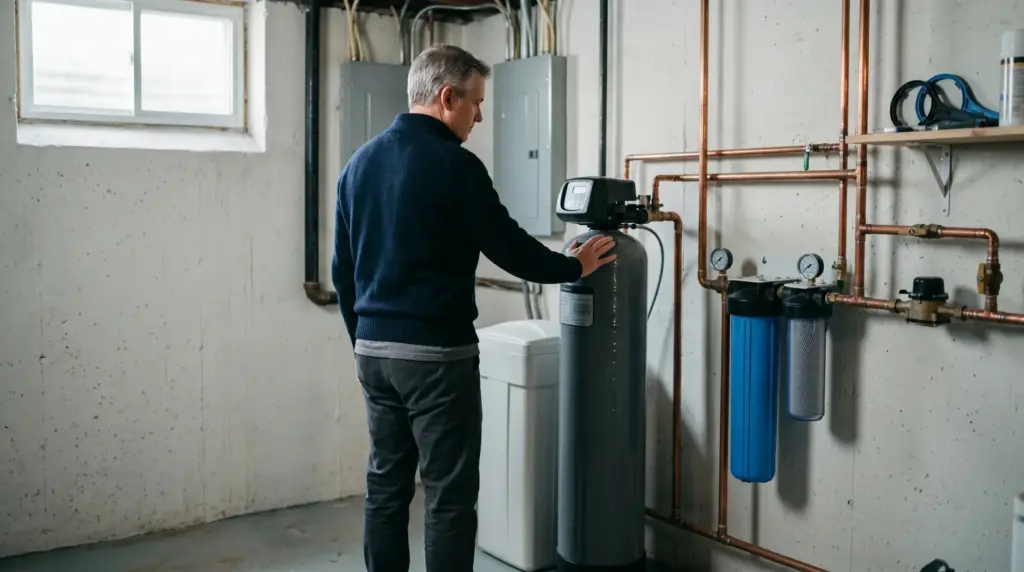
Walk into any home-improvement store, or fall down a late-night internet rabbit hole, and you'll hit the same wall of confusion: water softeners, water filters, conditioners, purifiers, "whole-house systems." They all promise better water. The salespeople blur the lines on purpose. And if you've got a private well, the stakes are higher, because no city utility is treating your water before it reaches your tap. It's on you.
Here's the single most useful thing to understand, and it clears up most of the confusion right away:
A water softener fixes one specific problem: hardness. Scale on your faucets, soap that won't lather, spotty dishes, dry skin, a water heater that dies young. That's it. A softener does that one job extremely well and does almost nothing else.
A water filter fixes everything else: contaminants, bad taste, rotten-egg smell, sediment, iron stains, and health-related pollutants like nitrate, arsenic, or bacteria. "Filter" is really an umbrella term covering several different technologies, each aimed at different problems.
They are not interchangeable. A softener will not make unsafe water safe to drink. A filter will not stop your shower glass from getting that cloudy white crust. Buy the wrong one and you've spent a couple thousand dollars solving a problem you didn't have, while the one that bugs you every day goes untouched.
This guide walks you through exactly how to tell which device your well needs, when you genuinely need both, what order they go in, and roughly what it all costs. But before any of that, one rule that overrides everything below.
Rule Zero: Test Your Water Before You Buy Anything
You cannot pick the right equipment until you know what's actually in your water. This is the mistake that costs people the most money, buying a system based on a symptom or a salesperson's hunch instead of a lab report.
The CDC recommends that private well owners test their water at least once a year for total coliform bacteria, nitrate, total dissolved solids, and pH, and to check with the local health department about what else to test for based on your area, such as lead, arsenic, or pesticides, depending on local geology and land use.1 A good well-water panel will also report your hardness (in grains per gallon or mg/L), iron, manganese, and hydrogen sulfide, which are exactly the numbers you need to size a softener or a filter correctly.
A water test turns guesswork into a shopping list. If your report says 18 grains of hardness and nothing else of concern, you need a softener and you're done. If it says low hardness but 6 mg/L of nitrate and a positive coliform hit, a softener would be a complete waste of money, you need treatment aimed at those contaminants. We walk through exactly how to do this in how to test your well water. Do that first. Everything below assumes you have a test report in hand.
What a Water Softener Actually Does (and Doesn't)
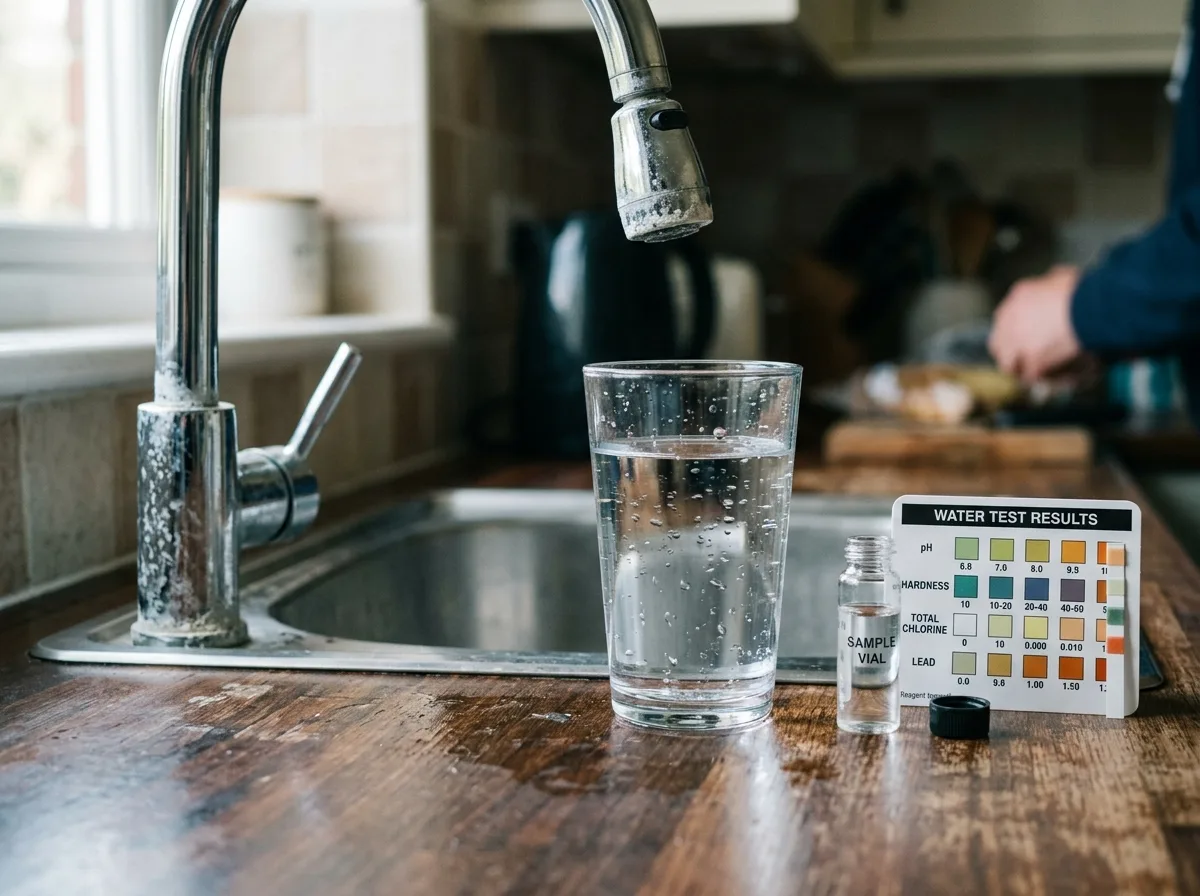
Hard water is water carrying dissolved calcium and magnesium. These minerals aren't harmful to drink, which is why the EPA doesn't enforce a federal limit on hardness at all.2 But they wreak practical havoc: they bond with soap to leave scum and film, they form hard scale inside pipes, water heaters, and dishwashers, and they shorten the life of every water-using appliance in the house.
A standard water softener uses a process called ion exchange. Inside the tank is a bed of resin beads charged with sodium. As hard water flows through, the calcium and magnesium ions stick to the beads, and an equivalent amount of sodium is released into the water. The EPA describes it plainly: cation-exchange softeners "remove the calcium and magnesium ions found in hard water by exchanging them with sodium (or potassium) ions."3 Done right, ion exchange removes nearly all of the hardness minerals from the water.4
Periodically the resin fills up and has to be cleaned, a cycle called regeneration, in which a strong brine solution rinses the calcium and magnesium off the beads and down the drain, recharging them with fresh sodium. This is why softeners need a salt tank you refill, and why they use extra water: the EPA notes regeneration can use 25 gallons of water or more per day, up to about 10,000 gallons a year.3
Here's where most people go wrong. A softener:
- Does eliminate scale, soap scum, spotty dishes, and that "filmy" feeling, and protects your appliances.
- Does not remove bacteria, nitrate, arsenic, lead, PFAS, pesticides, or volatile chemicals.
- Does not improve taste or odor in any meaningful way (it won't touch the rotten-egg sulfur smell or a chemical taste).
- Does not remove sediment, and it can only handle a small amount of iron, more than a few ppm will damage it (more on that below).
If your only complaints are scale and soap, a softener is the entire answer. If your complaint is anything to do with safety, taste, or smell, the softener is the wrong tool.
How Hard Is "Hard"? The USGS Scale
The U.S. Geological Survey classifies hardness on a simple scale, measured in milligrams per liter of calcium carbonate (mg/L), which equals parts per million:5
| Classification | mg/L (ppm) | Grains per gallon (gpg) |
|---|---|---|
| Soft | 0 – 60 | 0 – 3.5 |
| Moderately hard | 61 – 120 | 3.6 – 7.0 |
| Hard | 121 – 180 | 7.1 – 10.5 |
| Very hard | Over 180 | Over 10.5 |
The mg/L ranges come straight from the USGS.5 To convert to the grains-per-gallon (gpg) figures your softener dealer will use, one grain per gallon equals about 17.1 mg/L.6 Most water-treatment pros consider a softener worthwhile once you're consistently above roughly 7 gpg (about 120 mg/L), and well water frequently runs well into the "very hard" range. Your test report will give you the exact number you need to size the system.
What a Water Filter Actually Does
"Water filter" isn't one device, it's a category. The right one depends entirely on what your test found. Here are the four you'll actually encounter for well water, and what each is for.
Sediment filters
The simplest type, a physical screen or cartridge that catches sand, silt, rust flakes, and grit, common in wells. Cheap, and usually the first stage in any larger system. It does nothing for dissolved contaminants or taste.
Activated carbon filters
The workhorse for taste and odor. Carbon adsorbs chlorine, organic chemicals, pesticides, many volatile organic compounds (VOCs), and the compounds behind bad tastes and smells. Carbon filters certified to NSF/ANSI Standard 53 are independently verified to reduce specific health-related contaminants such as lead, certain VOCs, and microbial cysts; Standard 42 covers aesthetic effects like taste, odor, and chlorine.7 Carbon is what kills a chemical taste or musty smell. It does not remove dissolved minerals, nitrate, or most salts.
Reverse osmosis (RO)
The heavy hitter. RO pushes water through an extremely fine membrane that blocks a very broad range of dissolved contaminants, heavy metals, nitrate, arsenic, fluoride, and more. Systems certified to NSF/ANSI Standard 58 are tested for reducing total dissolved solids and can carry specific claims for contaminants like arsenic, nitrate, lead, and chromium-6.7 RO is usually installed as a point-of-use unit under the kitchen sink, because it's overkill (and expensive) to run your whole house through it.
Specialty filters for iron, sulfur, and contaminants
Wells often need a targeted filter: an oxidizing iron filter for orange staining, a system for the rotten-egg sulfur smell, or treatment for a specific contaminant your test flagged. We cover the most common well nuisances in hard water and iron in well water, and the full menu of approaches in well water treatment options.
One modern point worth knowing: for the newer "forever chemicals" (PFAS), the EPA finalized national drinking-water limits in 2024, setting 4 parts per trillion for PFOA and PFOS individually and 10 ppt for several others.8 Those limits apply to public water systems, not private wells, but if your area has known PFAS, the EPA confirms that granular activated carbon and reverse osmosis point-of-use systems can greatly reduce it.9 A softener does nothing for PFAS.
The Decision Framework: Match the Symptom to the Device
This is the part to bookmark. Find your symptom on the left; the right column tells you the device. (Always confirm with a test, but this is the map.)
| What you're noticing | Likely cause | What you need |
|---|---|---|
| White crusty scale on faucets, kettle, glass shower doors | Hardness | Softener |
| Soap won't lather; filmy residue on skin and dishes | Hardness | Softener |
| Dry skin and hair after showering | Hardness | Softener |
| Water heater failing early / appliances scaling up | Hardness | Softener |
| Chlorine, chemical, or musty taste/smell | Chlorine, VOCs, organics | Carbon filter |
| Rotten-egg (sulfur) smell | Hydrogen sulfide | Specialty / oxidizing filter |
| Orange/brown staining on fixtures and laundry | Iron / manganese | Iron filter (before any softener) |
| Sand, grit, or cloudiness | Sediment | Sediment filter |
| Failed bacteria test (coliform/E. coli) | Microbial contamination | Disinfection (UV / chlorination) |
| High nitrate, arsenic, lead, or PFAS on your report | Dissolved contaminants | Reverse osmosis (point-of-use) |
Notice the pattern: every "feel" and "appearance" problem (scale, soap, dry skin) points to a softener, and every "taste, smell, safety, or color" problem points to some kind of filter. They live in different worlds. That's why so many well owners end up needing one of each.
When You Need BOTH (and Most Wells Do)
Here's the reality for a lot of private wells: the water is both hard and has a contaminant or aesthetic issue. Hard water with iron staining. Hard water with high nitrate. Hard water that also tastes off. In those cases neither device alone gets you all the way, and the right answer is a softener and a filter working together.
The classic well-water setup is:
- Whole-house treatment (softener, plus an iron/sediment/carbon stage if needed) on the main line, so every tap, shower, and appliance gets protected water.
- A point-of-use reverse osmosis unit under the kitchen sink for the water you actually drink and cook with, handling the health-related contaminants the whole-house gear isn't built for.
This split is deliberate and cost-smart. Softening every gallon makes sense (you bathe, wash, and run appliances on all of it). But running your entire house through RO is wildly expensive and wasteful when you only drink and cook with a small fraction. So you soften everything and finely purify just the drinking water. Whole-house treatment stacks for well water that combine sediment, iron removal, and carbon commonly run $2,000–$6,000 or more once you're dealing with multiple issues.10
Order Matters: What Goes First
When you're combining devices, the sequence isn't optional, get it wrong and you'll wreck an expensive component. The reason is iron.
A softener can handle only a small amount of iron, roughly 1–3 ppm of dissolved (ferrous) iron, before the iron starts coating the resin beads and permanently reducing the softener's capacity, a problem called "iron fouling."11 And iron stains start showing up at very low levels: the EPA's secondary (aesthetic) guideline for iron is just 0.3 mg/L, and noticeable staining can begin even lower, around 0.05 mg/L.12 So if your test shows meaningful iron, a dedicated iron filter has to come before the softener to protect it.
The standard whole-house order for well water is:
- Sediment filter first, catches grit so it doesn't clog everything downstream.
- Iron / manganese filter next (if your test calls for it), protects the softener from fouling.
- Water softener, removes hardness from already iron-free, sediment-free water.
- Carbon filter for taste/odor, often after the softener.
- Disinfection (UV) last if bacteria are a concern, on clear, treated water so the UV light can do its job.
- Point-of-use RO at the kitchen sink for drinking water.
You don't need every stage, you need the stages your test report justifies. But the order among the ones you do install matters. This is exactly the kind of sequencing where a licensed local well or water-treatment pro earns their fee; getting it backwards can cost you a softener.
What It All Costs
Real numbers help. These are typical installed-cost ranges from 2025–2026 industry pricing data, your actual cost depends on your water test, your region, and how much plumbing has to be rerouted.
| Equipment | Typical installed cost | Ongoing cost |
|---|---|---|
| Salt-based softener (ion exchange) | $500 – $2,500+ (avg ~$1,500) | Salt ~$5–$10 per 40-lb bag; service plans $100–$300/yr |
| Salt-free conditioner | $800 – $4,000 | ~$60–$170/yr media replacement |
| Whole-house carbon/sediment (basic) | $850 – $1,400 | $50–$300/yr filter changes |
| Whole-house well treatment stack (sediment + iron + carbon) | $2,000 – $6,000+ | $50–$300/yr |
| Under-sink reverse osmosis | ~$250 – $950 | Filters $80–$150/yr; membrane every 2–5 yrs |
| Whole-house reverse osmosis | $4,000 – $11,000 | $400–$700/yr |
Sources for these ranges are listed at the end.10,13,14 A few things to budget for that catch people off guard: plumbing modifications can add a few hundred dollars, and some jurisdictions require a permit, which can add $200–$500.13 For a deeper look at well-related project costs, see our well cost guide and the calculators in our tools section.
Salt vs. Salt-Free: An Important Distinction
You'll see "salt-free water softeners" advertised heavily, and the name is genuinely misleading. They don't soften water in the technical sense.
A traditional salt-based softener removes calcium and magnesium through ion exchange, your water is actually softer afterward. A salt-free "conditioner" uses a different approach, usually Template Assisted Crystallization (TAC), which doesn't remove the hardness minerals at all. Instead it converts them into tiny, stable crystals that stay suspended in the water and don't stick to surfaces.15 The minerals are still in your water; they just don't form scale on your pipes and fixtures as readily.
What that means in practice:
- Salt-based softener: Truly soft water, no scale, slippery-soft feel, better lather, full appliance protection. Downsides: needs salt and a drain, uses extra water for regeneration, and adds a little sodium to your water.
- Salt-free conditioner: Good scale prevention with no salt, no electricity, no wastewater, and very low maintenance. Downsides: water doesn't feel "soft," won't fix the soap-scum/spotting issues as completely, and it's the wrong choice if you have significant iron.
If hard-water scale on your equipment is the worry, a salt-free conditioner can be a fine, low-hassle choice. If you want the full soft-water experience, lather, no spots, no film, a salt-based system is the only thing that delivers it.
A Note on Sodium
People on sodium-restricted diets sometimes worry about salt-based softeners. The amount added is small and proportional to your hardness, roughly 8 mg of sodium per liter for each grain of hardness removed.4 At 10 grains of hardness, that's about 80 mg of sodium per liter, still less than you'd get from a single tablespoon of ketchup. If it's still a concern, you can run a salt-based softener on potassium chloride instead of sodium chloride; it works the same way and releases potassium instead of sodium. Many households also simply drink from the unsoftened cold line or the RO tap and let the softener handle everything else.
Whole-House vs. Point-of-Use
One more axis that trips people up: where the device goes.
Whole-house (point-of-entry) systems treat all the water entering your home. Softeners almost always go here, you want soft water at every shower, sink, and appliance. Sediment, iron, and carbon stages usually go here too.
Point-of-use systems treat water at a single tap, almost always the kitchen sink. Reverse osmosis is the classic example: you don't need RO-purified water to flush a toilet or wash laundry, so you install it only where you drink and cook. It's far cheaper and more efficient than purifying the whole house.
The general logic: soften and pre-filter the whole house, finely purify only the drinking water. That combination covers the vast majority of well-water situations without overspending.
Putting It Together: Your Game Plan
Step back and the whole thing is simple:
- Test first. Get a full well-water panel so you know your hardness, iron, and any contaminants. No test, no smart purchase.
- Hardness only? A softener (or salt-free conditioner) solves it. You're done.
- Contaminants, taste, or smell only? The matching filter solves it. Skip the softener.
- Both? Plan a whole-house setup (softener plus the filters your test calls for) and a point-of-use RO at the kitchen sink, installed in the correct order.
- Bacteria on the report? Treat that as a safety priority, disinfect, and don't rely on a softener or carbon filter to handle it.
Because well-water treatment so often involves stacking several devices in the right sequence, and because a mistake (like putting a softener ahead of an iron filter) can ruin expensive equipment, this is a good place to bring in a professional. A licensed local well or water-treatment contractor can read your test report, size the system to your household's water use, and install it so each stage protects the next. If you'd like to compare options without the hard sell, you can get free quotes from licensed water-well and treatment pros in your area through Well Driller Finder, and use them to sanity-check what any one company is recommending.
The bottom line: a softener and a filter aren't competitors, they're two different tools for two different jobs. Once you know which job your water actually needs done, the choice makes itself.
Frequently Asked Questions
Does a water softener also filter out contaminants?
No. A water softener only removes hardness minerals (calcium and magnesium) through ion exchange. It does not remove bacteria, nitrate, arsenic, lead, PFAS, pesticides, or sediment, and it does not meaningfully improve taste or odor. If your water has any health or aesthetic concern beyond hardness, you need a filter designed for that contaminant, not a softener.
If I install reverse osmosis, do I still need a softener?
Usually yes, if your water is hard. Reverse osmosis is typically installed only at one tap (the kitchen sink) for drinking and cooking, so it does nothing for the hard water flowing to your showers, laundry, and water heater. You'd still get scale and soap scum everywhere else. Many well owners pair a whole-house softener with a point-of-use RO unit. (As a bonus, softening the water first can extend the life of an RO membrane by reducing scaling.)
Is a salt-free system as good as a real softener?
It depends on what you want. Salt-free conditioners (Template Assisted Crystallization) don't actually remove hardness; they convert the minerals into crystals that don't stick to surfaces, so they're good at preventing scale with no salt, no wastewater, and low maintenance. But your water won't feel "soft," and they won't fully eliminate soap scum and spotting the way a salt-based ion-exchange softener does. For true soft water, you need salt-based.
My well water has iron stains. Will a softener fix that?
Only at very low levels. A softener can handle roughly 1–3 ppm of dissolved iron, but beyond that the iron coats and permanently damages the resin (iron fouling). Since iron staining can appear at as little as 0.05 mg/L and the EPA's aesthetic guideline is 0.3 mg/L, most wells with visible orange staining need a dedicated iron filter installed before the softener, not a softener alone.
How do I know if my well water is hard?
Test it. Hardness is reported in grains per gallon (gpg) or mg/L. Using the USGS scale, anything over about 120 mg/L (roughly 7 gpg) is "hard," and over 180 mg/L (about 10.5 gpg) is "very hard." You can also spot the signs, white scale on faucets and shower glass, soap that won't lather, spotty dishes, and dry skin, but a test gives you the exact number needed to size a softener correctly.
What should I test my well water for before buying any treatment?
The CDC recommends testing private wells at least annually for total coliform bacteria, nitrate, total dissolved solids, and pH, plus anything common in your area, such as lead, arsenic, or pesticides, that your local health department flags. For equipment sizing, make sure your panel also reports hardness, iron, manganese, and hydrogen sulfide. That single report tells you whether you need a softener, a filter, both, or neither.
How much should a complete well-water treatment setup cost?
It varies widely by what your water needs. A salt-based softener alone runs roughly $500–$2,500 installed. A whole-house well stack combining sediment, iron removal, and carbon commonly runs $2,000–$6,000 or more. An under-sink reverse osmosis unit adds roughly $250–$950. Permits and plumbing changes can add a few hundred dollars on top. Getting quotes from two or three licensed local pros is the best way to know your real number.

Author: Well Driller Finder Editorial Team
The Well Driller Finder editorial team researches and writes our guides on water-well drilling, pumps, and well water for homeowners across the US and Canada. We translate current cost data, NGWA and state well-construction standards, and EPA and CDC guidance into clear, practical answers. What we stand for: honest, independent help. Every price and claim is researched and fact-checked against multiple 2026 sources — never guessed, never borrowed from a single advertiser. We answer to homeowners, not to the companies we write about, because our only goal is to help you make a confident, well-informed decision about your water.
Find verified, local contractors who handle new installations, pump service, and water quality testing — in your area.