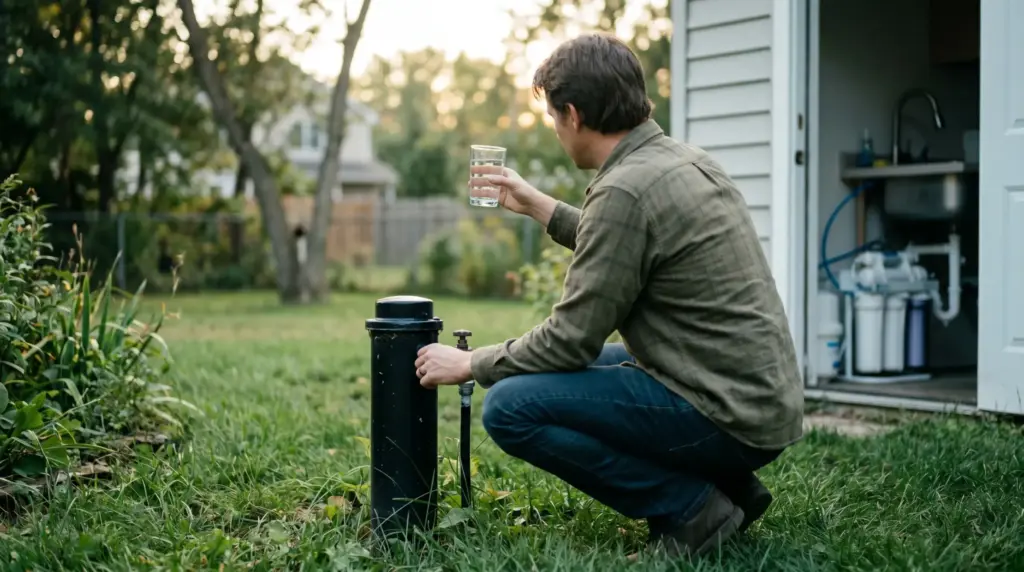
If you draw your water from a private well, there is one contaminant you almost certainly are not testing for, and it is one of the few that the federal government now regulates down to a few parts per trillion. PFAS, the family of synthetic compounds nicknamed "forever chemicals," don't smell, don't taste, and don't change the color of your water. They are invisible by every sense you have. And unlike a public water utility, which is now required to test for them, nobody checks your well unless you ask.
That gap is the whole problem. A landmark U.S. Geological Survey study estimated that at least 45% of tap water across the country contains one or more PFAS, and found that PFAS profiles and concentrations in private wells were broadly similar to those in public systems. Your well isn't automatically safer just because it's yours. This guide walks through what PFAS actually are, why private wells are uniquely exposed, what the 2024 EPA limits say (and what changed in 2025), how to get a real test done, and which treatment systems genuinely remove these chemicals, versus the popular options that do nothing at all.
- ✓Reverse osmosis — >99% of most PFAS (look for NSF/ANSI 58)
- ✓Granular activated carbon — certified to NSF/ANSI 53
- ✓Anion-exchange resin — certified to NSF/ANSI 53
- ✕Boiling — can actually concentrate PFAS
- ✕Water softeners — remove hardness, not PFAS
- ✕Standard carbon pitchers / fridge filters — unless specifically PFAS-certified
- ✕Shock chlorination — does nothing to PFAS
What PFAS Actually Are, and Why "Forever" Is Not Marketing Hype
PFAS stands for per- and polyfluoroalkyl substances. They're a family of more than 12,000 individual chemicals built around an extremely strong carbon-fluorine bond, which is exactly why they were so useful in the first place. That bond resists heat, water, grease, and stains, so PFAS went into nonstick cookware, waterproof jackets, stain-resistant carpet, fast-food wrappers, cosmetics, and firefighting foam.
The same bond that makes them useful makes them nearly indestructible in the environment. They don't break down meaningfully in soil or groundwater, they don't get filtered out by conventional water treatment, and they accumulate in the human body over years. That's the "forever" part, and it's literal, not a slogan.
Two of the most-studied compounds are PFOA (perfluorooctanoic acid, once used to make Teflon) and PFOS (perfluorooctane sulfonic acid, used in Scotchgard and firefighting foam). Both were largely phased out of U.S. manufacturing years ago, but because they don't degrade, they're still showing up in well water today. Newer replacement chemicals like GenX (HFPO-DA) carry many of the same concerns.
What the science says about health
This is where it pays to be precise, because PFAS coverage online swings between panic and dismissal. Here is how the actual health agencies describe it. According to the CDC's Agency for Toxic Substances and Disease Registry (ATSDR), studies have found associations between PFAS exposure and:
- Increased cholesterol levels
- A lower antibody response to some vaccines (a weakened immune response)
- Changes in liver enzymes
- Pregnancy-induced high blood pressure and preeclampsia
- Small decreases in infant birth weight
- Increased risk of kidney and testicular cancer (linked specifically to PFOA)
ATSDR is careful to call these associations, and notes the strength of evidence varies and research is ongoing. But the EPA went a step further in its 2024 rule: it set the health-based goal for PFOA and PFOS at zero, concluding there is no level of exposure to these two chemicals that is without risk of health effects. That is an unusually strong position for a regulator, and it's the reason the legal limits landed so low.
Why Private Wells Are Especially at Risk
Two things stack the deck against well owners. First is proximity, and second is the complete absence of routine testing.
PFAS contamination tends to cluster around specific sources, and groundwater carries it. In fact, USGS research found that proximity to contamination sources is one of the strongest predictors of whether PFAS shows up in a well at all. Penn State Extension and multiple state health departments flag these as the high-risk neighbors:
- Military bases and airports. Firefighting foam (AFFF) used in training and emergencies is a major PFAS source. Studies of private wells near military installations that used this foam have found PFAS in a large share of them, well above background rates.
- Fire-training facilities where that same foam was sprayed for decades.
- Industrial sites that manufactured or used PFAS, including textile, paper, plastics, and electronics plants.
- Landfills and dumps, where consumer products containing PFAS leach into groundwater.
- Farm fields treated with biosolids, the treated sewage sludge sometimes spread as fertilizer, which can carry PFAS onto land and into shallow aquifers.
The second problem is structural. When you're on a public water system, the utility is now legally required to monitor for PFAS and notify you if levels are high. When you're on a private well, you are the water utility. No agency tests your water, no one sends you a report, and standard well-water test panels, the ones you might run for bacteria, nitrates, or hardness, do not include PFAS. You have to specifically request it, and it costs noticeably more than a routine test. The result is that countless wells with elevated PFAS are simply never checked.
This is one more reason the basics of testing your well water matter so much: a clean bacteria result tells you nothing about forever chemicals. They're a separate question entirely.
The 2024 EPA Limits, and What Changed in 2025
In April 2024, the EPA finalized the first-ever national, legally enforceable drinking water standard for PFAS. It set maximum contaminant levels (MCLs) for six compounds, with the rule becoming effective June 25, 2024. Here are the original 2024 figures:
| PFAS compound | 2024 EPA limit (MCL) | Health-based goal (MCLG) |
|---|---|---|
| PFOA | 4.0 parts per trillion (ppt) | Zero |
| PFOS | 4.0 parts per trillion (ppt) | Zero |
| PFHxS | 10 ppt | 10 ppt |
| PFNA | 10 ppt | 10 ppt |
| HFPO-DA (GenX) | 10 ppt | 10 ppt |
| Mixtures of PFHxS, PFNA, GenX, PFBS | Hazard Index of 1 (unitless) | Hazard Index of 1 |
To put 4 parts per trillion in perspective: that's roughly four drops of water spread across about 20 Olympic-sized swimming pools. The fact that EPA set an enforceable limit that low tells you how seriously the agency takes these two compounds.
The important 2025 update
Here's where you need the current picture, not last year's. In May 2025, the EPA announced changes to the rule, which it has been working through proposed rulemaking since:
- The 4.0 ppt limits for PFOA and PFOS stayed in place as enforceable standards, but the EPA moved to give public water systems an option to request two extra years, until 2031, to comply.
- The EPA announced its intent to rescind and reconsider the limits for PFHxS, PFNA, GenX, and the Hazard Index. As of mid-2026 those four are working through a separate rulemaking rather than being firmly settled.
What does that mean for you as a well owner? Two practical things. First, the 4 ppt benchmark for PFOA and PFOS is the number to anchor on; it has survived the reconsideration and reflects the EPA's strongest health position. Second, these federal limits legally apply to public water systems, not to private wells. Nobody will force you to meet them. But they're the best available yardstick for deciding whether your well water is safe, and many states set their own standards that may differ. When in doubt, treat the 4 ppt PFOA/PFOS figure as your line in the sand.
How to Test Your Well for PFAS
You cannot test for PFAS with a home test strip, a tap-mounted gadget, or the standard mail-in kit you'd use for hardness or iron. PFAS detection happens at the parts-per-trillion level, which requires sophisticated lab instruments and meticulous sample handling. Here's how to do it right.
1. Use a lab certified for EPA Method 533 or 537.1
These are the two EPA-approved drinking water methods, and the difference between them matters:
- EPA Method 537.1 measures 18 PFAS compounds, including PFOA and PFOS.
- EPA Method 533 measures 25 compounds and, importantly, is designed to catch the shorter-chain PFAS that Method 537.1 can miss. It's a strong choice for private wells because it's less likely to return a misleading "non-detect" for those compounds.
Ask the lab directly whether it's state-accredited for PFAS drinking water analysis using one of these methods. Many ordinary water-testing labs are not equipped for PFAS at all, and only a minority of certified labs can run these analyses. Your state's drinking water or environmental agency usually keeps a list of accredited labs.
2. Follow the sampling instructions exactly
PFAS sampling is unusually fussy because PFAS are in so many everyday products that they can contaminate the sample itself. The lab will send special bottles and a strict protocol, which typically tells you to avoid certain clothing (no waterproof or stain-treated fabrics), skip cosmetics and sunscreen that day, and not use any plastic wrap or sticky notes near the sample. Follow it to the letter, or you risk a false positive.
3. Budget for the cost
A PFAS test runs roughly $250 to $500 per sample, considerably more than a basic well-water panel, because of the specialized equipment involved. Before you assume you have to pay full price, check whether your state has a free or subsidized testing program. Several states, including Colorado and parts of New York, have launched programs offering free PFAS testing to private well owners, especially near known contamination. Your county or state health department is the place to ask.
Who should test first?
If your budget is tight, prioritize testing if any of the high-risk neighbors from earlier, military base, airport, fire-training site, industrial facility, landfill, or biosolid-treated farmland, are within a few miles of your well. A shallow well (under about 100 feet) near one of these sources is a particularly strong candidate. If you have an infant, are pregnant, or are planning a pregnancy, that's another strong reason to move it up the list, given the developmental concerns. And if you're buying a home with a well, a PFAS test belongs on your inspection checklist, especially in a region with known contamination.
Which Treatments Actually Remove PFAS, and Which Don't
This is the section where money gets wasted, so let's be blunt about it. The EPA has identified a short list of technologies that genuinely remove PFAS. Everything else is either ineffective or actively counterproductive.
What works
The EPA lists three technologies as effective for PFAS removal, and all three are available in home-scale systems:
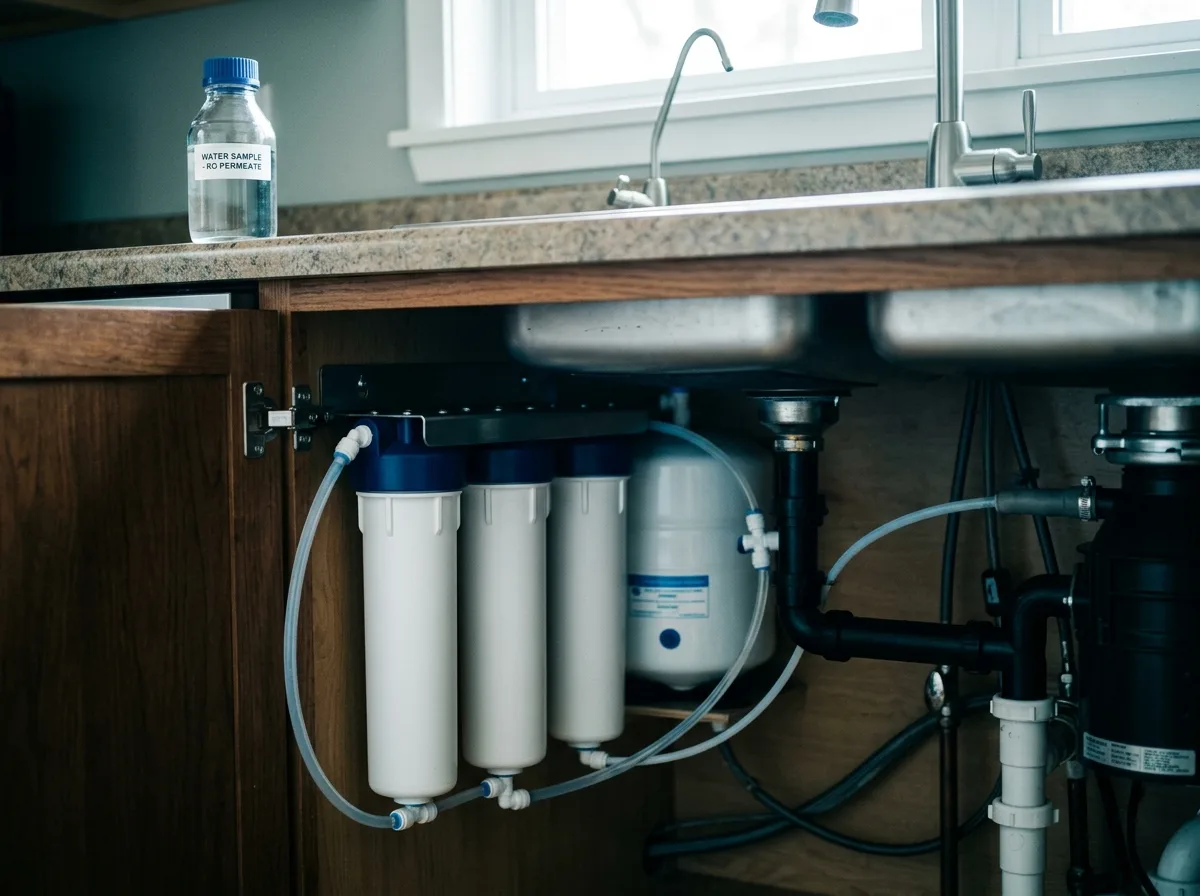
- Reverse osmosis (RO). The most thorough option for a household. RO membranes remove more than 99% of most PFAS and perform well even against the harder-to-catch short-chain compounds. Typically installed as an under-sink, point-of-use system for drinking and cooking water. The tradeoffs are that it wastes some water and treats only one tap, not the whole house.
- Granular activated carbon (GAC). The most common PFAS treatment, GAC works by adsorbing the chemicals onto carbon's vast porous surface. It's effective on the longer-chain PFAS like PFOA and PFOS and can be sized either for a single faucet or for the whole house (point-of-entry). The catch is that the carbon eventually saturates and must be replaced on schedule, and it is less reliable against the shortest-chain compounds.
- Anion exchange resin. A specialized resin that grabs PFAS molecules and is often used in whole-house systems. It can outperform GAC on certain compounds.
If you want the broader picture of how these fit alongside other water-quality fixes, our guide to well water treatment options walks through the full menu. PFAS treatment overlaps heavily with the same technologies used to tackle other tough contaminants, the way reverse osmosis is also the go-to for arsenic in well water.
What does NOT work
Save yourself the disappointment:
- Boiling. Worse than useless. Boiling does not destroy PFAS, and because some water evaporates, it can slightly concentrate what's left.
- Water softeners. Softeners are built to remove calcium and magnesium hardness. They have essentially no effect on PFAS.
- Standard sediment filters and most basic carbon pitchers. Ordinary carbon pitchers and fridge filters are designed for taste and chlorine, not PFAS. Unless a pitcher is specifically certified for PFAS reduction, assume it doesn't help.
- Standard chlorination or shock chlorination. Useful for bacteria, irrelevant for PFAS.
The one label that matters: NSF/ANSI certification
Plenty of products claim to "reduce PFAS." The way to separate marketing from proof is independent certification. Look for a system certified to one of these NSF/ANSI standards for PFAS reduction:
- NSF/ANSI 53 — for activated carbon and anion exchange filters.
- NSF/ANSI 58 — for reverse osmosis systems.
One quick note that trips people up: you may see older products advertised as "NSF P473 certified." That standalone protocol was folded into Standards 53 and 58 and is now outdated. A product still leaning on the P473 label is a sign to look more carefully. When NSF updated its "Total PFAS" reduction claim, it lowered the certified threshold for combined PFAS from 70 ppt down to 20 ppt and added several more compounds beyond PFOA and PFOS.
One honest caveat from the EPA itself: as of when the rule was finalized in April 2024, the existing filter certifications didn't yet guarantee removal all the way down to the new 4 ppt drinking-water limit. Certifications are catching up. The practical takeaway is to choose a certified RO or GAC system, install it correctly, and then verify with a follow-up test rather than trusting the box alone.
Maintenance is not optional
Every PFAS filter has a finite capacity. Once the carbon saturates or the resin exhausts, the system stops removing PFAS, and a neglected filter can even release accumulated chemicals back into your water. The EPA is explicit that filters work only if maintained on the manufacturer's replacement schedule. Mark the dates on a calendar, keep cartridges on hand, and retest your water periodically to confirm the system is still doing its job. If your well also has other issues, fold PFAS-filter changes into your broader well maintenance routine so nothing slips.
A Simple Action Plan
If this feels like a lot, here's the short version of what to do, in order:
- Assess your risk. Are you within a few miles of a military base, airport, fire-training site, landfill, industrial plant, or biosolid-treated farmland? If yes, move to step 2 with urgency.
- Test once, properly. Use a state-accredited lab running EPA Method 533 or 537.1. Check for a free state program first; budget $250–$500 otherwise.
- Read your result against 4 ppt. Compare your PFOA and PFOS numbers to the EPA's 4.0 ppt enforceable limit. If you're at or above it, treat it as a clear signal to act.
- Install certified treatment. Choose a reverse osmosis (NSF/ANSI 58) or activated carbon / anion exchange (NSF/ANSI 53) system, point-of-use for drinking and cooking at minimum.
- Maintain and re-test. Replace cartridges on schedule and confirm the system is working with a follow-up test.
PFAS sit at the intersection of two things that make well owners uneasy: they're invisible, and nobody is testing for you. The flip side is that they're also one of the most fixable water problems once you know they're there. A single test answers the question, and proven, affordable home systems handle the rest.
Some of this, especially sizing a whole-house anion exchange or point-of-entry system, is genuinely worth a professional's eye. A licensed local well contractor can interpret your test results, factor in your well depth and flow, and recommend a treatment setup matched to your specific water rather than a generic off-the-shelf guess. If you'd like a second opinion or an installation done right, you can get free quotes from licensed water-well drillers and water-treatment pros in your area and compare your options with no obligation.
Frequently Asked Questions
Can I smell or taste PFAS in my well water?
No. PFAS have no taste, odor, or color even at levels well above the EPA's limits. The only way to know whether they're present is a laboratory test using EPA Method 533 or 537.1. You cannot rely on your senses, and a normal-looking, good-tasting glass of water can still contain PFAS.
What is the EPA limit for PFAS in drinking water?
In its 2024 rule, the EPA set an enforceable limit of 4.0 parts per trillion (ppt) each for PFOA and PFOS, with health-based goals of zero for both. It also set 10 ppt limits for PFHxS, PFNA, and GenX (HFPO-DA), plus a combined Hazard Index. In May 2025 the EPA kept the 4 ppt PFOA/PFOS limits (offering public systems extra time, to 2031, to comply) but moved to rescind and reconsider the limits for PFHxS, PFNA, GenX, and the Hazard Index. The 4 ppt figure for PFOA and PFOS is the most reliable benchmark to use today. Note that these standards legally apply to public water systems, not private wells, so testing your own well is up to you.
How much does it cost to test a private well for PFAS?
A PFAS test typically costs about $250 to $500 per sample, considerably more than a routine well-water panel because it requires specialized lab equipment and careful sampling. Several states offer free or subsidized PFAS testing for private well owners, particularly near known contamination, so check with your state or county health department before paying out of pocket.
Does a reverse osmosis system remove PFAS?
Yes. Reverse osmosis is one of the most effective home options, removing more than 99% of most PFAS and performing well even against the short-chain compounds that other methods can miss. Look for a system certified to NSF/ANSI 58 for PFAS reduction, install it at the tap you use for drinking and cooking, and replace the membrane and filters on the manufacturer's schedule.
Will my water softener or a Brita pitcher remove PFAS?
A standard water softener will not remove PFAS; it's designed for hardness minerals, not these chemicals. Most ordinary carbon pitchers and fridge filters also won't remove PFAS unless they are specifically certified for PFAS reduction under NSF/ANSI 53. Boiling doesn't help either and can slightly concentrate PFAS as water evaporates. Stick with certified reverse osmosis, activated carbon, or anion exchange systems.
Are PFAS in my well water dangerous?
Health agencies including the CDC's ATSDR have linked PFAS exposure to higher cholesterol, a weaker vaccine response, liver enzyme changes, pregnancy complications, lower infant birth weight, and increased risk of kidney and testicular cancer. The EPA set the health goal for PFOA and PFOS at zero, meaning it considers no level of exposure to be without risk. The actual risk depends on how much PFAS is in your water and how long you've been exposed, which is exactly why testing and, if needed, treatment matter.

Author: Well Driller Finder Editorial Team
The Well Driller Finder editorial team researches and writes our guides on water-well drilling, pumps, and well water for homeowners across the US and Canada. We translate current cost data, NGWA and state well-construction standards, and EPA and CDC guidance into clear, practical answers. What we stand for: honest, independent help. Every price and claim is researched and fact-checked against multiple 2026 sources — never guessed, never borrowed from a single advertiser. We answer to homeowners, not to the companies we write about, because our only goal is to help you make a confident, well-informed decision about your water.
Find verified, local contractors who handle new installations, pump service, and water quality testing — in your area.