
You fill a glass at the kitchen tap and the water looks like watered-down milk. An hour ago it was clear. Now it's cloudy, maybe a little white, maybe a little gray. The first question almost everyone asks is the right one: is this dangerous, or is it nothing?
Here's the honest answer, and it's good news more often than not: the most common cause of cloudy or milky well water is simply air — tiny dissolved bubbles, completely harmless, that you can confirm in about two minutes with a single glass. But cloudiness can also mean sediment (silt, sand, or clay), a mineral problem like iron or manganese, or — in a smaller number of cases — a real warning sign that surface water is finding its way into your well. The trick is knowing which one you're looking at, and you don't need a lab to take the first step.
Start here: the glass test (two minutes, zero cost)
Before you spend a dollar or worry for one more minute, do this. It's the single most useful diagnostic for cloudy well water, and well-service companies use the same logic.
- Fill a clear glass straight from a cold tap and set it on the counter.
- Watch closely. Don't stir it, don't move it.
- Note the direction the water clears.
The direction is everything:
- Clears from the bottom up, within about 1–2 minutes → this is air. Millions of tiny bubbles rise to the surface and escape, so the clear zone climbs from the bottom toward the top. Air in water is harmless — it doesn't affect taste, safety, or your plumbing. This is the happy outcome.
- Clears from the top down, and leaves grit at the bottom → this is sediment. Silt, sand, and clay are heavier than water, so they sink. The clear zone forms at the top and works down, leaving a dusting of fine material in the glass. Sediment usually needs filtration.
- Stays cloudy for several minutes and never settles → this is the one to take seriously. Water that won't clear can point to very fine clay, dissolved iron or manganese, or biological cloudiness. This is your cue to test the water rather than guess.
That sorts the common harmless case (air, bottom-up) from the ones that need attention. Everything below is organized around that result.
If it clears bottom-up: it's air (and it's harmless)
Dissolved air is the number-one reason well water turns milky, and it's nothing to treat. Water under pressure holds a surprising amount of dissolved gas; when it leaves the plumbing and hits open air at your faucet, that gas comes out of solution as a cloud of microscopic bubbles — the same way a soda fizzes when you open it. The bubbles are too small to see individually, so the water looks white, then clears within a minute or two as they rise out. Air is safe to drink, doesn't meaningfully change the taste, and won't hurt your appliances.
But a sudden increase in milkiness is worth a quick look, because it often points to a fixable mechanical cause:
- You recently had pump or well work done. Whenever a tech pulls and resets a pump, air gets into the lines. Milky water for a few days afterward is completely normal as that air works out. If you just had service and the water clears bottom-up, run the taps — it clears on its own.
- A pressure tank that has lost its air charge or has a failing bladder. Pressure tanks use a cushion of air to deliver even pressure. When that cushion is wrong, the pump can “short-cycle” and whip air into the water. If milkiness comes with pressure that pulses or surges, or a pump that snaps on and off rapidly, suspect the tank. Our guide to well pressure tank problems walks through the symptoms.
- The pump is starting to draw air. If the water level drops close to the pump intake — during dry spells, heavy irrigation, or in a struggling well — the pump can pull in a slug of air. If milky water shows up with sputtering faucets and dropping pressure, that's a different problem: read signs your well is running dry, because air from a falling water table often arrives with sediment. It's also one of the broader signs of a failing well pump.
Bottom line: harmless on its own. If it's new and you didn't just have pump work done, check the pressure tank and rule out a dropping water level — but you don't need to filter anything or run to a lab.
If it clears top-down with grit: it's sediment
Sediment is the second-most-common cause, and it's exactly what it sounds like: solid particles — sand, silt, fine clay, sometimes rust flakes — that sink because they're denser than water. Plain silt isn't a health hazard by itself, but sediment is hard on plumbing, clogs fixtures and appliances, and wears out pumps faster. More importantly, the cause tells you whether this is a filter problem or a well problem.
Common, lower-concern causes
- A new or freshly serviced well. A newly drilled well, or one where the pump was just replaced, often produces sediment for a few days to a few weeks while it “settles in.” This usually clears on its own.
- A pump set too low. If the intake sits near the bottom, it can draw up fine material that accumulates there. A tech can often fix this by raising the pump 10–20 feet off the bottom — one of the cheapest fixes there is.
Causes that point to a real well issue
- A dropping water table. When the water level falls — during drought, late summer, or in an over-used well — the pump pulls water harder and faster through the surrounding earth and the well screen. That faster flow yanks loose fine particles the screen would normally hold back. Sediment that shows up during a dry spell, especially with falling pressure, is often a well being pushed past what it can comfortably supply — the same mechanism behind a well running dry.
- A failing or damaged well screen. Most wells have a screen — a slotted section that lets water in while keeping sand out. Over years, screens corrode, crack, or wear, and once openings widen the well starts producing sand. A sudden appearance of gritty sand you can feel between your fingers (not fine silt) is a classic sign of screen failure. This is a job for a licensed driller: it can mean screen repair, a liner, or rehabilitating the well.
- Overpumping. Running a high-demand fixture, irrigation, or a too-large pump faster than the aquifer can keep up drops the water level fast and increases the velocity rushing toward the well — which drags sand through openings that would normally block it. Sometimes the cure is simply not pumping so hard, so fast.
So: fine silt that comes and goes is usually a filter problem. Coarse sand that appears suddenly, or sediment during dry spells with falling pressure, is a well problem worth a driller's eyes.
If it won't clear: test for iron, manganese, or contamination
Water that stays cloudy — or that comes with color, odor, or staining — is where you stop diagnosing by eye and start testing.
Iron and manganese
Dissolved iron and manganese are extremely common in groundwater. They're often invisible the instant water leaves the tap, then oxidize (react with air) within minutes to hours and turn the water cloudy and tinted:
- Iron gives a rusty, reddish-orange or yellowish cloudiness and leaves orange staining on fixtures and laundry. The EPA's secondary (cosmetic, non-health-based) standard for iron is 0.3 mg/L — above that you start to notice color and staining.
- Manganese produces a brown-to-black tint, black or brownish staining, and a bitter metallic taste. EPA's secondary standard is 0.05 mg/L.
Staining is mostly a nuisance — but manganese also has a health dimension. EPA set a non-enforceable lifetime health advisory of 0.3 mg/L for manganese and a shorter-term advisory of 1 mg/L for acute (1- to 10-day) exposure. Critically, EPA advises that infants under 6 months should not drink water — or be given formula made with water — above 0.3 mg/L of manganese for more than about 10 days a year, because studies link higher manganese exposure to neurological effects in infants and young children. The World Health Organization uses an even lower provisional guideline of 0.08 mg/L. So if your cloudiness comes with a brown-black tint, manganese is worth measuring, not just wiping off the sink.
Surface-water intrusion — the one to take seriously
This is the cause behind the most important sentence in this article. If your water turns cloudy or muddy shortly after heavy rain, snowmelt, or flooding, that's not a coincidence and it's not just “dirt.” It often means surface water — runoff from yards, fields, roads, or septic areas — is reaching your well without being filtered through the ground first. Cloudiness that tracks the weather is a red flag for surface infiltration.
Why it matters: surface water carries bacteria and other pathogens that safe groundwater doesn't. The CDC recommends testing your private well for total coliform bacteria and E. coli after flooding, and treating a visible change — discoloration, cloudiness, floating particles, or odor — as a sign the surface may have impacted your water. Until you've tested and gotten a clean result, the safe move is to use an alternative water supply for drinking and cooking (bottled, or boil first) rather than assume it's fine.
Don't filter your way around it and hope. Test the water for bacteria, and if it comes back positive you're likely looking at a well that needs to be disinfected and a route of entry that needs to be found and sealed — a damaged casing, a bad well cap, failed grouting, or a wellhead sitting too low. Our guide to coliform and E. coli in well water walks through the steps. That's a driller's job, and it's the difference between a one-time chlorine shock and a recurring problem.
Methane (gas) — uncommon, but worth knowing
In some regions — particularly areas with coal, shale, or oil-and-gas geology — dissolved methane can make water look milky and fizzy, much like air, but with a key difference: it can be flammable when it escapes into a confined space. Because methane's solubility in water tops out around 28–30 mg/L, concentrations near that limit can release enough gas to be a flammability or explosion concern inside a well or an enclosed well house. USGS guidance commonly treats under 10 mg/L as monitor-only, 10–28 mg/L as the point to contact your county health department and remove ignition sources, and above 28 mg/L as the level for immediate health-department contact and venting. If your milky water comes with sputtering, a “gassy” character, or you live in a gas-producing region, ask your lab to include dissolved methane.
How to clear cloudy well water: the actual fixes
Match the fix to the cause you identified. Don't install a $400 filter to solve a problem that's really air, and don't filter your way around bacteria.
For air (bottom-up clearing)
Nothing to treat. If it's new, run your taps to purge trapped air, and check your pressure tank if the milkiness comes with pulsing pressure. If you just had pump work, give it a few days. Otherwise, ignore it — it's harmless.
For sediment (top-down clearing): filters and micron ratings
The standard fix for silt and sand is a sediment filter, and the key number is the micron rating — the size of particle it catches. A smaller number means finer filtration but faster clogging. Here's how the common ratings stack up:
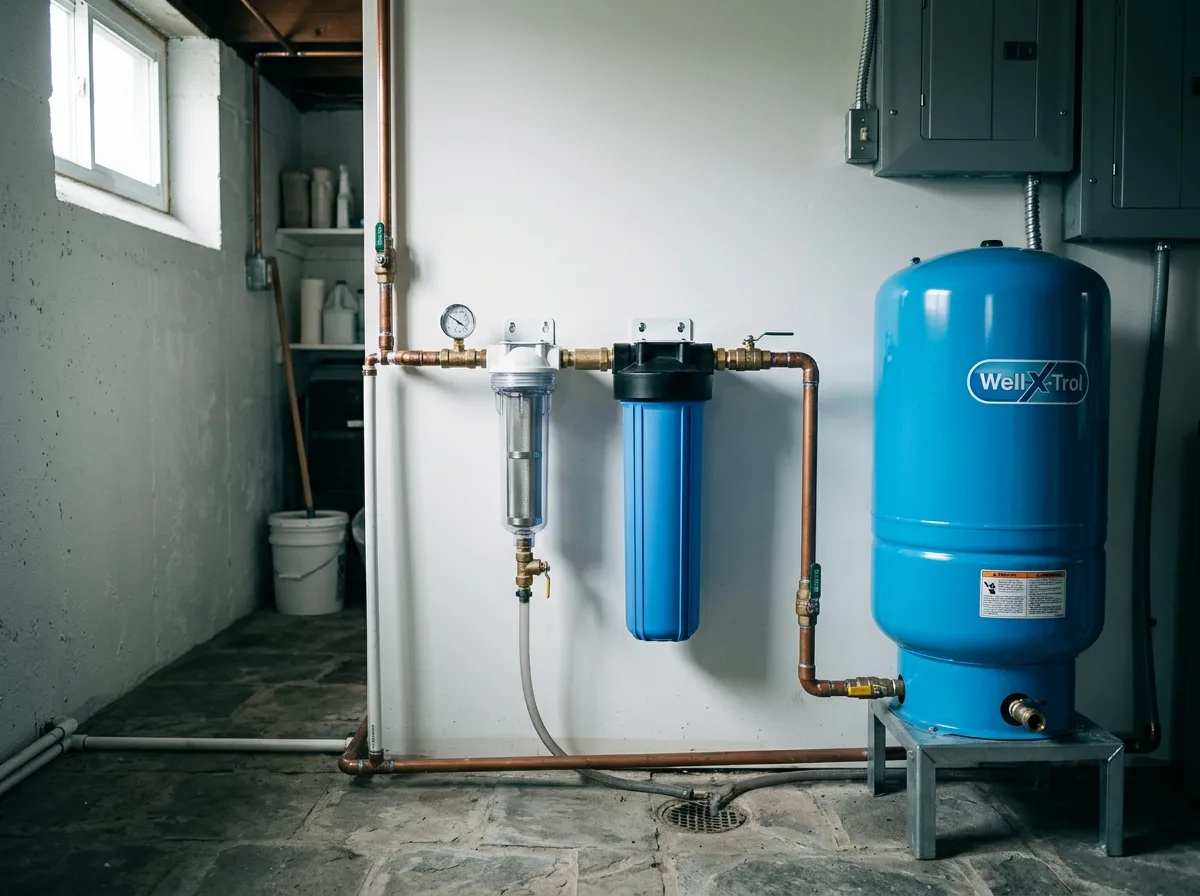
- 50-micron spin-down filter (first stage, for visible sand/grit): a flushable screen filter installed before the pressure tank. It catches coarse sand, has no cartridge to replace, and you flush it with a valve. Ideal when you can see and feel sand.
- 5-micron cartridge (the workhorse): for most well homes, a 5-micron sediment cartridge is the standard recommendation. It catches fine silt without choking your water pressure or forcing constant changes.
- 1-micron filter (fine polish / cyst protection): a 1-micron absolute-rated filter is fine enough that NSF/ANSI Standard 53 recognizes it for removing Cryptosporidium and Giardia cysts. It clogs faster than a 5-micron, so it's used as a final stage, not a first line.
For a heavy sediment load, technicians stage the filters so each handles only what it should: 50-micron spin-down → 5-micron cartridge → optional 1-micron polish. The coarse filter protects the fine one, so you're not replacing a fine cartridge every week.
One free first step for occasional sediment: let it settle. Sediment-laden water clears in a pitcher in minutes. But settling only buys clear water for the moment — if sediment keeps coming, you need filtration, and you need to ask why it's coming (see the screen and water-table causes above).
Important: a sediment filter handles particles only. It does not remove dissolved iron, manganese, bacteria, or methane. For those, see our overview of well water treatment options, which covers oxidizing filters for iron and manganese, disinfection for bacteria, and more.
For iron, manganese, or “won't clear” cloudiness
Test first to learn which mineral and how much, then match the treatment. Dissolved iron and manganese are typically handled by an oxidizing/catalytic filter (sometimes air-injection or a greensand-type media) that converts the dissolved mineral to a filterable solid, or by a water softener at lower concentrations. The right choice depends on your numbers, your pH, and whether bacteria are also present — which is exactly why you test before you buy equipment.
For surface-water intrusion or bacteria
This is not a filter-and-forget situation. If a test comes back positive for total coliform or E. coli, the standard response is to disinfect the well (a chlorine shock) and find and fix the entry point so it doesn't come back. Our walkthrough on how to shock-chlorinate a well covers the disinfection step; a driller then inspects the casing, cap, and grout and corrects whatever is letting surface water in. Continuous disinfection (like UV) may be recommended for a well with a persistent vulnerability. Until it's resolved, use a safe alternative water source for drinking and cooking.
When to call a licensed driller
A lot of cloudy water clears up on its own or with a cartridge filter. But some signs mean it's time for a professional — and these are the ones not to sit on:
- Sudden, gritty sand (not just fine silt) — possible well-screen failure or pump pulling sand.
- Cloudiness after rain, snowmelt, or flooding — possible surface-water intrusion; test for bacteria and inspect the wellhead.
- Sediment plus falling pressure during dry spells — the well may be over-pumped or the water table dropping.
- A positive bacteria test — needs disinfection and a fix for the cause.
- Milky water with sputtering, gas, or a region known for methane — test for dissolved methane.
- Cloudiness that won't clear and that home filters can't keep up with.
The hard part is usually not the cloudiness itself — it's knowing whether you're dealing with a $30 filter or a well that needs a professional's hands. If your glass test and the symptoms above point toward a well problem, it's worth having a licensed local well driller take a look before a small issue becomes an expensive one. You can see typical well-service costs here, or request free quotes from licensed drillers in your area and let a pro confirm what's going on. No pressure — even a single inspection often pays for itself by catching a screen or casing problem early.
Frequently Asked Questions
Is cloudy well water safe to drink?
It depends entirely on the cause. If the cloudiness is air (it clears from the bottom of the glass up within a minute or two), it's harmless and safe to drink. If it's sediment, plain silt isn't a health hazard but it's hard on plumbing and worth filtering. If the water won't clear, has color or odor, or appeared after heavy rain, don't assume it's safe — test for bacteria, iron, and manganese, and use an alternative water source for drinking until you have results.
Why is my well water suddenly milky white?
Sudden milky-white water is most often dissolved air, especially if you recently had pump or well work done — air gets introduced into the system and takes a few days to clear. Confirm with the glass test: air clears from the bottom up. If it's instead pulsing with surging pressure, the cause may be a pressure-tank issue; if it comes with sputtering taps, the pump may be drawing air from a dropping water level.
How do I tell if it's air or sediment?
Fill a clear glass and watch which way it clears. Air rises, so the water clears from the bottom upward and is gone in 1–2 minutes, leaving nothing behind. Sediment sinks, so the water clears from the top down and leaves grit or a film at the bottom. Water that stays cloudy and never settles is a sign to test for iron, manganese, or bacteria.
What micron sediment filter do I need for well water?
For most homes, a 5-micron cartridge is the standard all-purpose choice for fine silt. If you have visible sand or grit, add a 50-micron flushable spin-down filter ahead of it. For the finest polish — and for cyst protection — a 1-micron absolute-rated filter can go last. A staged setup (50 → 5 → optional 1 micron) keeps the fine filters from clogging too fast. Note that sediment filters remove particles only, not dissolved iron, manganese, bacteria, or methane.
My water got cloudy after heavy rain — should I worry?
Yes, take this one seriously. Cloudiness that shows up after heavy rain, snowmelt, or flooding can mean surface water is reaching your well without being filtered through the ground — which can carry bacteria. The CDC recommends testing your well for total coliform and E. coli after flooding. Until you have a clean result, use bottled or boiled water for drinking and cooking, and have a driller check the wellhead, cap, casing, and grouting for the entry point.
What are the EPA limits for iron and manganese in well water?
EPA's secondary (cosmetic) standards are 0.3 mg/L for iron and 0.05 mg/L for manganese — above these, you'll notice color, staining, and metallic taste. These aren't enforceable for private wells, but they're good targets. Manganese also has a health dimension: EPA's lifetime health advisory is 0.3 mg/L, with a stricter recommendation that infants under 6 months not drink water (or formula made with water) above 0.3 mg/L for more than about 10 days a year.
Can a water filter fix cloudy well water?
Sometimes — it depends on the cause. A sediment filter clears silt, sand, and clay. But a filter won't fix air (nothing to fix), and it won't make bacteria-contaminated or surface-infiltrated water safe — that needs disinfection and a repair to the well itself. Dissolved iron and manganese need a specific oxidizing or softening treatment, not a basic sediment cartridge. Identify the cause first, then match the fix.

Author: Well Driller Finder Editorial Team
The Well Driller Finder editorial team researches and writes our guides on water-well drilling, pumps, and well water for homeowners across the US and Canada. We translate current cost data, NGWA and state well-construction standards, and EPA and CDC guidance into clear, practical answers. What we stand for: honest, independent help. Every price and claim is researched and fact-checked against multiple 2026 sources — never guessed, never borrowed from a single advertiser. We answer to homeowners, not to the companies we write about, because our only goal is to help you make a confident, well-informed decision about your water.
Find verified, local contractors who handle new installations, pump service, and water quality testing — in your area.