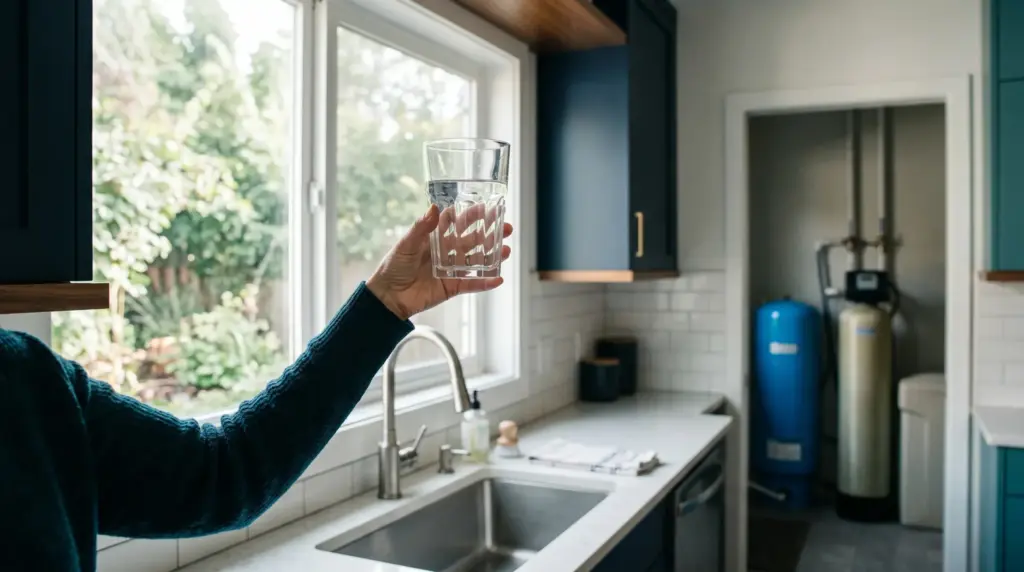
You fill a glass from the tap, take a sip, and there it is — a faint salty or brackish edge that wasn't there last year. Maybe it's only the hot water. Maybe it comes and goes. Either way, it's the kind of thing that makes you stop trusting your own well, and that's a fair instinct. Taste is one of the few warning systems a private well gives you for free.
The good news: a salty taste is almost always traceable to one of a handful of specific causes, and most of them can be measured with an inexpensive water test. The taste itself is rarely a serious health emergency — but it's a signal worth chasing down, both because some of the causes get worse over time and because high sodium genuinely matters for people on restricted diets. This guide walks through what makes well water taste salty, how to figure out which cause is yours, and what it actually takes to fix it.
What "salty" actually means in water chemistry
When water tastes salty, you're almost always tasting two things: chloride and sodium. They usually travel together (table salt is sodium chloride), but they can also show up separately, and a couple of other minerals can mimic the effect.
The U.S. Environmental Protection Agency sets a secondary maximum contaminant level (SMCL) of 250 mg/L for chloride, and it lists "salty taste" as the noticeable effect at that level. Sulfate has the same 250 mg/L secondary standard and can also push water toward a salty, bitter taste. Total dissolved solids — the catch-all measure of everything dissolved in your water — has a secondary standard of 500 mg/L, above which water starts to taste off and leave deposits (EPA Secondary Drinking Water Standards).
One important detail: these are secondary standards. The EPA calls them non-enforceable, aesthetic guidelines — they're about taste, color, and staining, not health. Chloride at 250 mg/L isn't going to hurt a healthy adult. But the taste is telling you something is getting into your water that wasn't designed to be there, and the underlying cause sometimes carries other problems with it (corroded pipes, rising contamination, a softener gone wrong). So the taste is the smoke; the job is to find the fire.
Sodium is the other half of the story, and it's the one with a genuine health angle. The EPA doesn't regulate sodium as a health standard, but it does publish guidance: for people on a very-low-sodium diet of about 500 mg per day, the EPA recommends drinking water not exceed 20 mg/L of sodium, and notes that levels above 120 mg/L can be a problem for anyone on a sodium-restricted diet (EPA Drinking Water Advisory: Sodium). For taste specifically, the EPA recommends keeping sodium between 30 and 60 mg/L — above that range, taste-sensitive people start to notice it.
Cause #1: Saltwater intrusion (the coastal one)
If your well is anywhere near a coast, a tidal river, or a salty estuary, this is the first suspect. Saltwater intrusion is exactly what it sounds like: ocean water working its way into the freshwater aquifer your well draws from.
Here's how it works, in plain terms. Underground, fresh groundwater normally sits on top of and pushes back against denser saltwater, with a mixing zone between them. As long as enough fresh water keeps flowing toward the sea, that boundary stays put. But when too much fresh water gets pumped out — by your well, your neighbors' wells, and the area's overall demand — the pressure holding the saltwater back drops, and the salty water gets drawn inland and upward toward the wells (USGS: Saltwater Intrusion). Sea-level rise and drought both make it worse.
The frustrating part is that intrusion can be seasonal or creeping. You might taste salt only in late summer when everyone's irrigating and the water table is low, then have it clear up after fall rains recharge the aquifer. Over years, though, the trend in a stressed coastal aquifer is usually the wrong direction. Seawater is intensely salty — roughly 35,000 mg/L of dissolved salts, about a hundred and forty times the chloride taste threshold — so it doesn't take much mixing to make your fresh water taste noticeably off (USGS: Saline Water and Salinity).
Tell-tale signs of intrusion: you're within a few miles of saltwater; the taste is worse during dry spells or heavy pumping; chloride and sodium are both elevated and rising over repeated tests; and neighbors with wells are noticing the same thing.
Cause #2: Road salt runoff (the shallow-well one)
You don't have to live near the ocean to get salt in your water. In snowbelt regions, the salt spread on winter roads is one of the most common sources of chloride in private wells. Road salt is mostly sodium chloride; it doesn't bind well to soil, so when the snow melts it percolates straight down into shallow groundwater.
Research on private wells found the highest chloride levels in wells downhill of road-salt storage facilities, followed by wells within about 30 meters (roughly 100 feet) of a major road — and wells sitting lower in elevation than the nearest road are especially vulnerable (Environmental Science & Technology, 2018). The contamination is stubborn: once chloride is in the groundwater, it can take years to flush out, because nothing in the soil really holds onto it or breaks it down.
Road salt is the prime suspect if: your well is shallow, near a salted road, parking lot, or a municipal salt-storage yard; the salty taste shows up or intensifies in late winter and spring after the melt; and you live somewhere that salts heavily. There's a corrosion angle here too — the same research found higher chloride accelerates corrosion of plumbing, which can leach metals like lead and copper into the water, so road-salt contamination is worth taking seriously beyond just taste.
Cause #3: Your water softener (the one people overlook)
This is the cause that surprises homeowners, because the very device meant to improve your water can be the thing making it taste salty. A water softener works by passing your hard water over resin beads that swap calcium and magnesium for sodium. To recharge those beads, the softener periodically rinses them with a strong salt brine and then flushes that brine to the drain. When it's working correctly, only a small, tasteless amount of sodium ends up in your water.
When it's not working correctly, brine can leak into your drinking water. The EPA notes that domestic water softeners can raise sodium in drinking water to more than 300 mg/L (EPA Drinking Water Advisory: Sodium) — well past the salty-taste threshold. Common culprits: a stuck or clogged injector or brine valve, a control head set to regenerate too often or with too much salt, a drain line problem, or simply using water in the house while the unit is mid-regeneration so brine bypasses into the supply.
The classic softener fingerprint: the saltiness is worse in hot water, or it appears right after the softener regenerates (often overnight), and it's the same year-round regardless of weather. If that's your pattern, the softener jumps to the top of the list — and the fix is often just a service call or a settings adjustment, not a treatment system.
Cause #4: Natural geology
Sometimes nothing has gone wrong at all — your water is just passing through salty rock. Deep wells, and wells in areas with marine sedimentary deposits, ancient seabeds, or naturally briny aquifers, can pick up high chloride, sodium, or sulfate straight from the geology. Connate water (saltwater trapped in the rock since it formed) and dissolving mineral deposits both contribute. Sulfate-rich layers, common in parts of the arid West and Midwest, add their own salty, bitter note and often a laxative effect at high concentrations.
Natural sources are the likely explanation when: the saltiness has been there as long as you've had the well rather than appearing suddenly; you're far from the coast, salted roads, and have no softener; and your well is deep or your area is known for mineralized groundwater. It won't get better on its own, but it's also stable and predictable, which makes it straightforward to treat. A local driller who knows the regional geology can usually tell you in one conversation whether your formation tends to run salty — see how deep a well should be for how depth interacts with water quality.
How to test — pinpointing the real cause
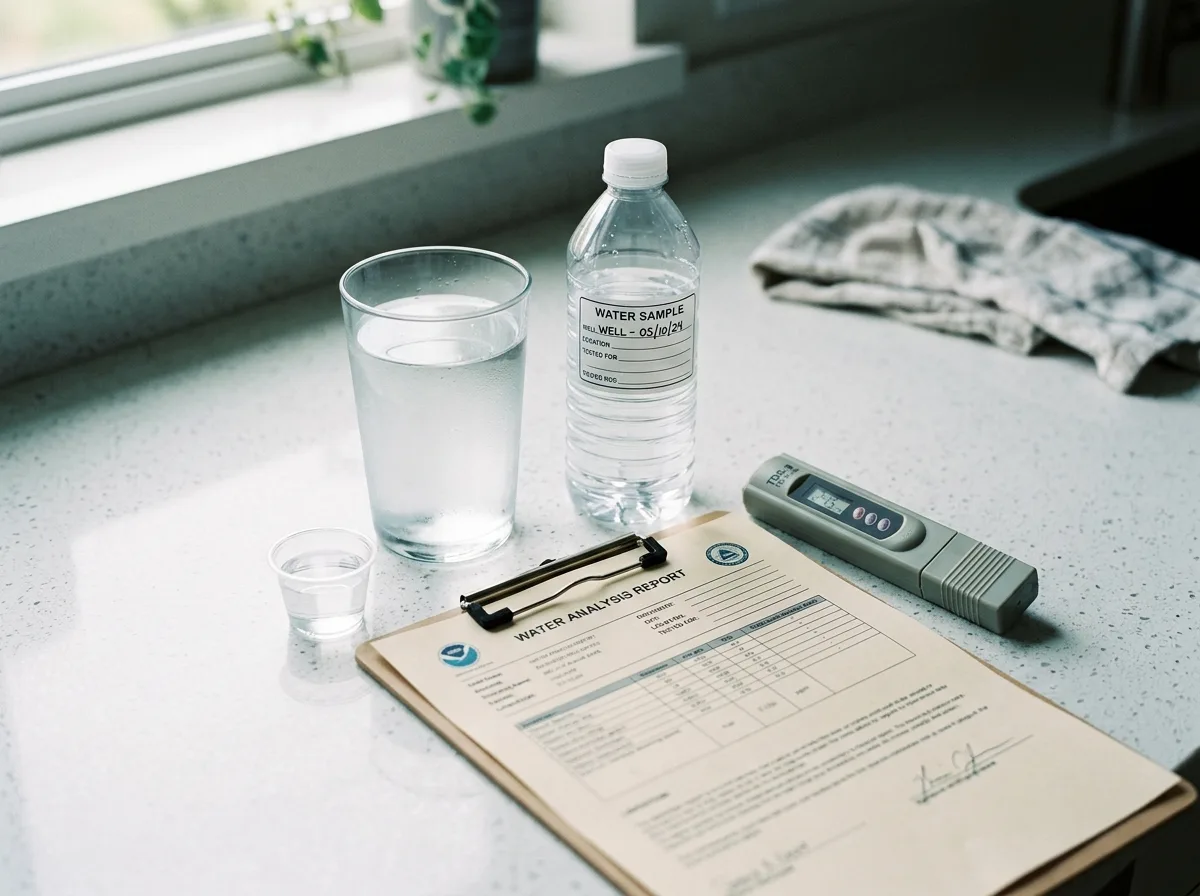
Taste alone can't tell you which of these four causes you have, and the fix depends entirely on the cause. So before you buy any treatment equipment, get the water tested. This is the step that saves you money. The parameters to ask for:
- Chloride — the master indicator for a salty taste; compare to the 250 mg/L secondary standard.
- Sodium — the health-relevant number, especially if anyone in the house is on a low-sodium diet; compare to the 20 mg/L and 120 mg/L EPA guidance levels.
- Total dissolved solids (TDS) — the overall mineral load; the 500 mg/L secondary standard is the marker.
- Sulfate — the other "salty/bitter" mineral, with its own 250 mg/L standard.
- Conductivity (or a handheld TDS/EC meter reading) — a fast, cheap proxy for total salts that's handy for tracking changes over time.
Use a state-certified laboratory for the numbers that matter, not just an inexpensive meter — a TDS meter tells you something is dissolved but not what, and the "what" is the whole point here. Our guide to how to test your well water walks through finding a certified lab and reading the report. If you suspect saltwater intrusion or road salt, it's worth testing more than once across the seasons, since both causes fluctuate; a single snapshot can mislead you.
The pattern in the results often diagnoses the cause on its own. Very high sodium with a softener in the house points at the softener. High chloride in a shallow well near a salted road points at road salt. Both chloride and sodium climbing over repeated coastal tests points at intrusion. Stable, long-standing elevated minerals far from any obvious source points at geology.
| What you notice / measure | Most likely cause | First move |
|---|---|---|
| Salty hot water, or right after softener cycles | Water softener malfunction or settings | Service / re-set the softener first |
| Worse in late winter/spring; shallow well near a salted road | Road salt runoff | Lab test for chloride; consider RO |
| Coastal well; worse in droughts; chloride & sodium rising over time | Saltwater intrusion | Test seasonally; talk to a driller about depth/relocation |
| Salty since day one; deep well; no coast, road, or softener | Natural geology | RO for drinking water |
| Bitter-salty taste, possible laxative effect | High sulfate | Test sulfate; RO or specialized media |
The fixes that actually work
Once the test points at a cause, the fix usually falls into one of these buckets. Match the solution to the diagnosis — don't bolt on a treatment system if a softener service call would have done it.
Fix the softener (if that's the cause)
If your testing and the hot-water/post-regeneration pattern point at the softener, start here — it's the cheapest fix and you may not need any new equipment. Have it serviced to clear a stuck brine or injector valve, check the drain line, and have the regeneration frequency and salt dose set correctly for your actual hardness and household size. If you or someone in the house is on a sodium-restricted diet, ask about switching the softener's fill to potassium chloride instead of sodium chloride — it softens the same way without adding sodium. Our overview of well water treatment options covers how softeners fit alongside other equipment.
Reverse osmosis — the workhorse for salty water
For salt that's genuinely in the water — intrusion, road salt, natural geology — reverse osmosis (RO) is the main fix, and it's what state extension programs and the EPA point to. An RO system forces water through a membrane fine enough to strip out dissolved salts; it's effective at removing sodium, chloride, and sulfate along with a long list of other dissolved contaminants (Virginia Cooperative Extension).
Most homeowners install RO as a point-of-use unit under the kitchen sink, treating only the water you drink and cook with. That's usually the smart, economical choice — you don't need desalinated water to flush a toilet or wash the car, and treating the whole house is far more expensive and wastes more water. RO does send some water down the drain as concentrate and can remove beneficial minerals, but for a salty-taste problem it's the proven answer. (We're publishing a dedicated guide to reverse osmosis systems; in the meantime the treatment options guide covers where RO fits.) Distillation is an alternative that also removes salts effectively, though it's slower and uses energy to boil the water.
Well deepening, sealing, or relocation (for intrusion)
When the cause is saltwater intrusion, treatment removes the salt from the water you drink, but it doesn't address the well itself drawing increasingly salty water. For a long-term answer, this is a conversation for a licensed driller. Depending on your site and the local geology, options can include drilling deeper or in a different spot to reach a cleaner part of the aquifer, sealing off the salty zone, or in some cases relocating the well away from the advancing saltwater. These are real construction projects, not weekend fixes, and the right choice depends heavily on local conditions — which is exactly why you want a driller who knows your area's aquifers. See how to choose a well driller before you commit to any of it.
When salty water is a bigger warning sign
Most of the time, a salty taste is a nuisance and a tractable one. But a few situations deserve faster attention. If sodium comes back high and anyone in your household has high blood pressure, kidney disease, or is on a doctor-ordered low-sodium diet, treat the drinking water and mention the lab numbers to their physician — the water can be a meaningful slice of daily sodium intake. If chloride is high, remember the corrosion angle: elevated chloride eats at plumbing and can leach lead and copper, so it's worth confirming those metals aren't also elevated. And a sudden new saltiness in a coastal well that's getting steadily worse is the early signal of intrusion you want to catch before it forces an expensive well replacement.
One reassurance: salt is not the contaminant to lose sleep over from a poisoning standpoint, and it's unrelated to the truly dangerous, tasteless threats. You can't taste bacteria, nitrate, arsenic, or "forever chemicals" — PFAS, for instance, are colorless, odorless, and tasteless and only show up in a lab test (EPA: PFAS). So if a salty taste prompts you to finally run a full well-water test, that's a win even beyond the salt. While you're at it, it's worth checking the other common private-well issues — see our guides on nitrates, arsenic, and coliform and E. coli.
Putting it together
Salty well water has a short list of causes — coastal saltwater intrusion, winter road salt, a misbehaving softener, or naturally salty geology — and a clear path to sorting them out. Test for chloride, sodium, TDS, and sulfate; let the pattern point at the cause; then match the fix, whether that's a softener service, a reverse-osmosis system for your drinking water, or a structural change to the well itself.
The two jobs that benefit most from a professional are the diagnosis and the well-level fixes. A licensed local driller knows whether your area's aquifers run salty, whether intrusion is a known problem nearby, and what it would take to deepen, seal, or relocate a well if it comes to that — and they can usually rule those big-ticket options in or out quickly. If your test comes back salty and you're not sure where to go next, it's worth getting a couple of free quotes from licensed drillers in your area so you can compare what they'd recommend before you spend a dollar on equipment.
Frequently Asked Questions
Is it safe to drink slightly salty well water?
For a healthy adult, water that's mildly salty from chloride is an aesthetic problem, not an acute health hazard — the EPA's 250 mg/L chloride standard is a taste guideline, not a health limit. The exceptions are people on sodium-restricted diets, where the sodium content matters, and any case where high chloride is also corroding plumbing and leaching metals. The safe move is to test it, find out the actual sodium and chloride numbers, and decide from there rather than guessing from taste alone.
Why does only my hot water taste salty?
That pattern points strongly at a water softener problem. Softeners use a salt brine to recharge, and if brine is leaking into the supply — a stuck valve, a too-frequent regeneration, or water being drawn while the unit regenerates — you'll often notice it most in the hot water, which sits in the tank. Have the softener serviced and its settings checked before assuming the salt is coming from the ground.
Will a water softener fix salty-tasting water?
No — and a softener can actually be the cause. Softeners remove hardness (calcium and magnesium) by swapping in sodium; they don't remove chloride or reduce overall saltiness, and a malfunctioning one adds sodium. To remove salt from your drinking water you want reverse osmosis or distillation, not a softener. If you already have a softener and the water tastes salty, get the softener checked first, then add RO for drinking water if the salt is coming from the well itself.
Does reverse osmosis remove salt from well water?
Yes. Reverse osmosis is the most common and effective home treatment for a salty taste — it pushes water through a fine membrane that removes the great majority of dissolved sodium, chloride, and sulfate, which is why state extension programs and the EPA point to it for sodium and salt. Most homeowners install it as an under-sink point-of-use unit treating only drinking and cooking water, which is cheaper and more efficient than treating the whole house.
Can road salt really get into my well?
Yes, and it's a leading cause of chloride in private wells in regions that salt their roads. Road salt is sodium chloride, it doesn't cling to soil, and it washes down into shallow groundwater during the melt. Wells that are shallow, close to a major road or a salt-storage yard, and lower in elevation than the road are the most exposed — and once chloride is in the aquifer it can linger for years.
How do I know if it's saltwater intrusion?
The clues are location and trend: a well within a few miles of the coast or a tidal waterway, a salty taste that worsens during droughts or heavy pumping season, chloride and sodium that climb across repeated tests, and neighbors reporting the same thing. Because intrusion fluctuates seasonally, the way to confirm it is to test the same parameters several times over the year and watch the direction. If it's trending up, talk to a local driller about your options before the well gets worse.

Author: Well Driller Finder Editorial Team
The Well Driller Finder editorial team researches and writes our guides on water-well drilling, pumps, and well water for homeowners across the US and Canada. We translate current cost data, NGWA and state well-construction standards, and EPA and CDC guidance into clear, practical answers. What we stand for: honest, independent help. Every price and claim is researched and fact-checked against multiple 2026 sources — never guessed, never borrowed from a single advertiser. We answer to homeowners, not to the companies we write about, because our only goal is to help you make a confident, well-informed decision about your water.
Find verified, local contractors who handle new installations, pump service, and water quality testing — in your area.