
You turn on the tap and nothing comes out. Maybe it sputtered, coughed a little air, and quit — or maybe it was just dead from the first second. When your home runs on a private well, there's no water company to call and no neighbor's main to blame. It's just you, a pump somewhere down a pipe, and a sinking feeling.
Take a breath. A surprising number of "my well is dead" emergencies turn out to be something small and fixable — a flipped breaker, a tripped switch, a pressure tank that's lost its charge. This page walks you through the checks in the order a seasoned well technician would do them, starting with the safest and simplest. We'll also be honest with you about where the do-it-yourself part ends. Some of this involves line voltage and the well itself, and at those points the right move is to stop and pick up the phone. We'll flag every one of those moments clearly.
Work through this top to bottom. Don't skip ahead — the early steps take two minutes and rule out the most common (and cheapest) culprits before you start worrying about the pump.
First, a 30-Second Triage: One Tap or the Whole House?
Before anything else, answer one question, because it splits the whole problem in half.
Walk to two or three different fixtures in different parts of the house — a bathroom sink, the kitchen, an outside spigot. Turn each one on.
- If only one fixture is dry and the rest of the house has normal water, your well, pump, and pressure tank are fine. The trouble is local to that one fixture — a clogged aerator, a stuck shut-off valve under the sink, a frozen branch line in an exterior wall, or a failed faucet cartridge. That's a plumbing fix, not a well problem, and it's not an emergency. You can stop reading the well-focused steps below and look at that fixture specifically.
- If the whole house is dry — every tap, nothing anywhere — then the problem is upstream at your well system. Keep going. The rest of this checklist is for you.
One more thing before we touch anything: if you've already lost water, stop flushing toilets and stop running taps "to check." Each flush drains the pressure tank further, and if there's any chance of contamination (more on that below), you don't want to keep pulling water through the system.
Step 1 — Check the Power: The Breaker and the Pump Switch
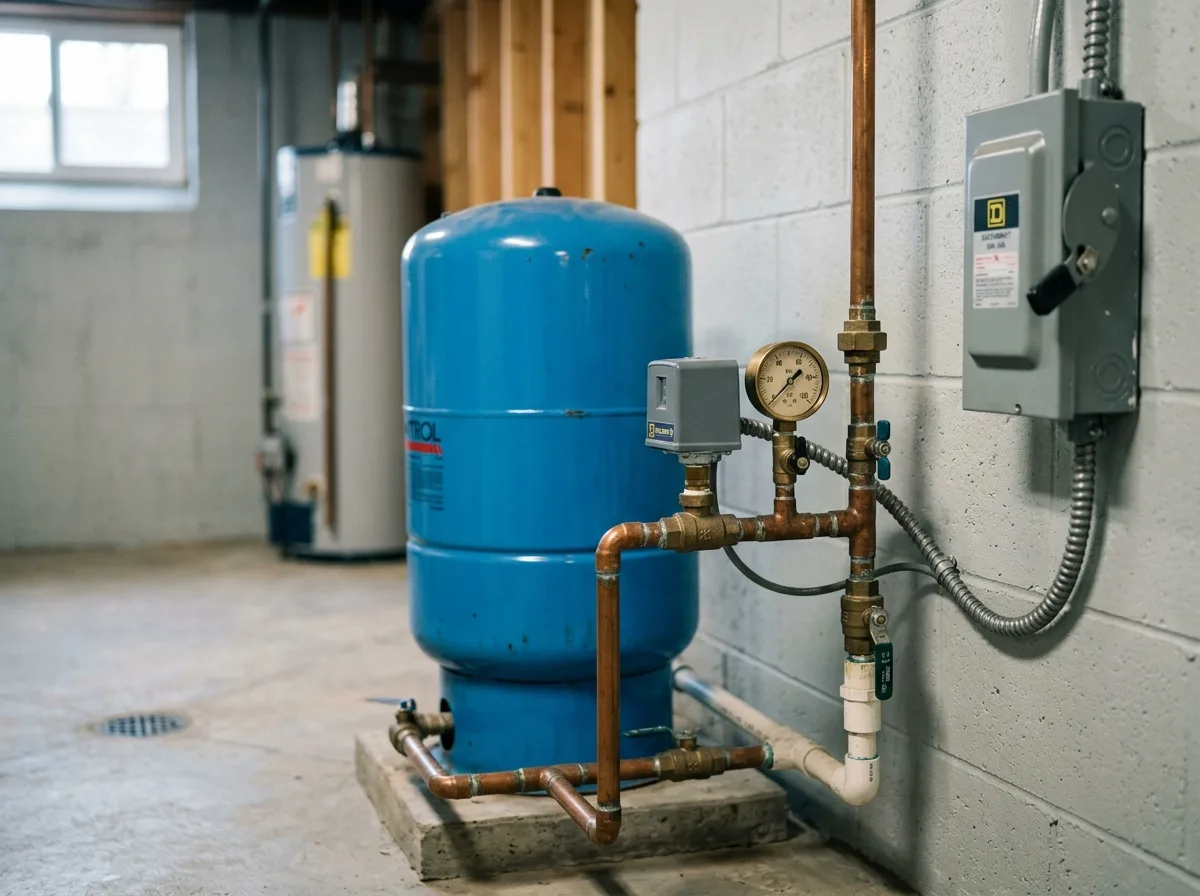
The single most common reason a whole house suddenly loses water is that the well pump lost power. Your pump is just an electric motor, and like any motor on a circuit, it can be cut off by a tripped breaker.
Go to your main electrical panel. Look for the breaker labeled "Well," "Well Pump," "Pump," or "Submersible Pump." (If nothing is labeled, look for a double-width 240-volt breaker — most deep-well pumps run on 240 volts.) A tripped breaker usually sits in the middle position, not fully ON and not fully OFF.
While you're there, check for a second switch. Many systems have a separate pump disconnect switch or a fused box near the pressure tank or on the wall of a well house or basement. It can get bumped off by accident — by a broom, a stored box, or a curious kid.
To reset a tripped breaker: push it firmly all the way to OFF first, then back to ON. If water returns and the breaker stays on, wonderful — you're done, and it was likely a one-time fluke (a brief power surge, a storm flicker, a moment of overload).
⛔ STOP if the breaker trips again. Reset a breaker once. If it trips a second time — especially if it trips the instant you flip it on, or within a few seconds of the pump trying to start — do not keep resetting it. A breaker that trips repeatedly is doing its job: it's telling you there's a real electrical fault behind it. A trip within a second or two of startup usually points to a short circuit, a ground fault, or failing motor windings, and repeatedly forcing a faulted circuit back on can cause overheating, a fire risk, and further damage to your pump motor. Submersible pumps are especially prone to ground faults because the motor runs underwater. Leave it off and call a licensed well-pump pro or electrician.
Step 2 — Read the Pressure Gauge on the Tank
If power is on and the breaker is holding, your next clue is the pressure tank — the bulky steel tank (often blue) sitting near where your water line enters the house. Most tanks have a small round pressure gauge on the plumbing nearby.
Here's the quick mental model. Your pump doesn't run constantly. It fills the pressure tank to a high pressure, shuts off, and then the tank feeds your house until pressure drops, at which point the pump kicks on again. The two trigger points are set by a pressure switch, and the most common factory settings are 30/50 or 40/60 — meaning the pump turns ON (cut-in) at 30 or 40 psi and turns OFF (cut-out) at 50 or 60 psi.
So glance at that gauge:
- Gauge reads zero (or near it): The system has no pressure at all. That fits with the pump not running — which sends you back to power (Step 1), or forward to the pressure switch (Step 3), or to a pump that has actually failed (Step 6).
- Gauge sits at a normal-looking number (say 40–60 psi) but you still have no water: That's a clue the gauge itself may be stuck, or there's a closed valve or a blockage between the tank and the house. A stuck gauge can lie. Note it for the pro.
- Gauge needle bounces wildly every time a little water moves, and the pump clicks on and off rapidly — that points to a waterlogged pressure tank, covered just below.
The waterlogged-tank check (safe and quick)
A pressure tank holds a cushion of compressed air that pushes water out to your house. Over years, the air bladder inside can fail, the tank fills entirely with water, and the air cushion is gone. The classic symptom is the pump cycling on and off every few seconds whenever you draw water.
You can sanity-check it: with the pump powered off and a faucet opened to bleed off pressure, press the little air valve (it looks just like a tire valve, a Schrader valve) on top of the tank. Air should hiss out. If water sprays out instead, the bladder has failed and the tank needs replacing. A correctly charged tank's air pre-charge should sit about 2 psi below the pump's cut-in pressure — so 28 psi for a 30/50 switch, or 38 psi for a 40/60 switch. We go deeper into tank symptoms and fixes in well pressure tank problems.
Step 3 — The Pressure Switch (Look, Don't Touch the Wires)
The pressure switch is a small gray box, usually mounted right on the pipe near the pressure tank, with a thin tube connecting it to the water line and electrical wires running into it. It's the brain that tells the pump when to start. When it fails, the pump never gets the "go" signal — and you get no water, even though everything else looks fine.
There are two failure modes worth knowing:
- Burned or pitted contacts. Inside the switch are two metal contact points that snap together to send power to the pump. Over thousands of cycles, or after a power surge, they can burn, corrode, or weld shut. Sometimes you'll see a scorch mark or smell a faint burnt-electrical odor near the switch.
- A clogged sensing port. The little tube that lets the switch "feel" water pressure can clog with sediment or mineral scale, so the switch never senses that pressure has dropped and never starts the pump.
⛔ STOP — this is line voltage. The pressure switch carries the same 120 or 240 volts that runs your pump. Opening that cover with the power on, or poking at the contacts, exposes you to a shock that can injure or kill. There's an old field trick of lifting the switch lever by hand to "jump-start" a stuck switch, and you'll find it all over the internet — we're not going to tell you to do it, because doing it safely means knowing the power is truly dead and respecting live terminals. A new pressure switch is an inexpensive part — typically around $20 to $50 for the switch itself — but the diagnosis and the wiring belong to someone qualified. If you suspect the switch, that's your cue to call a licensed well-pump pro.
Step 4 — It's Winter: Check for a Frozen Pipe
If this happened during a cold snap, frozen plumbing jumps to the top of the suspect list — and it's often very localized, which is why the "one tap or whole house?" triage in the beginning matters so much.
Pipes are most at risk where they run through unheated space: a crawl space, an unheated basement or garage, a well house or pump house, or inside an exterior wall. Research from the University of Illinois Building Research Council found that pipes in an unheated, insulated space generally start forming ice once the outside air drops below about 20°F — though poorly insulated runs, or pipes exposed to wind through a wall gap, can freeze at higher temperatures.
Telltale signs of a freeze: water stops during a hard freeze (not a gradual decline), one section of the house is affected, and you may see frost or a bulge on an exposed pipe. If you can safely reach the frozen section, you can warm it gently — with a hair dryer, a heating pad, towels soaked in hot water, or a space heater kept well away from anything flammable. Open the affected faucet first so melting water has somewhere to go, and work from the faucet end back toward the frozen spot.
⛔ Never thaw a pipe with an open flame. No blowtorch, propane or kerosene heater, or charcoal stove — the American Red Cross is explicit that you should never use an open-flame device, because it's a fire risk and can damage the pipe. And if a pipe has already burst, shut off the water at the main and call a plumber. To prevent the next freeze, the Red Cross advises keeping your home's heat set no lower than 55°F if you travel in winter, letting a faucet trickle during deep cold, and insulating exposed pipes; on especially vulnerable runs, UL-listed heat tape is a common add-on.
Step 5 — Rule Out a Power Outage (and Why It Matters for Your Water Safety)
It sounds obvious, but confirm the rest of the house has power. An electric well pump can't move a drop without it. If the power is out across the neighborhood, your "no water" problem is simply the outage — water will return when the power does. A generator that can run the pump circuit is the only workaround during an outage.
There's a safety wrinkle here worth knowing. When a well system loses power and you open taps, the system loses pressure — and once pressure is lost, bacteria, viruses, and other disease-causing organisms can work their way into the water, sometimes with no change in how the water looks, smells, or tastes. After any event that may have damaged the well — a flood, a nearby lightning strike, debris in the well — the CDC advises drinking bottled water until you are certain your water is safe, and having the system checked before you trust it again. If your water comes back looking cloudy, smelling off, or carrying sediment, hold off on drinking it. Our guide on how to test well water walks through confirming it's safe, and after any disturbance a precautionary shock chlorination is a common next step.
Step 6 — When It's the Pump or the Well Itself
If you've confirmed power is good, the breaker holds, the gauge shows no pressure, and nothing's frozen, you're now looking at the part of the system that lives underground — the pump or the well. This is firmly professional territory, but understanding what's happening helps you describe it on the phone and not get oversold.
The pump has failed
Well pumps don't last forever. A submersible pump typically runs 8–15 years, and a failing one often gives warning signs first — sputtering air, dropping pressure, strange noises, or short-cycling — before it quits for good. If the breaker holds, power reaches the pump, but no water comes and the gauge stays at zero, a dead or failing pump is a strong candidate. Our guide to the signs of a failing well pump covers what to listen and watch for.
The well ran dry
Sometimes the pump is fine and the well simply doesn't have enough water to give. The classic signs: faucets sputter and spit air, water comes out cloudy or carries sand and sediment, the pump runs much longer than usual, and water pressure fades during heavy use and slowly recovers afterward. These mean the water level in the well has dropped near or below the pump intake, so the pump is gulping air.
This is common in drought years. As Penn State Extension explains, when groundwater levels fall, "the water level in your well may drop below the submersible pump, causing a loss of water." A prolonged drought can pull a regional water table down by tens of feet, so the advice from extension specialists and state health departments is the same: conserve water early, and don't assume the well is broken — the aquifer may simply be low and will often recover after rain. Our full guide on a well running dry covers recovery, conservation, and longer-term fixes.
| What you're seeing | Most likely cause | Your move |
|---|---|---|
| Only one fixture is dry | Local plumbing (aerator, valve, frozen branch) | DIY — fix that fixture; not a well emergency |
| Whole house dry, breaker tripped, resets and holds | One-time trip / overload | DIY — you're done |
| Breaker trips again immediately | Electrical fault, short, or failing pump motor | ⛔ Stop — call a pro / electrician |
| Gauge bounces, pump rapid-cycles | Waterlogged pressure tank | Confirm, then call for tank service |
| Pump won't start, gauge at zero, power is good | Pressure switch or dead pump | ⛔ Line voltage / underground — call a pro |
| No water during a hard freeze, one area affected | Frozen pipe | DIY — thaw gently, no open flame |
| Sputtering air, sand, pump runs long (esp. in drought) | Well ran dry / low water table | Conserve, then call a well driller |
What a Pro Visit Looks Like (and Roughly What It Costs)
If you've reached the point of calling someone, here's what to expect so the numbers don't blindside you. A pressure switch is a small part — typically around $20 to $50 for the switch itself, plus a service call. A pressure tank is a few hundred dollars installed. The big one is the pump.
According to HomeAdvisor's 2025 cost data, replacing a well pump runs a national average of about $1,900, with most homeowners paying between roughly $977 and $2,824 — and the full range stretches from a couple hundred dollars for a shallow jet pump to roughly $5,800 at the high end. Depth is the biggest single driver: cost-guide data puts a deep submersible pump in a 300–400-foot well at around $2,800 to $5,500, because deeper wells mean more pipe to pull, more labor, often a truck-mounted hoist, and a bigger pump. You can dig into the breakdown in our well pump replacement cost guide.
One protective note before you book the first company that answers: well work involves electrical wiring and, for submersibles, equipment that operates underwater. The CDC's guidance is that before power is restored to a well after any damaging event, "a qualified electrician, well contractor, or pump contractor should check the equipment wiring system." This isn't a job for a general handyman. Choosing a properly licensed, experienced contractor is worth a few minutes — our checklist on how to choose a well driller covers exactly what to ask and which credentials to confirm.
When to Stop and Call — The Short Version
To make it simple, here are the hard lines. If you hit any of these, stop the DIY and bring in a licensed professional:
- The breaker trips again after one reset — that's a real electrical fault. (Electrician or well-pump pro.)
- Anything involving the wiring — the pressure switch contacts, the pump wiring, the control box. Line voltage is not a DIY risk worth taking.
- The problem is in the well itself or the underground pump — dropped water level, dead pump, sand in the water.
- A pipe has burst, or water is where it shouldn't be near electrical equipment.
- You're simply not sure — calling is never the wrong call when your household's only water supply is down.
A licensed well contractor can diagnose in an hour what might take you a worried afternoon to guess at, and they carry the parts and the meter to do it safely. When you're ready, you can compare a few local licensed drillers and pump pros and request free quotes — having two or three estimates in hand for a job like a pump replacement is genuinely worth it, and it costs you nothing to ask. There's no harm in lining that up even while you work through the early checks; if it turns out to be a flipped breaker, you've lost nothing.
A Quick Word on Staying Ready
Most "sudden" well failures aren't really sudden — the system was dropping hints for weeks. Annual checks of your pressure tank and switch, watching for early sputtering or short-cycling, and keeping the breaker labeled and accessible all shorten the next emergency from a crisis to a five-minute fix. A little routine attention is the cheapest insurance a well owner can buy, and it's a lot more pleasant than standing at a dry tap wondering what just happened.
Frequently Asked Questions
Why did my well water suddenly stop completely?
The most common causes, in order, are: a tripped breaker or pump disconnect (power loss), a failed pressure switch or waterlogged pressure tank, a frozen pipe in winter, a failed pump, or a well that has run low on water. Start by checking whether the whole house is dry or just one tap, then check the breaker — that combination resolves a large share of cases without a service call.
Is it safe to keep resetting the breaker on my well pump?
No. Reset it once. If it trips again — especially within seconds — stop resetting it. A breaker that trips repeatedly is signaling a genuine electrical fault (a short, a ground fault, or a failing pump motor), and repeatedly forcing it back on creates a real risk of overheating and fire and can further damage the pump motor. Leave it off and call a licensed electrician or well-pump pro.
Can I fix a well pressure switch myself?
We don't recommend it. The pressure switch carries the same 120 or 240 volts that powers your pump, and working on it live exposes you to a serious shock hazard. The part itself is inexpensive — usually around $20 to $50 — but the safe diagnosis and the wiring belong to a qualified well-pump technician or electrician. You can safely identify a suspect switch (scorch marks, burnt smell, a pump that won't start with power confirmed) and report that to the pro.
My faucets are sputtering and spitting air — what does that mean?
Air in the lines usually means the pump is pulling air instead of water, which most often points to a dropping water level in the well — the well running low or dry — or, less commonly, a failing pump losing prime. If the water is also cloudy or carries sand, a low water table is the likely cause, and it's especially common during drought. Conserve water and have a well driller diagnose it before the situation worsens.
How do I tell if my problem is a frozen pipe or a dead pump?
Timing and pattern are the tells. A frozen pipe happens during a hard freeze, often affects only part of the house, and you may see frost or a bulge on an exposed pipe in an unheated area. A dead pump cuts off the whole house regardless of weather, the pressure gauge sits at zero, and power is confirmed good at the breaker. If it's around 20°F or below and only some fixtures are out, suspect freezing first.
Will my well refill on its own if it ran dry in a drought?
Often, yes. Many wells recover after rainfall or once you reduce usage, because seasonal water-table swings are normal. But if the regional water table has dropped substantially, recovery may require lowering the pump (a short-term fix) or deepening the existing well or drilling a new one (the permanent fixes). A licensed well driller or hydrogeologist can measure your water level and tell you which situation you're in.
Should I drink the water once it comes back after an outage or flood?
Not until you're sure it's safe. The CDC advises using bottled water after any event that may have damaged the well, because a loss of pressure can let contaminants enter the system. If the water returns cloudy, discolored, or with an odor, don't drink it. Test the water — and after a flood or other disturbance, a precautionary shock chlorination is the standard next step before the well is considered safe again.

Author: Well Driller Finder Editorial Team
The Well Driller Finder editorial team researches and writes our guides on water-well drilling, pumps, and well water for homeowners across the US and Canada. We translate current cost data, NGWA and state well-construction standards, and EPA and CDC guidance into clear, practical answers. What we stand for: honest, independent help. Every price and claim is researched and fact-checked against multiple 2026 sources — never guessed, never borrowed from a single advertiser. We answer to homeowners, not to the companies we write about, because our only goal is to help you make a confident, well-informed decision about your water.
Find verified, local contractors who handle new installations, pump service, and water quality testing — in your area.